\n
## Diagram: Entity Relationship Diagram
### Overview
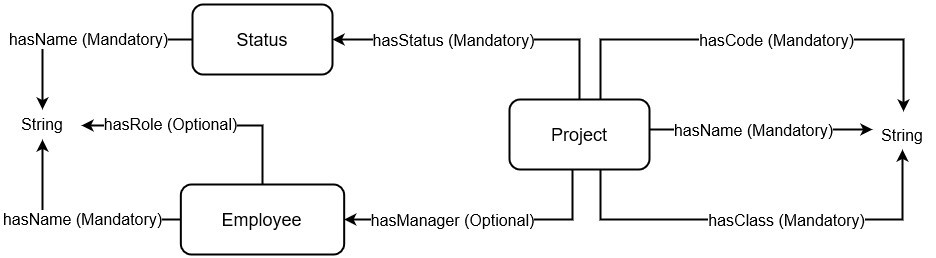
This diagram depicts an Entity Relationship Diagram (ERD) illustrating the relationships between entities: `Status`, `Project`, and `Employee`. The diagram uses boxes to represent entities and arrows to represent relationships, with labels indicating the nature of the relationship and whether it is mandatory or optional.
### Components/Axes
The diagram consists of the following entities:
* **Status:** Represents the status of a project.
* **Project:** Represents a project.
* **Employee:** Represents an employee.
* **String:** Represents a string data type.
The relationships are as follows:
* `Status` has a `hasCode` (Mandatory) relationship with `Project`.
* `Project` has a `hasStatus` (Mandatory) relationship with `Status`.
* `Project` has a `hasName` (Mandatory) relationship with `String`.
* `Employee` has a `hasName` (Mandatory) relationship with `String`.
* `Employee` has a `hasRole` (Optional) relationship with `String`.
* `Project` has a `hasManager` (Optional) relationship with `Employee`.
* `Project` has a `hasClass` (Mandatory) relationship with `String`.
### Detailed Analysis or Content Details
The diagram shows the following relationships:
1. **Status - Project:** A `Status` entity `hasCode` (Mandatory) to a `Project` entity. This indicates that every project must have a status code.
2. **Project - Status:** A `Project` entity `hasStatus` (Mandatory) to a `Status` entity. This indicates that every project must have a status.
3. **Project - String (Name):** A `Project` entity `hasName` (Mandatory) to a `String` entity. This indicates that every project must have a name.
4. **Employee - String (Name):** An `Employee` entity `hasName` (Mandatory) to a `String` entity. This indicates that every employee must have a name.
5. **Employee - String (Role):** An `Employee` entity `hasRole` (Optional) to a `String` entity. This indicates that an employee may or may not have a role.
6. **Project - Employee (Manager):** A `Project` entity `hasManager` (Optional) to an `Employee` entity. This indicates that a project may or may not have a manager.
7. **Project - String (Class):** A `Project` entity `hasClass` (Mandatory) to a `String` entity. This indicates that every project must have a class.
### Key Observations
* The relationships `hasCode`, `hasStatus`, `hasName`, and `hasClass` are all mandatory, suggesting these attributes are essential for defining the entities.
* The relationships `hasRole` and `hasManager` are optional, indicating these attributes are not required for defining the entities.
* The `String` entity is used to represent textual attributes for both `Project` and `Employee`.
### Interpretation
This ERD models a simplified system for managing projects and employees. The diagram suggests a hierarchical structure where projects have statuses, names, and classes, and employees have names and roles. The optional relationship between projects and employees (via `hasManager`) indicates that not all projects necessarily have assigned managers. The use of "Mandatory" and "Optional" labels highlights the constraints and flexibility within the data model. The diagram is a high-level representation and doesn't include details about data types or specific attributes beyond the names. It focuses on the core relationships between the entities.