## UML Class Diagram: System Entity Relationships
### Overview
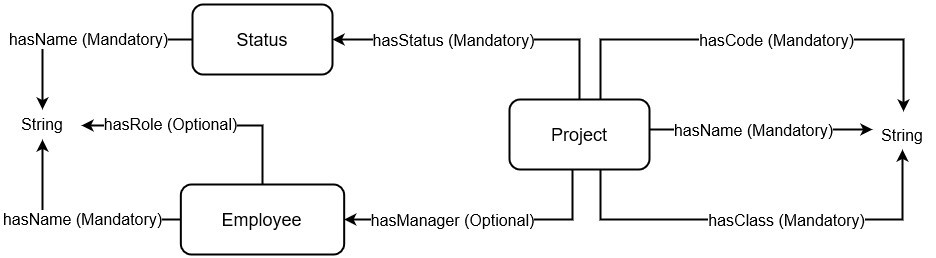
The diagram illustrates a UML class model depicting relationships between three core entities: **Employee**, **Status**, and **Project**. It defines attributes, associations, and constraints (mandatory/optional) governing interactions between these entities.
### Components/Axes
1. **Classes/Entities**:
- **Employee**: Contains attributes `hasName (Mandatory)` and `hasRole (Optional)`.
- **Status**: Contains attribute `hasStatus (Mandatory)`.
- **Project**: Contains attributes `hasName (Mandatory)` and `hasClass (Mandatory)`.
2. **Associations**:
- **Employee ↔ Status**:
- `hasStatus (Mandatory)`: Employee *must* have a Status.
- `hasRole (Optional)`: Employee *may* have a Role linked to Status.
- **Project ↔ Status**:
- `hasStatus (Mandatory)`: Project *must* have a Status.
- **Project ↔ String**:
- `hasName (Mandatory)`: Project *must* have a Name (String).
- `hasClass (Mandatory)`: Project *must* have a Class (String).
3. **Data Flow**:
- Arrows indicate directional relationships (e.g., `hasName` flows from Employee to String).
- Multiplicity is implied via labels (e.g., "Mandatory" enforces 1:1 or 1:many constraints).
### Detailed Analysis
- **Employee**:
- `hasName`: A non-nullable String attribute (mandatory).
- `hasRole`: An optional association to a Role (no explicit Role class shown; likely a String or Enum).
- **Status**:
- `hasStatus`: A mandatory attribute, likely a String or Enum (e.g., "Active", "Inactive").
- **Project**:
- `hasName`: Mandatory String identifier.
- `hasClass`: Mandatory String, possibly denoting project category or type.
- **Relationships**:
- Employee and Project both *require* a Status, suggesting Status acts as a shared state or metadata container.
- Project’s `hasClass` implies a hierarchical or categorical system (e.g., "Research", "Development").
### Key Observations
1. **Mandatory Constraints**:
- All entities have at least one mandatory attribute (e.g., Employee’s `hasName`, Project’s `hasClass`).
- Status is a required attribute for both Employee and Project.
2. **Optional Associations**:
- `hasRole` is the only optional link, indicating roles are not universally assigned.
3. **String Dependencies**:
- All entities ultimately depend on String attributes (e.g., Names, Classes), suggesting textual identifiers are foundational.
### Interpretation
This diagram models a system where:
- **Employees** are tied to Projects via shared Status, but Roles are discretionary.
- **Projects** require both a Name and Class, enforcing structured categorization.
- **Status** serves as a unifying attribute, possibly for tracking workflow stages (e.g., "Pending", "Completed").
The absence of a Role class suggests roles are lightweight (e.g., String values) rather than complex entities. The mandatory Status for both Employee and Project implies a centralized state management system, critical for workflow automation or reporting.
## Language Note
All text is in English. No non-English content detected.