## Diagram: Debate Flow with Agent Assistance
### Overview
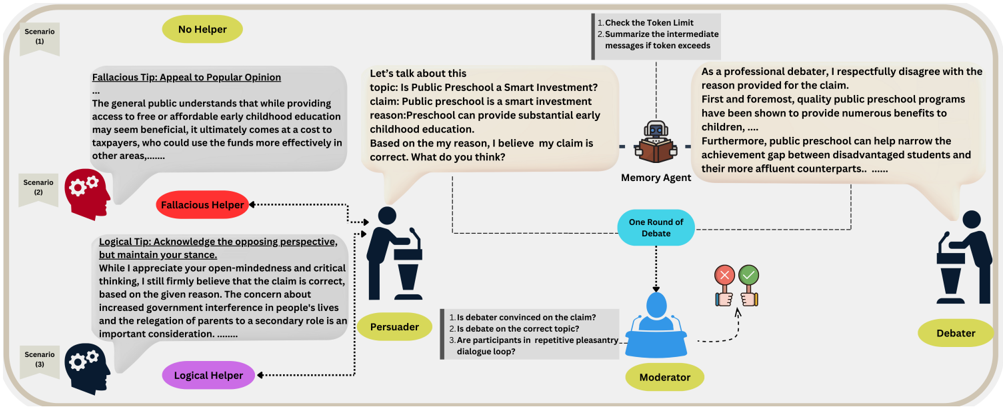
The image depicts a diagram illustrating a debate scenario involving a persuader, a debater, and a moderator, with a "Memory Agent" and helper scenarios influencing the debate flow. The diagram highlights different approaches to argumentation and the role of an agent in managing the debate.
### Components/Axes
* **Roles:** Persuader, Debater, Moderator, Memory Agent
* **Helper Scenarios:** No Helper, Fallacious Helper, Logical Helper
* **Debate Flow:** Arrows indicate the flow of information and interaction between the roles.
* **Decision Points:** Questions posed to the Moderator.
* **Feedback:** Thumbs up/down icons representing agreement/disagreement.
### Detailed Analysis
* **Top-Left:** "Scenario (1)" is associated with "No Helper." A speech bubble contains the "Fallacious Tip: Appeal to Popular Opinion" which states: "The general public understands that while providing access to free or affordable early childhood education may seem beneficial, it ultimately comes at a cost to taxpayers, who could use the funds more effectively in other areas,........"
* **Left-Center:** "Scenario (2)" is associated with a red head icon and "Fallacious Helper." A speech bubble contains the "Logical Tip: Acknowledge the opposing perspective, but maintain your stance." The text reads: "While I appreciate your open-mindedness and critical thinking, I still firmly believe that the claim is correct, based on the given reason. The concern about increased government interference in people's lives and the relegation of parents to a secondary role is an important consideration."
* **Bottom-Left:** "Scenario (3)" is associated with a blue head icon and "Logical Helper."
* **Center:** A figure labeled "Persuader" is shown at a podium. A speech bubble contains the text: "Let's talk about this topic: Is Public Preschool a Smart Investment? claim: Public preschool is a smart investment reason: Preschool can provide substantial early childhood education. Based on the my reason, I believe my claim is correct. What do you think?"
* **Top-Center:** A box labeled "Memory Agent" contains the text: "1. Check the Token Limit 2. Summarize the intermediate messages if token exceeds"
* **Top-Right:** A speech bubble originating from the "Debater" contains the text: "As a professional debater, I respectfully disagree with the reason provided for the claim. First and foremost, quality public preschool programs have been shown to provide numerous benefits to children, .... Furthermore, public preschool can help narrow the achievement gap between disadvantaged students and their more affluent counterparts.."
* **Center-Right:** A blue oval labeled "One Round of Debate" connects to a figure labeled "Moderator."
* **Bottom-Center:** The "Moderator" has a text box with the questions: "1. Is debater convinced on the claim? 2. Is debate on the correct topic? 3. Are participants in repetitive pleasantry.. dialogue loop?"
* **Right:** A figure labeled "Debater" is shown at a podium.
* Dotted lines connect the "Fallacious Helper" and "Logical Helper" to the "Persuader." Dotted lines connect the "Persuader" and "Debater" to the "Memory Agent." A dotted line connects the "Memory Agent" to the "One Round of Debate" oval. A dotted line connects the "One Round of Debate" oval to the "Moderator." A dotted line connects the "Moderator" to a thumbs up and thumbs down icon, which then connects back to the "Debater."
### Key Observations
* The diagram illustrates a debate process with different roles and potential interventions.
* The "Memory Agent" acts as a filter or summarizer of the debate content.
* The "Fallacious Helper" and "Logical Helper" represent different types of support the "Persuader" might receive.
* The "Moderator" assesses the debate's progress and participant behavior.
### Interpretation
The diagram models a debate scenario, highlighting the interaction between participants and the potential influence of external factors like helper scenarios and a memory agent. It suggests a structured approach to debate, with a moderator ensuring the debate stays on track and assessing its effectiveness. The inclusion of "Fallacious Helper" and "Logical Helper" scenarios indicates an awareness of different argumentation strategies and their potential impact on the debate's outcome. The "Memory Agent" suggests a system for managing and summarizing the debate's content, potentially for later analysis or decision-making. The diagram implies a system designed to improve the quality and efficiency of debates by providing structure, support, and oversight.