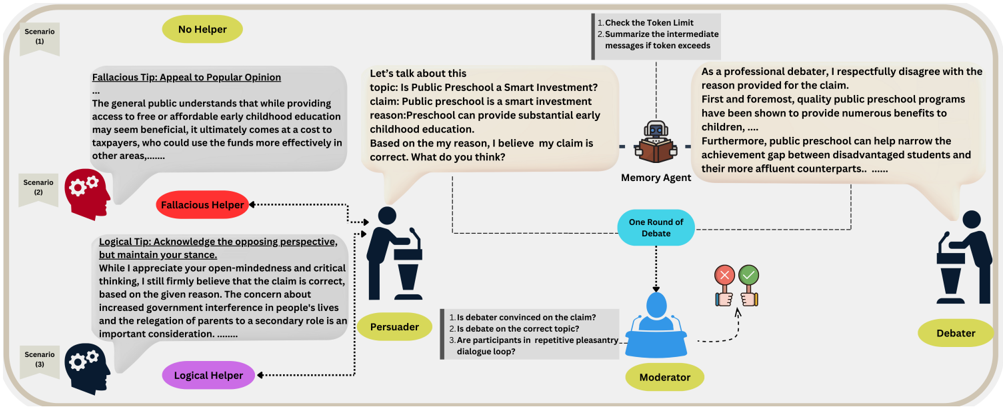
## Flowchart: Debate Moderation System with AI Assistance
### Overview
The flowchart illustrates a structured debate moderation system designed to facilitate productive dialogue between debaters while leveraging AI assistance to correct fallacies, reinforce logical arguments, and manage dialogue flow. The system emphasizes fact-based reasoning, repetition avoidance, and adherence to debate etiquette.
---
### Components/Axes
1. **Roles**:
- **Debater**: Participant in the debate (depicted as a human figure at a podium).
- **Moderator**: Oversees the debate flow (depicted as a blue figure at a podium with a microphone).
- **Memory Agent**: AI component storing/retrieving debate context (depicted as a robot with a book).
- **Helpers**: AI strategies to guide debaters:
- **Fallacious Helper** (red): Counters fallacious arguments.
- **Logical Helper** (purple): Reinforces logical reasoning.
- **Persuader** (yellow): Enhances argument persuasiveness.
2. **Process Flow**:
- **Token Limit Check**: Ensures messages stay within predefined length constraints.
- **Summarization**: Condenses intermediate messages if token limits are exceeded.
- **Debate Rounds**: Structured interactions between debaters, moderators, and AI components.
3. **Key Elements**:
- **Scenario Labels**: Contextual debate topics (e.g., "Is Public Preschool a Smart Investment?").
- **Dialogue Tips**: Predefined strategies for debaters (e.g., "Appeal to Popular Opinion," "Acknowledge Opposing Perspective").
- **Outcome Indicators**: Visual cues (✅/❌) for debate resolution.
---
### Detailed Analysis
1. **Memory Agent**:
- Central to the system, it stores intermediate messages and retrieves prior context to maintain coherence.
- Example: "As a professional debater, I respectfully disagree with the reason provided for the claim."
2. **Debater-Moderator Interaction**:
- The Moderator initiates a debate round, prompting debaters to engage with the topic.
- Debaters receive AI-generated tips to refine their arguments (e.g., addressing fallacies or improving logic).
3. **Helper Strategies**:
- **Fallacious Helper**: Challenges appeals to popular opinion (e.g., "The general public understands...").
- **Logical Helper**: Encourages acknowledgment of opposing views while maintaining stance (e.g., "While I appreciate your open-mindedness...").
- **Persuader**: Focuses on convincing the debater of the claim's validity (e.g., "Public preschool can help narrow the achievement gap...").
4. **Dialogue Management**:
- The system checks for repetition and ensures debates stay on-topic.
- Example: "Are participants in repetitive pleasantry dialogue loop?"
---
### Key Observations
1. **Structured Debate Flow**:
- The system enforces a clear sequence: topic introduction → AI-assisted argument refinement → moderated dialogue → outcome evaluation.
2. **AI-Driven Correction**:
- Helpers act as real-time fact-checkers, addressing logical fallacies and reinforcing evidence-based claims.
3. **Repetition Avoidance**:
- The Memory Agent and Moderator collaborate to prevent redundant arguments (e.g., "Are participants in repetitive pleasantry dialogue loop?").
4. **Persuasive Argumentation**:
- The Persuader Helper emphasizes benefits of claims (e.g., "Public preschool can provide substantial early childhood education").
---
### Interpretation
This system demonstrates a hybrid approach to debate moderation, combining human oversight with AI-driven argument correction. By integrating fallacy detection, logical reinforcement, and persuasive strategies, it aims to elevate public discourse quality. The Memory Agent ensures continuity, while the Moderator maintains focus on the debate's core topic. The emphasis on repetition avoidance and token limits suggests optimization for efficiency in large-scale or automated debate platforms. The flowchart underscores the importance of structured, AI-augmented dialogue in mitigating misinformation and fostering informed decision-making.