## Histograms: Token Frequency Distributions for Questions and Answers
### Overview
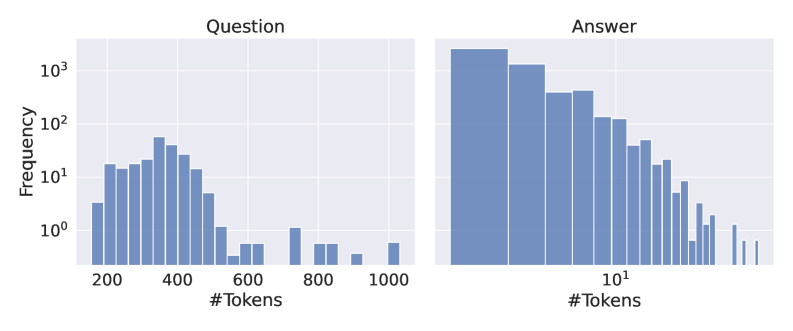
The image displays two side-by-side histograms titled "Question" and "Answer." They visualize the frequency distribution of token counts (likely from a text dataset) for two distinct categories: questions and answers. Both plots use a logarithmic scale for the frequency (y-axis).
### Components/Axes
* **Titles:** The left histogram is titled "Question." The right histogram is titled "Answer."
* **Y-Axis (Both Plots):** Labeled "Frequency." The scale is logarithmic, with major tick marks at 10⁰ (1), 10¹ (10), 10² (100), and 10³ (1000).
* **X-Axis (Question Plot):** Labeled "#Tokens." The scale is linear, with major tick marks at 200, 400, 600, 800, and 1000.
* **X-Axis (Answer Plot):** Labeled "#Tokens." The scale is logarithmic, with a major tick mark visible at 10¹ (10). The bins appear to represent powers of 10 or logarithmic intervals.
* **Data Series:** Each plot contains a single data series represented by blue vertical bars (a histogram). There is no separate legend, as the plot titles define the series.
### Detailed Analysis
**Question Histogram (Left):**
* **Trend:** The distribution is right-skewed. Frequency peaks in the lower-middle range of token counts and then generally declines, with a long tail extending to higher values.
* **Data Points (Approximate):**
* The highest frequency bar is in the bin centered approximately around 350 tokens, reaching a frequency of ~50 (between 10¹ and 10²).
* A cluster of high-frequency bars exists between ~200 and ~500 tokens, with frequencies ranging from ~10 to ~50.
* Frequency drops sharply after ~500 tokens. Bars between ~500 and ~600 tokens have frequencies around 1-5.
* There are sparse, low-frequency outliers (frequency ~1) at approximately 700, 800, 900, and 1000 tokens.
**Answer Histogram (Right):**
* **Trend:** The distribution is strongly right-skewed, with the vast majority of answers having a very low token count. Frequency decreases rapidly as the number of tokens increases.
* **Data Points (Approximate):**
* The highest frequency bar is the leftmost bin (likely representing 1-2 tokens), with a frequency exceeding 1000 (10³).
* The second bin (likely 2-4 tokens) has a frequency of ~1000.
* Frequencies drop to ~100-300 for the next few bins (covering approximately 4-8 tokens).
* Frequencies continue to decline into the single digits for bins representing token counts near and above 10 (10¹).
* The tail extends to the right with very low-frequency bars (frequency ~1) at the highest token count bins shown.
### Key Observations
1. **Scale Disparity:** The token count scales (x-axes) for Questions and Answers are fundamentally different. Questions are plotted on a linear scale from 200-1000 tokens, while Answers are plotted on a logarithmic scale from ~1-10 tokens. This indicates the two datasets occupy completely different ranges.
2. **Central Tendency:** The modal (most frequent) token count for Questions is in the hundreds (~350), while for Answers it is at the very low end (~1-2 tokens).
3. **Spread:** The Question distribution has a much wider spread (range of ~200-1000 tokens) compared to the Answer distribution, which is highly concentrated at the low end.
4. **Logarithmic Frequency:** The use of a log scale on the y-axis for both plots is necessary to visualize the extremely high frequencies of low-token answers alongside the much lower frequencies of high-token questions.
### Interpretation
This visualization strongly suggests a structural characteristic of the underlying Q&A dataset: **questions are substantially longer and more variable in length than answers.**
* **Data Relationship:** The plots are directly comparable as parts of a whole (a question-answer pair). The stark contrast implies that in this context, users or systems pose relatively detailed, multi-sentence questions, but receive very concise, often single-phrase or single-word answers.
* **Potential Contexts:** This pattern could be indicative of:
* A **factoid Q&A system** where questions seek specific data points (e.g., "What is the capital of France?") and answers are brief ("Paris").
* A **command-based interaction** where questions are actually instructions or queries, and answers are confirmations or short results.
* A dataset where "answers" are defined as short labels, categories, or extracted spans rather than full-sentence responses.
* **Anomaly/Notable Feature:** The most striking feature is the answer mode at 1-2 tokens. This extreme concentration suggests a highly constrained answer format, which is a critical design or data collection parameter to be aware of when using this dataset. The long tail of questions up to 1000 tokens also indicates the system must handle complex, lengthy inputs.