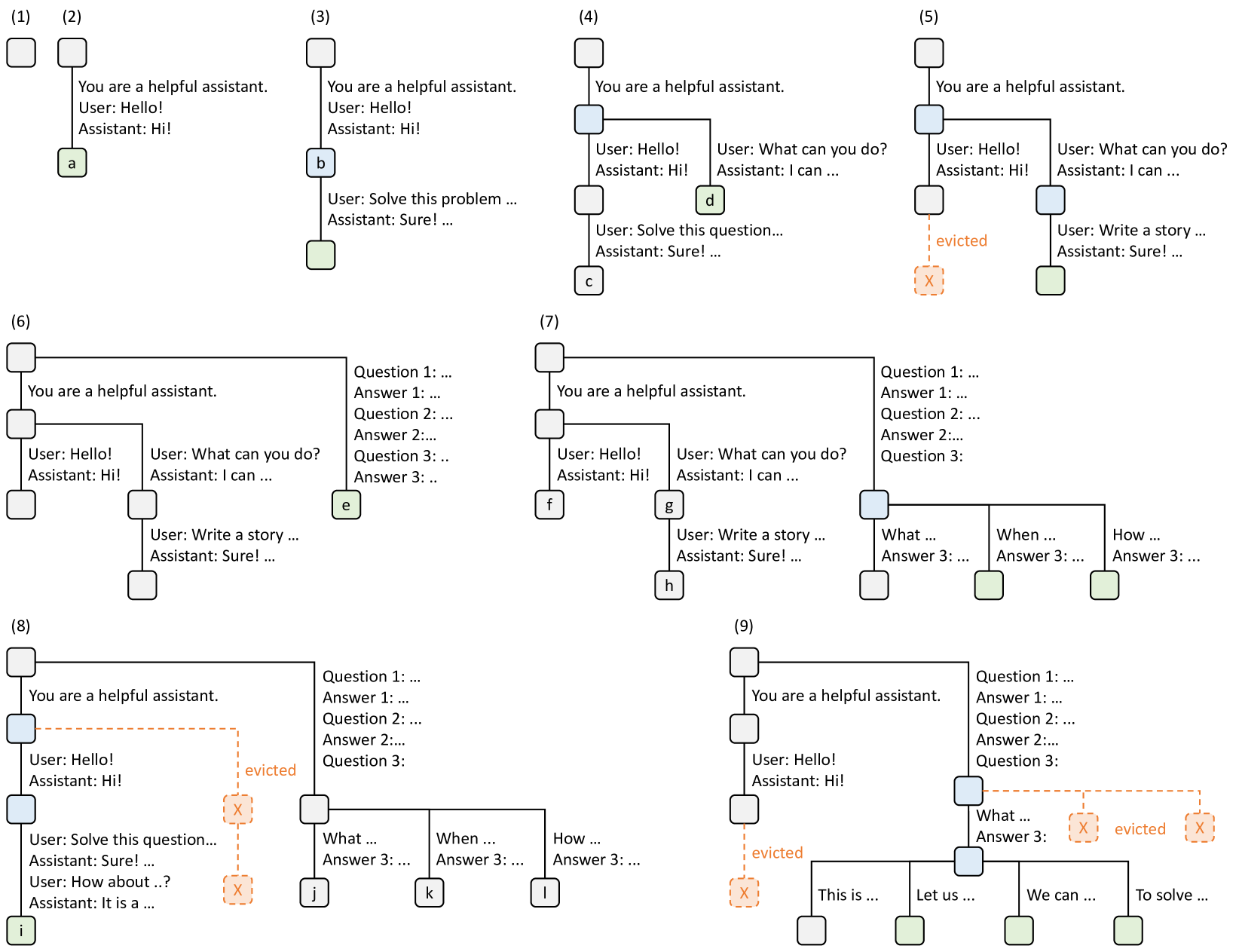
# Technical Document Extraction: Flowchart Analysis
## Node Descriptions
### Node (1)
- **Label**: `(1)`
- **Content**:
- "You are a helpful assistant."
- "User: Hello!"
- "Assistant: Hi!"
- **Connections**:
- Outgoing arrow to Node (2)
### Node (2)
- **Label**: `(2)`
- **Content**:
- "You are a helpful assistant."
- "User: Hello!"
- "Assistant: Hi!"
- **Connections**:
- Outgoing arrow to Node (3)
### Node (3)
- **Label**: `(3)`
- **Content**:
- "You are a helpful assistant."
- "User: Hello!"
- "Assistant: Hi!"
- "User: Solve this problem ..."
- "Assistant: Sure! ..."
- **Connections**:
- Outgoing arrow to Node (6)
### Node (4)
- **Label**: `(4)`
- **Content**:
- "You are a helpful assistant."
- "User: Hello!"
- "Assistant: Hi!"
- "User: What can you do?"
- "Assistant: I can ..."
- **Connections**:
- Outgoing arrow to Node (5)
### Node (5)
- **Label**: `(5)`
- **Content**:
- "You are a helpful assistant."
- "User: Hello!"
- "Assistant: Hi!"
- "User: What can you do?"
- "Assistant: I can ..."
- "User: Write a story ..."
- "Assistant: Sure! ..."
- **Connections**:
- Outgoing arrow to Node (7)
- **Evicted Node**:
- Label: `X` (dashed orange box)
- Text: "evicted"
### Node (6)
- **Label**: `(6)`
- **Content**:
- "You are a helpful assistant."
- "User: Hello!"
- "Assistant: Hi!"
- "User: What can you do?"
- "Assistant: I can ..."
- "User: Write a story ..."
- "Assistant: Sure! ..."
- **Connections**:
- Outgoing arrow to Node (8)
### Node (7)
- **Label**: `(7)`
- **Content**:
- "You are a helpful assistant."
- "User: Hello!"
- "Assistant: Hi!"
- "User: What can you do?"
- "Assistant: I can ..."
- "User: Write a story ..."
- "Assistant: Sure! ..."
- **Question/Answer Structure**:
- "Question 1: ..."
- "Answer 1: ..."
- "Question 2: ..."
- "Answer 2: ..."
- "Question 3: ..."
- "Answer 3: ..."
- **Connections**:
- Outgoing arrow to Node (9)
### Node (8)
- **Label**: `(8)`
- **Content**:
- "You are a helpful assistant."
- "User: Hello!"
- "Assistant: Hi!"
- "User: Solve this question..."
- "Assistant: Sure! ..."
- "User: How about ...?"
- "Assistant: It is a ..."
- **Connections**:
- Outgoing arrow to Node (9)
- **Evicted Node**:
- Label: `X` (dashed orange box)
- Text: "evicted"
### Node (9)
- **Label**: `(9)`
- **Content**:
- "You are a helpful assistant."
- "User: Hello!"
- "Assistant: Hi!"
- **Question/Answer Structure**:
- "Question 1: ..."
- "Answer 1: ..."
- "Question 2: ..."
- "Answer 2: ..."
- "Question 3: ..."
- "Answer 3: ..."
- **Subcategories**:
- "What ..."
- "When ..."
- "How ..."
- "Answer 3: ..."
- "This is ..."
- "Let us ..."
- "We can ..."
- "To solve ..."
- **Connections**:
- Outgoing arrows to:
- Node (10) (not explicitly labeled)
- **Evicted Nodes**:
- Label: `X` (dashed orange box)
- Text: "evicted"
## Connection Flow
1. **(1) → (2) → (3) → (6) → (8) → (9)**
2. **(4) → (5) → (7) → (9)**
3. **(6) → (8) → (9)**
4. **(7) → (9)**
5. **(8) → (9)**
## Evicted Nodes
- **Node (5)**:
- Dashed orange box labeled `X` with "evicted" text.
- **Node (8)**:
- Dashed orange box labeled `X` with "evicted" text.
- **Node (9)**:
- Two dashed orange boxes labeled `X` with "evicted" text.
## Key Observations
- **Redundant Nodes**: Nodes (2), (3), (4), (5), (6), (7), (8), and (9) repeat the phrase "You are a helpful assistant." and variations of user-assistant interactions.
- **Question/Answer Structure**: Nodes (7) and (9) include structured Q&A pairs (e.g., "Question 1: ...", "Answer 1: ...").
- **Eviction Pattern**: Nodes (5), (8), and (9) contain evicted sub-nodes marked with `X` and "evicted" text, suggesting discarded or invalid paths.
- **Flow Variability**: Multiple paths converge on Node (9), indicating divergent decision points or scenarios.
## Diagram Components
- **Nodes**: Rectangular boxes with labels `(1)` to `(9)`.
- **Arrows**: Directed edges indicating workflow progression.
- **Evicted Nodes**: Dashed orange boxes with `X` and "evicted" text, denoting rejected or invalid states.