## Line Chart: Accuracy vs. Attack Ratio for Federated Learning Defenses
### Overview
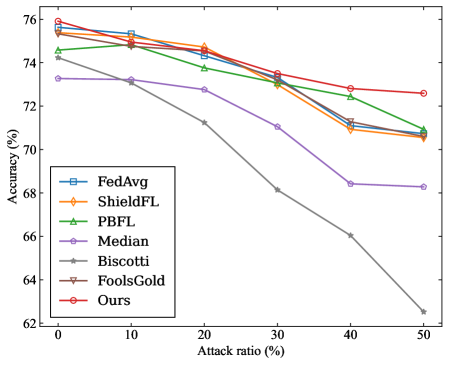
This line chart depicts the relationship between the attack ratio (percentage) and the accuracy (percentage) of several federated learning defense mechanisms. The chart compares the performance of six different defense strategies – FedAvg, ShieldFL, PBFL, Median, Biscotti, FoolsGold, and "Ours" – under varying levels of attack.
### Components/Axes
* **X-axis:** "Attack ratio (%)" ranging from 0 to 50, with markers at 0, 10, 20, 30, 40, and 50.
* **Y-axis:** "Accuracy (%)" ranging from 62 to 76, with markers at 62, 64, 66, 68, 70, 72, 74, and 76.
* **Legend:** Located in the bottom-left corner, listing the following defense mechanisms with corresponding line colors:
* FedAvg (Blue)
* ShieldFL (Orange)
* PBFL (Green)
* Median (Purple)
* Biscotti (Gray)
* FoolsGold (Brown)
* Ours (Red)
### Detailed Analysis
Here's a breakdown of each line's trend and approximate data points, verified against the legend colors:
* **FedAvg (Blue):** The line starts at approximately 75.5% accuracy at 0% attack ratio and decreases slightly to around 74.5% at 50% attack ratio. It remains relatively stable throughout.
* **ShieldFL (Orange):** Starts at approximately 75.5% accuracy at 0% attack ratio, dips to around 73% at 20% attack ratio, and then stabilizes around 70.5% to 71% for the remaining attack ratios.
* **PBFL (Green):** Begins at approximately 74.5% accuracy at 0% attack ratio, decreases to around 73% at 20% attack ratio, and then remains relatively stable around 72% to 73% for the rest of the attack ratios.
* **Median (Purple):** Starts at approximately 73.5% accuracy at 0% attack ratio and shows a significant decline, reaching around 68% at 50% attack ratio.
* **Biscotti (Gray):** Exhibits the most dramatic decline. It starts at approximately 73.5% accuracy at 0% attack ratio and plummets to around 63% at 50% attack ratio.
* **FoolsGold (Brown):** Starts at approximately 74.5% accuracy at 0% attack ratio, decreases to around 72.5% at 30% attack ratio, and then stabilizes around 72% to 73% for the remaining attack ratios.
* **Ours (Red):** Starts at approximately 75.5% accuracy at 0% attack ratio and shows a gradual decline, remaining above 72% even at 50% attack ratio, ending at approximately 72.5%.
### Key Observations
* Biscotti demonstrates the most significant vulnerability to increasing attack ratios, experiencing a substantial drop in accuracy.
* "Ours" consistently maintains the highest accuracy across all attack ratios, indicating its robustness.
* FedAvg, ShieldFL, PBFL, and FoolsGold exhibit relatively stable performance, with moderate declines in accuracy as the attack ratio increases.
* Median shows a more pronounced decline in accuracy compared to the aforementioned strategies.
### Interpretation
The chart demonstrates the effectiveness of different defense mechanisms against attacks in a federated learning environment. The "Ours" strategy appears to be the most resilient, maintaining high accuracy even under significant attack pressure. Biscotti, conversely, is highly susceptible to attacks, suggesting a weakness in its defense approach. The other strategies offer varying degrees of protection, with FedAvg, ShieldFL, PBFL, and FoolsGold providing moderate defense, and Median offering less protection.
The data suggests that the choice of defense mechanism is crucial for maintaining the integrity and reliability of federated learning systems in adversarial settings. The consistent performance of "Ours" highlights the importance of robust defense strategies in mitigating the impact of attacks. The steep decline of Biscotti suggests a potential design flaw or vulnerability that needs to be addressed. The chart provides valuable insights for researchers and practitioners seeking to enhance the security of federated learning applications.