## Diagram: Neural Network Architecture with Channel and Time Mixing
### Overview
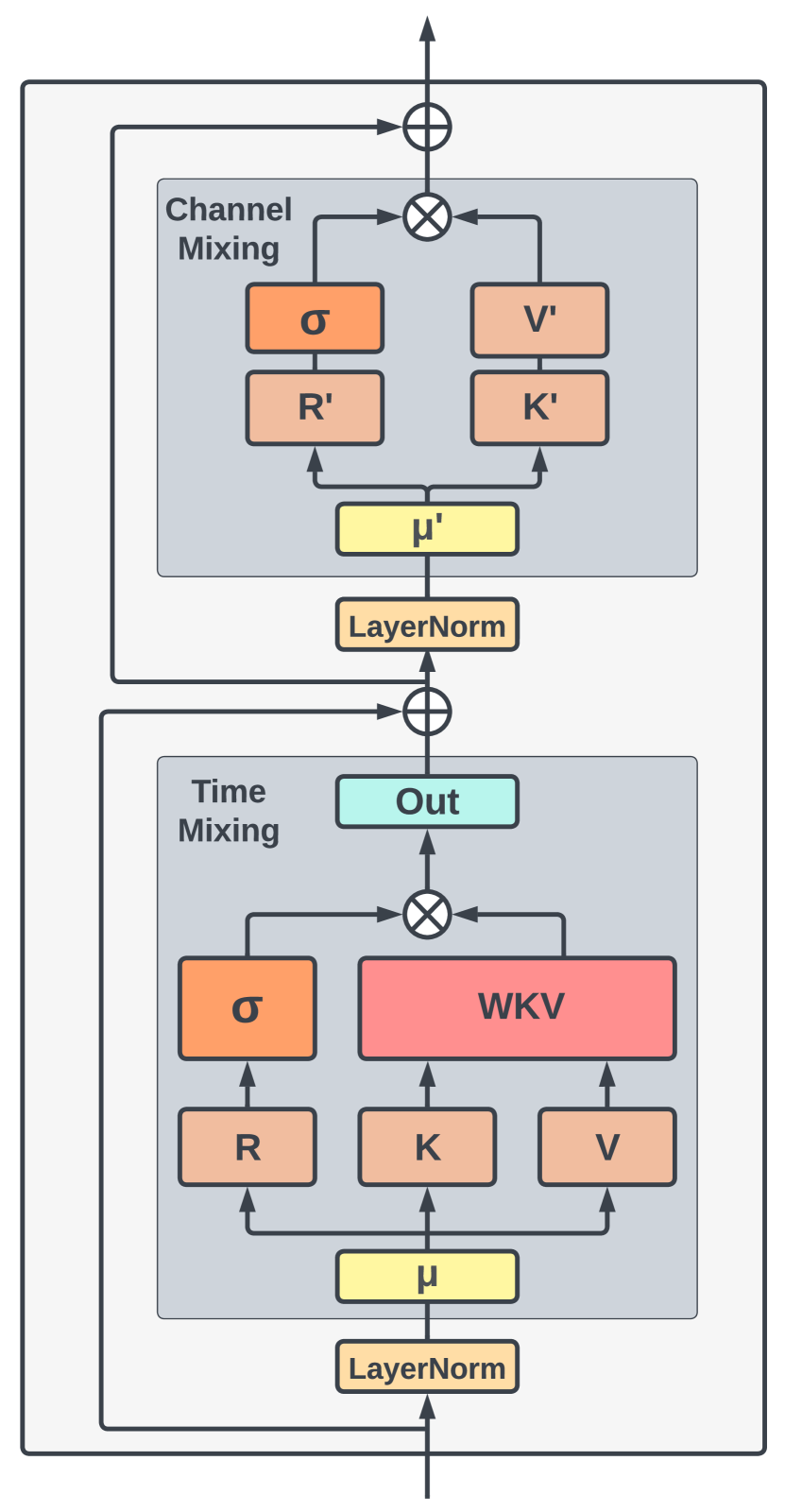
The diagram illustrates a neural network architecture with two primary processing streams: **Channel Mixing** (top) and **Time Mixing** (bottom). Both streams involve parameterized operations (σ, μ), normalization (LayerNorm), and attention-like mechanisms (WKV). Arrows indicate data flow, with cross symbols (⊗) representing element-wise multiplication and plus symbols (+) representing addition.
### Components/Axes
- **Channel Mixing (Top Block)**:
- **σ (sigma)**: Orange square, likely a sigmoid or scaling function.
- **R', K', V'**: Orange squares, representing modified "query," "key," and "value" vectors.
- **μ'**: Yellow rectangle, possibly a mean or bias term.
- **LayerNorm**: Yellow rectangle, layer normalization applied after mixing.
- **Flow**: σ → (R', K', V') → μ' → LayerNorm.
- **Time Mixing (Bottom Block)**:
- **σ (sigma)**: Orange square, same as in Channel Mixing.
- **R, K, V**: Orange squares, unmodified "query," "key," and "value" vectors.
- **WKV**: Red rectangle, a specialized operation combining R, K, V.
- **μ**: Yellow rectangle, mean or bias term.
- **LayerNorm**: Yellow rectangle, normalization after mixing.
- **Out**: Light blue rectangle, final output.
- **Flow**: σ → (R, K, V) → WKV → μ → LayerNorm → Out.
- **Legend**:
- Orange: σ, R, K, V, R', K', V'.
- Red: WKV.
- Yellow: μ, μ', LayerNorm.
- Light Blue: Out.
### Detailed Analysis
1. **Channel Mixing**:
- σ modulates R', K', V' (possibly attention weights).
- μ' is added to the mixed vectors, followed by LayerNorm.
- Output feeds into Time Mixing via a cross symbol (⊗), suggesting element-wise interaction.
2. **Time Mixing**:
- σ scales R, K, V before WKV processing.
- WKV combines R, K, V into a unified representation (e.g., attention output).
- μ is added, followed by LayerNorm and final output (Out).
3. **Connections**:
- The cross symbol (⊗) between Channel and Time Mixing implies multiplicative interaction between their outputs.
- Arrows indicate sequential processing within each block.
### Key Observations
- **Symmetry**: Both blocks use σ, μ, and LayerNorm, suggesting modular design.
- **WKV Specialization**: The red WKV block in Time Mixing implies a custom attention mechanism.
- **Normalization**: LayerNorm appears after mixing in both blocks, ensuring stable gradients.
### Interpretation
This architecture resembles a **transformer-based model** with specialized attention mechanisms.
- **Channel Mixing** likely processes spatial or feature-level interactions (e.g., in vision transformers).
- **Time Mixing** handles temporal or sequential dependencies (e.g., in language models).
- The cross symbol (⊗) between blocks suggests **multi-modal integration** or **cross-attention**, where outputs from Channel Mixing modulate Time Mixing.
- WKV’s red color and central role in Time Mixing highlight its importance in combining query, key, and value vectors, possibly with learnable weights.
The design emphasizes **modularity** (reusable components like σ, μ, LayerNorm) and **efficiency** (shared operations across blocks). The use of LayerNorm after mixing aligns with practices in modern transformers to mitigate internal covariate shift.