## Line Chart: Test Accuracy vs Communication Rounds (N=50, CIFAR-10)
### Overview
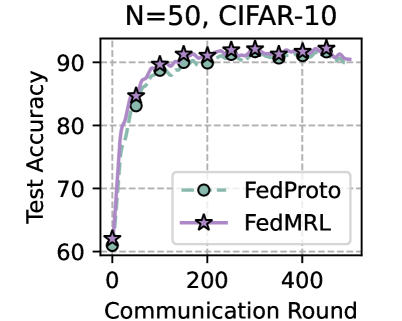
The chart compares the test accuracy of two federated learning algorithms, **FedProto** and **FedMRL**, over communication rounds on the CIFAR-10 dataset with 50 clients. Both models show improvement in accuracy as communication rounds increase, but **FedMRL** consistently outperforms **FedProto** after 200 rounds.
### Components/Axes
- **X-axis**: Communication Rounds (0, 200, 400)
- **Y-axis**: Test Accuracy (60–90%)
- **Legend**:
- **FedProto**: Green circles (dashed line)
- **FedMRL**: Purple stars (solid line)
- **Title**: "N=50, CIFAR-10" (top center)
### Detailed Analysis
1. **FedProto** (green circles):
- Starts at ~60% accuracy at 0 rounds.
- Sharp increase to ~85% by 200 rounds.
- Plateaus near 90% after 200 rounds with minimal further improvement.
- Final accuracy at 400 rounds: ~90% (uncertainty: ±1%).
2. **FedMRL** (purple stars):
- Begins slightly below FedProto (~62% at 0 rounds).
- Accelerates faster, surpassing FedProto by 200 rounds (~88% vs. ~85%).
- Reaches ~92% accuracy by 400 rounds, maintaining a ~2% lead over FedProto.
- Final accuracy at 400 rounds: ~92% (uncertainty: ±1%).
### Key Observations
- **Convergence Speed**: FedMRL converges faster, achieving higher accuracy earlier.
- **Plateauing**: FedProto’s accuracy stabilizes after 200 rounds, while FedMRL continues improving.
- **Performance Gap**: By 400 rounds, FedMRL outperforms FedProto by ~2%, suggesting superior optimization or robustness.
### Interpretation
The data demonstrates that **FedMRL** is more effective for federated learning on CIFAR-10 with 50 clients, likely due to better handling of non-IID data or improved aggregation mechanisms. The plateau in FedProto’s performance highlights potential limitations in its convergence strategy. The ~2% accuracy gap at 400 rounds underscores the importance of algorithmic design in federated settings, where communication efficiency and model robustness are critical. The consistent upward trend for FedMRL suggests it scales better with increased communication rounds, making it preferable for resource-constrained environments.