## Line Graph: Loss vs.Training Steps
### Overview
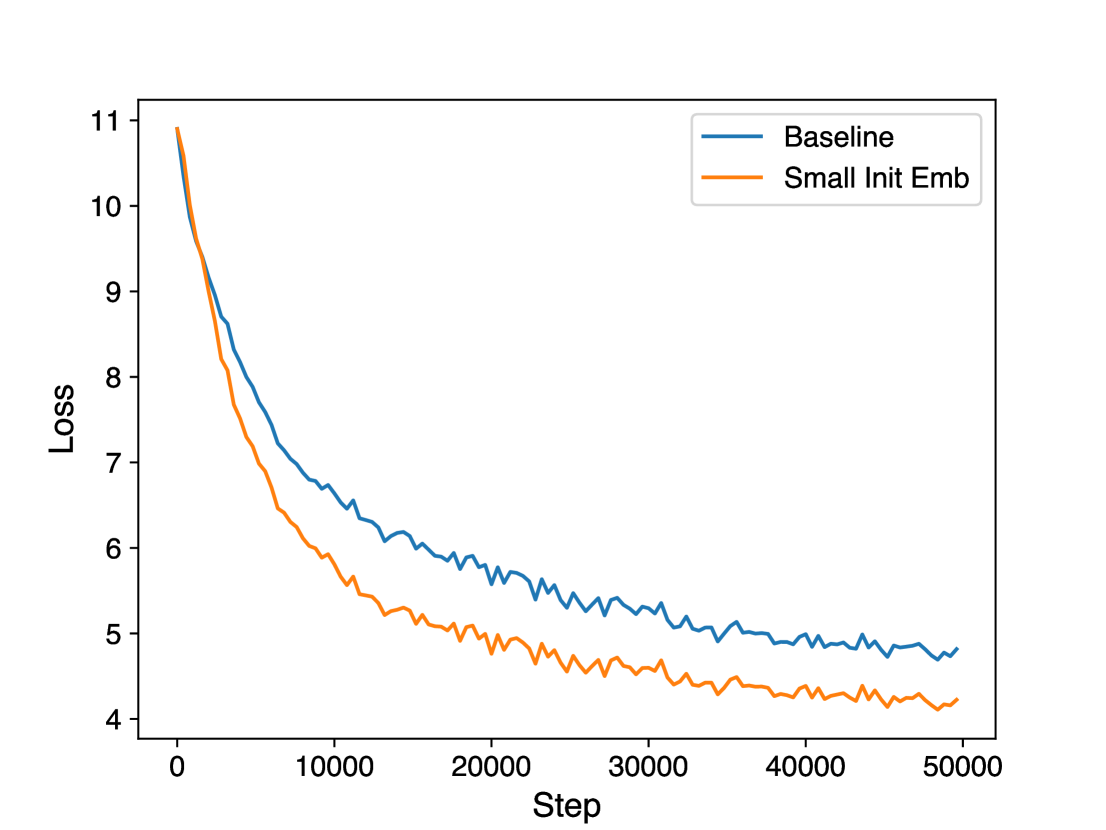
The image depicts a line graph comparing the loss reduction of two training methods ("Baseline" and "Small Init Emb") over 50,000 training steps. Both lines show a decreasing trend, with the "Small Init Emb" method consistently achieving lower loss values than the "Baseline" method.
### Components/Axes
- **X-axis (Horizontal)**: Labeled "Step," ranging from 0 to 50,000 in increments of 10,000.
- **Y-axis (Vertical)**: Labeled "Loss," ranging from 4 to 11 in increments of 1.
- **Legend**: Located in the top-right corner, with:
- **Blue line**: "Baseline"
- **Orange line**: "Small Init Emb"
### Detailed Analysis
1. **Baseline (Blue Line)**:
- Starts at approximately **10.8 loss** at step 0.
- Declines sharply initially, reaching ~7.5 loss by 10,000 steps.
- Gradually decreases to ~4.7 loss by 50,000 steps.
- Exhibits minor fluctuations (e.g., ~5.3 loss at 30,000 steps).
2. **Small Init Emb (Orange Line)**:
- Starts slightly higher at ~10.9 loss at step 0.
- Declines more steeply than the Baseline, reaching ~6.5 loss by 10,000 steps.
- Continues to drop, stabilizing around ~4.2 loss by 50,000 steps.
- Shows smoother convergence with fewer fluctuations compared to Baseline.
### Key Observations
- Both methods show a **monotonic decrease** in loss, but "Small Init Emb" achieves lower loss values at every step.
- The gap between the two lines narrows over time, suggesting convergence in performance at later stages.
- The "Small Init Emb" method demonstrates **~20-30% faster initial loss reduction** compared to Baseline.
### Interpretation
The data suggests that initializing embeddings with smaller dimensions ("Small Init Emb") improves training efficiency, as evidenced by faster and more consistent loss reduction. This could indicate that smaller initial embeddings help the model generalize better or reduce overfitting early in training. The convergence of the two lines at later steps implies that both methods eventually reach similar performance levels, but "Small Init Emb" maintains a persistent advantage. The trends align with common machine learning principles where initialization strategies significantly impact training dynamics.