## Block Diagram: Communication System with Two Receivers
### Overview
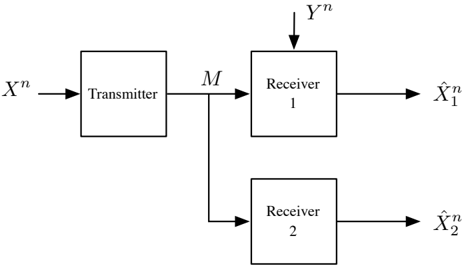
The diagram illustrates a communication system where a transmitter sends a signal \( X^n \) through a channel \( M \) to two receivers. Each receiver processes the signal and outputs an estimated version (\( \hat{X}_1^n \) and \( \hat{X}_2^n \)). The system includes variables \( X^n \), \( Y^n \), and channel \( M \), with directional flow indicated by arrows.
### Components/Axes
- **Transmitter**: Receives input \( X^n \) and transmits it through channel \( M \).
- **Channel \( M \)**: Represents the medium or process through which the signal propagates.
- **Receiver 1**: Processes the transmitted signal and outputs \( \hat{X}_1^n \).
- **Receiver 2**: Processes the transmitted signal and outputs \( \hat{X}_2^n \).
- **Variables**:
- \( X^n \): Input signal to the transmitter.
- \( Y^n \): Output signal from the channel (not directly connected to receivers in this diagram).
- \( \hat{X}_1^n \), \( \hat{X}_2^n \): Estimated signals from Receivers 1 and 2, respectively.
### Detailed Analysis
- **Flow Direction**:
- \( X^n \) → Transmitter → Channel \( M \) → Receiver 1 → \( \hat{X}_1^n \).
- \( X^n \) → Transmitter → Channel \( M \) → Receiver 2 → \( \hat{X}_2^n \).
- **Key Variables**:
- \( X^n \): Original transmitted signal.
- \( Y^n \): Channel output (not explicitly linked to receivers in this diagram).
- \( \hat{X}_1^n \), \( \hat{X}_2^n \): Estimated signals at each receiver.
- **Channel \( M \)**: Acts as a shared medium for both receivers, suggesting potential interference or collaborative processing.
### Key Observations
1. **Parallel Processing**: Both receivers operate independently on the same transmitted signal \( X^n \), implying redundancy or diversity in signal estimation.
2. **Estimation Focus**: The system emphasizes reconstructing the original signal (\( \hat{X}_1^n \), \( \hat{X}_2^n \)) from the channel output \( M \).
3. **No Direct Feedback**: There is no explicit feedback loop from receivers to the transmitter or channel.
### Interpretation
This diagram represents a **multiple-access or broadcast channel** scenario where a single transmitter communicates with multiple receivers. The use of \( \hat{X}_1^n \) and \( \hat{X}_2^n \) suggests the receivers perform **signal estimation** or **decoding** tasks, possibly in the presence of noise or interference (implied by channel \( M \)). The absence of \( Y^n \) in the receiver outputs indicates \( Y^n \) may represent an intermediate or unobserved state in the channel.
The system could model applications like **wireless communication**, **sensor networks**, or **distributed computing**, where reliable signal recovery across multiple receivers is critical. The lack of explicit error-correction mechanisms or feedback loops implies the focus is on open-loop estimation rather than iterative refinement.