## Heatmap Grid: MFCCs for Different Sound Events
### Overview
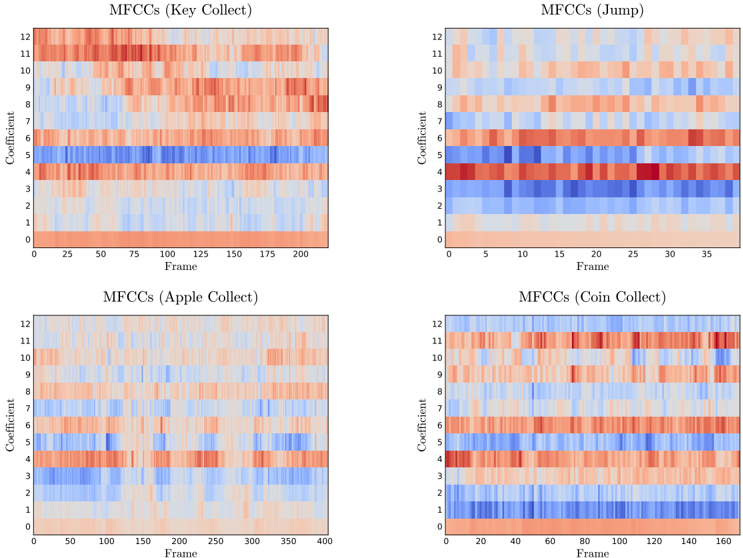
The image displays a 2x2 grid of four separate heatmaps. Each heatmap visualizes the Mel-frequency cepstral coefficients (MFCCs) over time for a distinct sound event, likely from a video game or interactive application. The heatmaps use a diverging color scale (blue to white to red) to represent the value of each coefficient at each time frame.
### Components/Axes
* **Overall Structure:** Four distinct plots arranged in a 2x2 grid.
* **Common Elements per Plot:**
* **Title:** Each plot has a title at the top center: "MFCCs (Key Collect)", "MFCCs (Jump)", "MFCCs (Apple Collect)", and "MFCCs (Coin Collect)".
* **Y-Axis:** Labeled "Coefficient" on the left side of each plot. The axis is categorical, representing discrete MFCC coefficient indices from 0 to 12 (inclusive).
* **X-Axis:** Labeled "Frame" at the bottom of each plot. The scale represents time in discrete frames. The range varies per plot.
* **Color Scale:** A diverging colormap is used. **Blue** represents negative values, **white/light gray** represents values near zero, and **red** represents positive values. The intensity of the color corresponds to the magnitude of the coefficient value. No explicit color bar legend is present, but the mapping is consistent across all four plots.
### Detailed Analysis
**1. MFCCs (Key Collect) - Top Left**
* **X-Axis Range:** 0 to approximately 210 frames.
* **Visual Trend & Data Points:** The heatmap shows a persistent, strong pattern over time.
* **Strong Positive (Red):** Coefficients 4, 5, 6, 10, 11, and 12 show consistent, high-magnitude positive values across nearly all frames.
* **Strong Negative (Blue):** Coefficient 3 shows a consistent, high-magnitude negative value across nearly all frames.
* **Mixed/Neutral:** Coefficients 0, 1, 2, 7, 8, and 9 show more variation, with lighter shades of blue and red, indicating values closer to zero or alternating signs.
**2. MFCCs (Jump) - Top Right**
* **X-Axis Range:** 0 to approximately 40 frames. This is a much shorter event than "Key Collect".
* **Visual Trend & Data Points:** The pattern is more temporally localized.
* **Strong Positive (Red):** A very distinct, high-magnitude red band appears at **Coefficient 4** from roughly frame 5 to frame 30. Coefficient 6 also shows a positive band, but it is less intense and more fragmented.
* **Strong Negative (Blue):** Coefficients 2 and 3 show a strong negative band, most prominent between frames 5-30.
* **Neutral/Weak:** Coefficients 0, 1, 5, and 7-12 are predominantly light-colored (white/light blue/light red), indicating values near zero for most of the event.
**3. MFCCs (Apple Collect) - Bottom Left**
* **X-Axis Range:** 0 to 400 frames. This is the longest event shown.
* **Visual Trend & Data Points:** The pattern is more diffuse and less structured than the others.
* **Persistent Positive (Red):** Coefficient 4 shows a relatively consistent, though not uniformly strong, positive value across the entire duration.
* **Persistent Negative (Blue):** Coefficient 3 shows a consistent negative value.
* **High Variability:** Most other coefficients (0, 1, 2, 5-12) display a "noisy" or speckled pattern with frequent alternation between light blue and light red, suggesting low-magnitude values that fluctuate over time without a strong, sustained trend.
**4. MFCCs (Coin Collect) - Bottom Right**
* **X-Axis Range:** 0 to approximately 165 frames.
* **Visual Trend & Data Points:** This heatmap shows a clear, repeating banded structure.
* **Alternating Bands:** There is a strong, repeating pattern of horizontal bands. For example, coefficients 4 and 10-12 are predominantly red, coefficients 2-3 and 8-9 are predominantly blue, and coefficients 0-1, 5-7 are more mixed.
* **Temporal Consistency:** Unlike the "Jump" event, these bands are sustained across the entire frame range, similar to the "Key Collect" pattern but with a different distribution of which coefficients are positive/negative.
### Key Observations
1. **Event Duration:** The sound events vary significantly in length, from ~40 frames ("Jump") to 400 frames ("Apple Collect").
2. **Pattern Distinctiveness:** Each event has a unique MFCC "fingerprint." "Key Collect" and "Coin Collect" show stable, sustained patterns. "Jump" shows a short, sharp pattern. "Apple Collect" shows a long, noisy, and less structured pattern.
3. **Coefficient Consistency:** Certain coefficients seem to carry strong, consistent signals for specific events (e.g., Coefficient 4 is strongly positive in "Jump" and "Key Collect"; Coefficient 3 is strongly negative in "Key Collect" and "Apple Collect").
4. **Spatial Layout:** The plots are arranged with "Key Collect" and "Jump" (shorter, more distinct events) on top, and "Apple Collect" and "Coin Collect" (longer events) on the bottom.
### Interpretation
This image is a technical visualization used in audio signal processing or machine learning for sound classification. MFCCs are features that represent the short-term power spectrum of a sound, emphasizing aspects relevant to human auditory perception.
* **What the data suggests:** The distinct visual patterns confirm that the acoustic characteristics (as captured by MFCCs) of these four sound events—"Key Collect," "Jump," "Apple Collect," and "Coin Collect"—are fundamentally different from one another. A machine learning model could potentially use these differences to automatically classify which event occurred based on an audio clip.
* **How elements relate:** The x-axis (Frame) represents time progression during the sound event. The y-axis (Coefficient) represents different frequency-related features. The color at any (x, y) point shows the strength and sign of that feature at that moment. The sustained bands in "Key Collect" and "Coin Collect" suggest these sounds have a stable timbral quality throughout. The localized burst in "Jump" corresponds to a short, impulsive sound. The noisy "Apple Collect" pattern might indicate a more complex or less tonal sound, making its MFCC representation less stable over time. The very short duration of the "Jump" event is also a key characteristic.
**Language Note:** All text in the image is in English.