## Heatmap: Transition Probabilities Between Code Editing Actions
### Overview
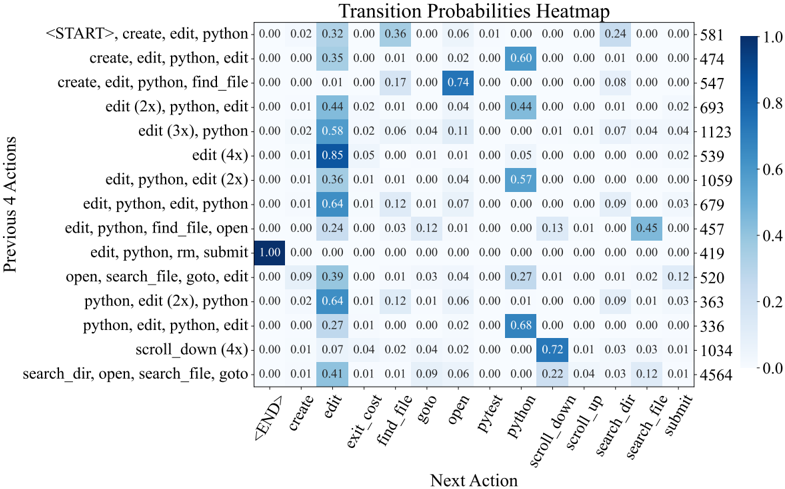
This heatmap visualizes transition probabilities between sequential code editing actions in a Python development environment. The matrix shows the likelihood of transitioning from a sequence of previous actions (y-axis) to a single next action (x-axis), with darker blue cells indicating higher probabilities.
### Components/Axes
- **Y-Axis (Previous 4 Actions)**:
- Sequences of up to 4 actions, including:
- `<START>, create, edit, python`
- `create, edit, python, edit`
- `create, edit, python, find_file`
- `edit (2x), python, edit`
- `edit (3x), python`
- `edit (4x)`
- `edit, python, edit (2x)`
- `edit, python, find_file, open`
- `edit, python, rm, submit`
- `open, search_file, goto, edit`
- `python, edit (2x), python`
- `python, edit, python, edit`
- `scroll_down (4x)`
- `search_dir, open, search_file, goto`
- Labels include action counts (e.g., "edit (2x)") and terminal states (e.g., `<START>`, `END>`).
- **X-Axis (Next Action)**:
- Single actions including:
- `END>`
- `create`
- `edit`
- `exit_cost`
- `find_file`
- `goto`
- `open`
- `pytest`
- `python`
- `scroll_down`
- `scroll_up`
- `search_dir`
- `search_file`
- `submit`
- **Legend**:
- Color scale from 0.0 (light blue) to 1.0 (dark blue) representing transition probabilities.
- Positioned vertically on the right side of the heatmap.
### Detailed Analysis
- **Highest Probabilities**:
- `<START>, create, edit, python` → `END>`: 1.0 (terminal state)
- `edit (2x), python` → `edit`: 0.58
- `edit, python, find_file, open` → `submit`: 0.45
- `python, edit (2x), python` → `edit`: 0.64
- `python, edit, python, edit` → `edit`: 0.68
- `scroll_down (4x)` → `scroll_down`: 0.72
- **Notable Patterns**:
- Terminal states (`END>`, `submit`) show high probabilities (0.24–1.0) after initial action sequences.
- Repetitive actions (e.g., "edit (2x)") cluster with high self-transition probabilities (0.35–0.64).
- File navigation actions (`find_file`, `goto`) show moderate transition probabilities (0.01–0.13).
### Key Observations
1. **Terminal State Dominance**: Sequences ending in `END>` or `submit` have the highest probabilities (1.0 and 0.45, respectively), suggesting these are common endpoints.
2. **Repetition Bias**: Actions with repetition counts (e.g., "edit (2x)") show stronger transitions to similar actions (e.g., "edit" at 0.64).
3. **File Operations**: File-related actions (`find_file`, `goto`) have low transition probabilities (<0.13), indicating they are less frequently followed by other actions.
4. **Scrolling Behavior**: `scroll_down (4x)` has a high self-transition probability (0.72), suggesting prolonged scrolling before other actions.
### Interpretation
This heatmap reveals patterns in code editing workflows, where:
- **Sequential Repetition** (e.g., multiple edits) reinforces similar actions, likely due to iterative coding.
- **Terminal Actions** (`END>`, `submit`) act as strong attractors after initial setup sequences.
- **File Navigation** (`find_file`, `goto`) is infrequently followed by other actions, possibly due to their role as transitional steps rather than endpoints.
- **Scrolling** dominates as a standalone action, with high self-transition probability, reflecting exploratory code review.
The data suggests that code editing workflows are characterized by repetitive action clusters, with terminal states and scrolling forming distinct behavioral patterns. The absence of high probabilities for file navigation actions implies they are often intermediate steps rather than focal points in the editing process.