## Text Comparison: Waking State vs. Dream State
### Overview
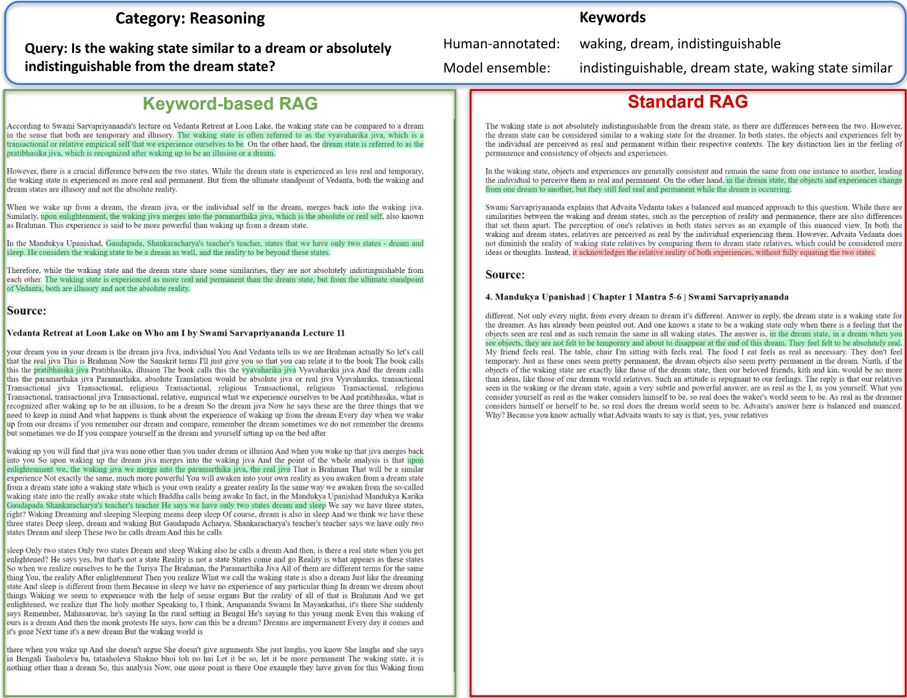
The image presents a comparison of perspectives on the similarity between the waking state and the dream state, using different approaches to information retrieval. It includes a query, keywords, and responses generated by "Keyword-based RAG" and "Standard RAG" methods, along with human-annotated keywords and model ensemble keywords.
### Components/Axes
* **Category:** Reasoning
* **Query:** Is the waking state similar to a dream or absolutely indistinguishable from the dream state?
* **Keywords:**
* Human-annotated: waking, dream, indistinguishable
* Model ensemble: indistinguishable, dream state, waking state similar
* **Sections:**
* Keyword-based RAG
* Standard RAG
### Detailed Analysis or ### Content Details
**Keyword-based RAG:**
* **Content:** This section provides a response to the query based on a keyword-based retrieval approach. It references Swami Sarvapriyananda's lecture on Vedanta, stating that the waking state can be compared to a dream because both are temporary and illusory. It introduces the concepts of "vyavaharika jiva" (transactional self) and "pratibhasika jiva" (illusory self). It acknowledges a difference between the two states, noting that the waking state is experienced as more real and permanent, but both are illusory from Vedanta's perspective. It mentions the merging of "jivas" upon waking or enlightenment. It also references the Mandukya Upanishad, where Gaudapada considers the waking state a dream.
* **Source:** Vedanta Retreat at Loon Lake on Who am I by Swami Sarvapriyananda Lecture 11.
* **Additional Text:** A longer excerpt from the source lecture is included, elaborating on the concepts of "jiva," Brahman, and the nature of reality in different states of consciousness. It includes Sanskrit terms and references to other spiritual figures and texts.
**Standard RAG:**
* **Content:** This section provides a response to the query using a standard retrieval-augmented generation approach. It states that the waking state is not absolutely indistinguishable from the dream state due to differences. However, it suggests the dream state can be considered similar to a waking state for the dreamer. It highlights that objects and experiences feel real and permanent within their respective contexts in both states. It notes that in the waking state, objects and experiences are generally consistent, while in the dream state, they change. It mentions Swami Sarvapriyananda's explanation of Advaita Vedanta's nuanced approach, acknowledging similarities and differences between the states. It uses the perception of relatives as an example.
* **Source:** 4. Mandukya Upanishad | Chapter 1 Mantra 5-6 | Swami Sarvapriyananda.
* **Additional Text:** An excerpt from the Mandukya Upanishad is included, discussing the nature of dreams and waking states. It suggests that the dream state is a waking state for the dreamer and that objects in dreams feel real. It addresses the question of how dream relatives differ from waking relatives, stating that both are real to the individual experiencing them.
### Key Observations
* Both RAG approaches acknowledge similarities between the waking and dream states, but also highlight differences.
* The Keyword-based RAG focuses more on the illusory nature of both states from a Vedanta perspective.
* The Standard RAG emphasizes the feeling of reality and permanence within each state's context.
* Both sections reference Swami Sarvapriyananda and the Mandukya Upanishad.
* The additional text in the Keyword-based RAG provides a more extensive explanation of related concepts.
### Interpretation
The image demonstrates how different information retrieval and generation methods can provide varying perspectives on a philosophical question. The Keyword-based RAG, by focusing on specific terms, delivers a response rooted in Vedanta's concept of illusion. The Standard RAG offers a more balanced view, acknowledging both similarities and differences based on the individual's experience. The inclusion of human-annotated and model ensemble keywords suggests an attempt to guide the retrieval process and evaluate the quality of the generated responses. The image highlights the complexity of the question and the potential for different interpretations depending on the approach and source material used.