TECHNICAL ASSET FINGERPRINT
960e547c54de8bbc1d393fe0
Click to view fullscreen
Press ESC or click to close
FOUND IN PAPERS
EXPERT: healer-alpha-free VERSION 1
RUNTIME: free/openrouter/healer-alpha
INTEL_VERIFIED
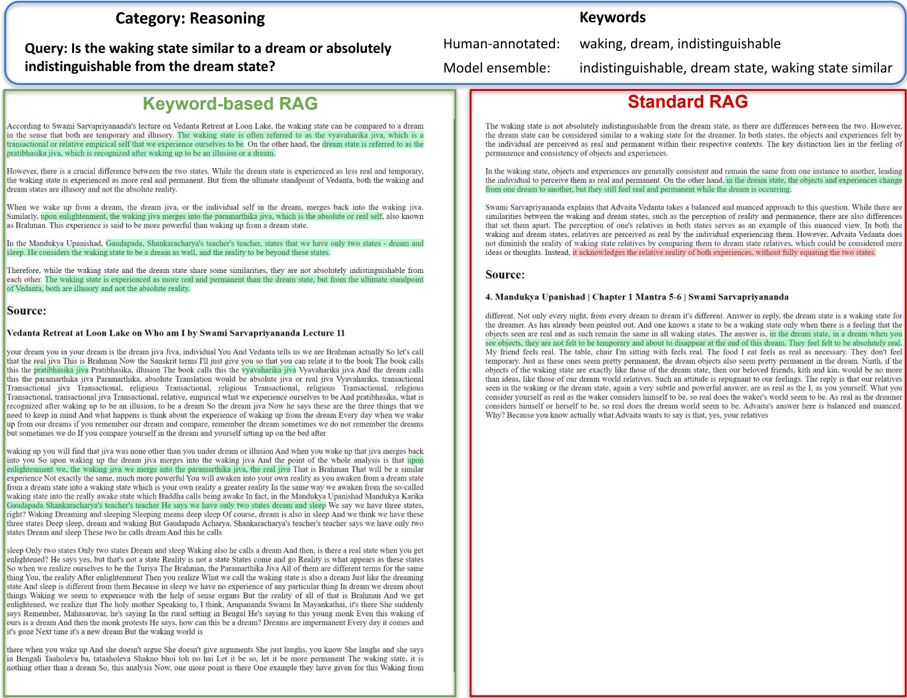
## Technical Document Analysis: RAG System Comparison
### Overview
The image is a structured comparison document analyzing two different Retrieval-Augmented Generation (RAG) approaches in response to a specific philosophical query. It presents a side-by-side analysis of "Keyword-based RAG" versus "Standard RAG," including their outputs, reasoning processes, and source references. The document uses color-coding (green for Keyword-based, red for Standard) to distinguish between the two systems.
### Components/Axes
**Header Section (Top):**
- **Category:** Reasoning
- **Query:** "Is the waking state similar to a dream or absolutely indistinguishable from the dream state?"
- **Human-annotated Keywords:** waking, dream, indistinguishable
- **Model ensemble Keywords:** indistinguishable, dream state, waking state similar
**Main Comparison Columns:**
1. **Left Column:** "Keyword-based RAG" (Green header, green-highlighted text)
2. **Right Column:** "Standard RAG" (Red header, red-highlighted text)
**Source Section (Bottom):**
- **Source Title:** "Vedanta Retreat at Loon Lake on Who am I by Swami Sarvapriyananda Lecture 11"
- **Additional Source Reference:** "4. Mandukya Upanishad | Chapter 1 Mantra 5-6 | Swami Sarvapriyananda"
### Detailed Analysis
#### Keyword-based RAG Output (Left Column)
**Content Summary:** This system provides a direct, text-based extraction from the source material, focusing on specific philosophical concepts from Vedanta.
**Key Extracted Text (with green highlights):**
- "The waking state is often referred to as the vyavaharika jiva, which is a transactional state, which is recalled after waking up to be an illusion, also known as the prabhasika jiva."
- "Similarly, upon enlightenment, the waking jiva merges into the paramarthika jiva, which is the absolute or real jiva, also known as Brahman."
- "Therefore, while the waking state and the dream state share some similarities, they are not absolutely indistinguishable from each other. The waking state is experienced as more real and permanent than the dream state, but from the ultimate standpoint of Vedanta, both are illusory and not the absolute reality."
**Source Text Block:** A lengthy transcript from Swami Sarvapriyananda's lecture discussing the nature of waking and dream states, referencing concepts like vyavaharika (transactional), prabhasika (illusory), and paramarthika (absolute) states of jiva (self).
#### Standard RAG Output (Right Column)
**Content Summary:** This system provides a more synthesized, analytical response that compares and contrasts the two states while referencing the same source material.
**Key Extracted Text (with red highlights):**
- "The waking state is not absolutely indistinguishable from the dream state, as there are differences between the two."
- "However, the dream state can be considered similar to a waking state for the dreamer. In both states, the objects and experiences felt by the individual are perceived as real and consistent within their respective contexts."
- "The key distinction lies in the feeling of permanence and consistency of objects and experiences."
- "Swami Sarvapriyananda explains that Advaita Vedanta takes a balanced and nuanced approach to this question. While there are similarities between the waking and dream states... there are differences that set them apart."
- "It acknowledges the relative reality of both experiences, rather than fully equating the two states."
**Source Reference:** Cites "4. Mandukya Upanishad | Chapter 1 Mantra 5-6 | Swami Sarvapriyananda" and includes a detailed philosophical explanation about the nature of reality in both states.
### Key Observations
1. **Response Style Difference:** Keyword-based RAG produces a more direct, quote-heavy extraction, while Standard RAG generates a synthesized, analytical comparison.
2. **Color-Coding Consistency:** Green highlights in the left column correspond to the "Keyword-based RAG" header, and red highlights in the right column correspond to the "Standard RAG" header.
3. **Source Attribution:** Both systems reference the same primary source (Swami Sarvapriyananda's lecture), but Standard RAG also references a specific Upanishad chapter.
4. **Philosophical Nuance:** Both systems acknowledge similarities between waking and dream states but conclude they are not absolutely indistinguishable, with Standard RAG providing more explicit comparative analysis.
5. **Text Density:** The Keyword-based RAG section contains more verbatim source text, while the Standard RAG section contains more interpretive analysis.
### Interpretation
This document demonstrates a comparative analysis of two RAG system architectures when processing a complex philosophical query about the nature of consciousness and reality.
**What the data suggests:**
- The Keyword-based approach appears to prioritize direct text retrieval and extraction, resulting in more verbatim source content but potentially less synthesis.
- The Standard RAG approach demonstrates more advanced reasoning capabilities, synthesizing information from the source to create a comparative analysis that addresses the query more directly.
- Both systems correctly identify the core philosophical position from the source material: that while waking and dream states share similarities in their subjective reality, they are not absolutely indistinguishable from the ultimate perspective of Advaita Vedanta.
**How elements relate:**
- The header query establishes the philosophical question being tested.
- The two columns represent different algorithmic approaches to answering that question using the same source material.
- The source references at the bottom validate the information presented in both columns.
- The color-coding system creates a clear visual distinction between the two approaches throughout the document.
**Notable patterns:**
- The Standard RAG output is more structured and analytical, suggesting better comprehension and synthesis capabilities.
- The Keyword-based RAG output, while accurate, reads more like a collection of relevant excerpts rather than a coherent response to the specific query.
- Both systems successfully extract the key philosophical concepts (vyavaharika, prabhasika, paramarthika states) but present them differently.
**Underlying significance:**
This comparison illustrates the evolution from simple keyword-based retrieval systems to more sophisticated RAG architectures that can perform nuanced reasoning and synthesis. The document serves as a technical demonstration of how different AI architectures handle the same complex philosophical material, with implications for how such systems might be deployed in educational, philosophical, or research contexts where nuanced understanding of complex texts is required.
DECODING INTELLIGENCE...