## Screenshot: Comparison of Keyword-based RAG and Standard RAG for Reasoning Query
### Overview
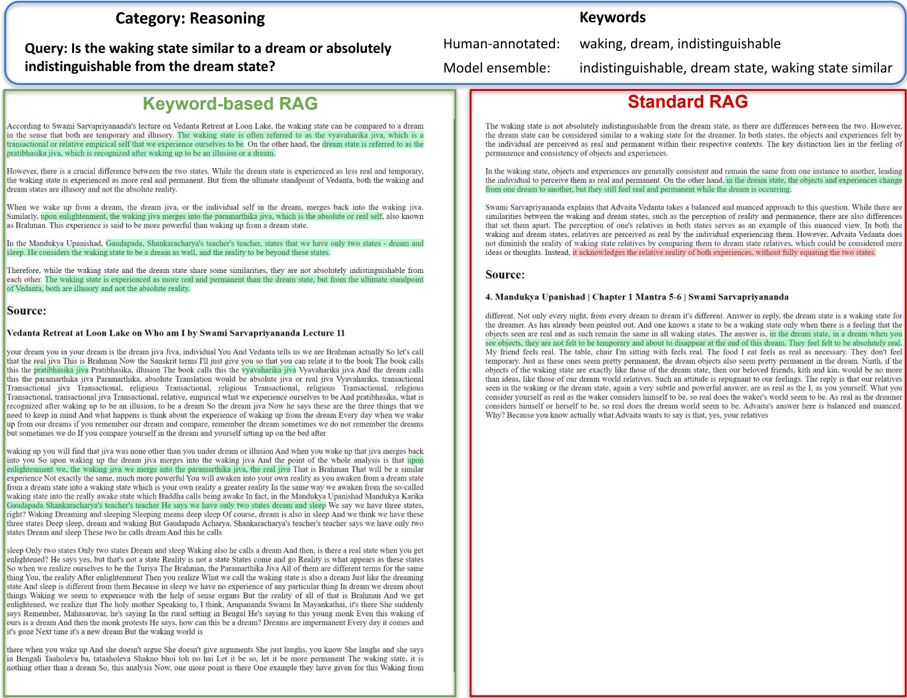
The image compares two approaches to answering a philosophical query about the similarity between waking and dream states. It presents two text blocks labeled "Keyword-based RAG" (green) and "Standard RAG" (red), each containing extracted passages from different sources discussing the nature of consciousness states.
### Components/Axes
- **Left Section (Keyword-based RAG)**:
- Header: "Keyword-based RAG" in green
- Content: Philosophical analysis of waking vs. dream states from Swami Sarvapriyananda's Vedanta Retreat lecture
- Source: "Vedanta Retreat at Loon Lake on Who am I by Swami Sarvapriyananda Lecture 11"
- Highlighted text: Key distinctions between waking (vyavaharika jiva) and dream (pratibhasika jiva) states
- **Right Section (Standard RAG)**:
- Header: "Standard RAG" in red
- Content: Analysis from Mandukya Upanishad (Chapter 1, Mantra 5-6)
- Source: "4. Mandukya Upanishad | Chapter 1 Mantra 5-6 | Swami Sarvapriyananda"
- Highlighted text: Emphasis on the relativity of both states
### Detailed Analysis
**Keyword-based RAG (Left Section)**:
1. **Core Argument**:
- Waking state (vyavaharika jiva) vs. dream state (pratibhasika jiva)
- Both are temporary/illusory but differ in perceived permanence
- Dream state merges back into waking consciousness upon awakening
2. **Key Passages**:
- "The waking state is experienced as more real and permanent than the dream state"
- "From the ultimate standpoint of Vedanta, both are illusory"
- "The dream jiva merges back into the waking jiva upon awakening"
3. **Source Context**:
- Draws from Advaita Vedanta philosophy
- References concepts like Brahman, Atman, and Maya
**Standard RAG (Right Section)**:
1. **Core Argument**:
- Similarities: Both states involve consistent perception of objects/relatives
- Differences: Waking state has "feeling of permanence"
- Philosophical nuance: "Acknowledges relative reality without equating states"
2. **Key Passages**:
- "In the dream state, objects and experiences change from one dream to another"
- "The waking world is more powerful than the dream world"
- "Reality is not a state but what appears as these states"
3. **Source Context**:
- Draws from Mandukya Upanishad (ancient Sanskrit text)
- References concepts like Turiya (absolute reality) and dream states
### Key Observations
1. Both approaches agree on fundamental similarities:
- Both states involve illusory perception of reality
- Both involve consistent experience of objects/relatives
2. Key differences:
- Keyword-based RAG emphasizes the temporary nature of both states
- Standard RAG focuses on the relative permanence of waking state
- Different source materials (modern lecture vs. ancient text)
3. Highlighted text patterns:
- Green highlights: Focus on state distinctions and transitions
- Red highlights: Emphasis on relative reality and philosophical nuance
### Interpretation
The comparison reveals how different RAG implementations handle philosophical queries:
1. **Keyword-based RAG** prioritizes:
- Clear state distinctions (waking vs. dream)
- Temporal aspects of consciousness
- Modern philosophical interpretations
2. **Standard RAG** emphasizes:
- Relative reality of both states
- Ancient textual sources (Mandukya Upanishad)
- Nuanced philosophical positions (Turiya, Brahman)
The analysis suggests that RAG implementation choices affect:
- Depth of philosophical nuance captured
- Source material selection
- Emphasis on state transitions vs. state characteristics
- Balance between similarity and distinction in consciousness states
The highlighted text patterns indicate that the query's focus on "similarity" vs. "indistinguishability" influences how each RAG system processes and presents the information.