## Charts: Performance of Continual Learning Strategies
### Overview
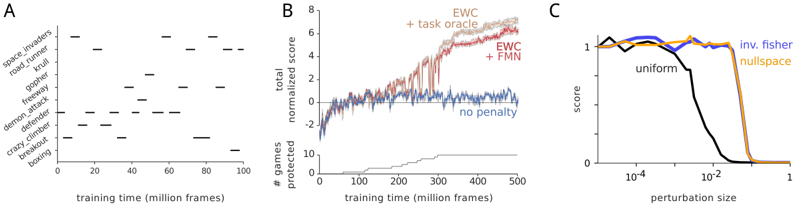
The image presents three charts (A, B, and C) comparing the performance of different continual learning strategies on a suite of Atari games. Chart A shows task completion times, Chart B displays normalized scores and protected games over training time, and Chart C illustrates performance degradation with increasing perturbation size.
### Components/Axes
**Chart A:**
* **X-axis:** Training Time (million frames) - Scale: 0 to 100 (approx.)
* **Y-axis:** List of Atari Games: space\_invaders, alien, road\_runner, krull, gopher, freeway, donkey\_kong, defender, demon\_attack, crazy\_climber, breakout, pong.
* Each game has a horizontal line indicating task completion.
**Chart B:**
* **X-axis:** Training Time (million frames) - Scale: 0 to 500 (approx.)
* **Y-axis (Top):** Total Normalized Score - Scale: -3 to 8 (approx.)
* **Y-axis (Bottom):** # Games Protected - Scale: 0 to 12 (approx.)
* **Legend:**
* "no penalty" (Blue)
* "EWC + FMN" (Red)
* "EWC + task oracle" (Pink)
**Chart C:**
* **X-axis:** Perturbation Size - Logarithmic Scale: 10^-4 to 1 (approx.)
* **Y-axis:** Score - Scale: 0 to 1.5 (approx.)
* **Legend:**
* "uniform" (Black)
* "inv. fisher nullspace" (Orange)
### Detailed Analysis or Content Details
**Chart A:**
* The chart shows when each game is "completed" during training.
* Space invaders is completed first, around 10 million frames.
* Pong is completed last, around 90 million frames.
* Most games are completed between 20 and 80 million frames.
**Chart B:**
* **"no penalty" (Blue):** The line fluctuates around a normalized score of 0, with some negative dips. The number of protected games increases slowly, reaching approximately 8 games by 500 million frames.
* **"EWC + FMN" (Red):** The line shows a generally upward trend, starting around a normalized score of -2 and reaching approximately 4 by 500 million frames. The number of protected games increases steadily, reaching approximately 10 games by 500 million frames.
* **"EWC + task oracle" (Pink):** The line shows a strong upward trend, starting around a normalized score of -2 and reaching approximately 6 by 500 million frames. The number of protected games increases rapidly, reaching approximately 12 games by 500 million frames.
**Chart C:**
* **"uniform" (Black):** The line starts at approximately 1.0 and rapidly decreases to near 0 as the perturbation size increases.
* **"inv. fisher nullspace" (Orange):** The line starts at approximately 1.0 and decreases more slowly than the "uniform" line, remaining above 0.2 even at a perturbation size of 1.
### Key Observations
* Chart B demonstrates that the "EWC + task oracle" strategy performs best, followed by "EWC + FMN", and then "no penalty".
* Chart C shows that the "inv. fisher nullspace" strategy is more robust to perturbations than the "uniform" strategy.
* Chart A shows the order in which the games are learned.
### Interpretation
The data suggests that regularization techniques like EWC (Elastic Weight Consolidation), especially when combined with a task oracle or FMN (Fast Modular Networks), significantly improve performance in continual learning scenarios. The "no penalty" strategy struggles to retain knowledge of previously learned tasks as new tasks are encountered.
Chart C highlights the importance of the perturbation direction. The "inv. fisher nullspace" strategy, which uses the Fisher information matrix to identify important weights, is more resilient to perturbations, indicating that it learns a more robust representation of the tasks. The rapid decline of the "uniform" strategy suggests that random perturbations can easily disrupt the learned weights.
The order of task completion in Chart A may reflect the inherent difficulty of each game or the effectiveness of the learning algorithm in solving specific types of problems. The combination of these charts provides a comprehensive evaluation of different continual learning strategies, revealing their strengths and weaknesses in terms of knowledge retention, performance improvement, and robustness to perturbations.