## Composite Visual Analysis: Training Performance and Robustness
### Overview
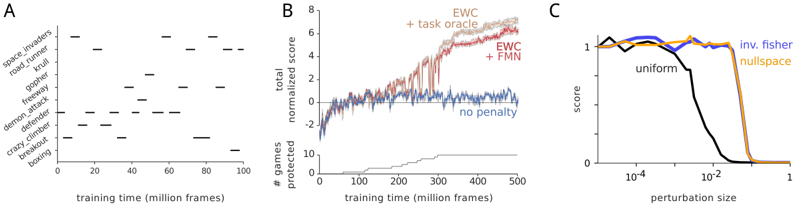
The image contains three distinct panels (A, B, C) presenting training dynamics, performance metrics, and robustness analysis across different algorithms and perturbation scenarios. Each panel uses distinct visualization techniques to convey specialized data.
### Components/Axes
**Panel A (Bar Chart):**
- **Y-axis**: Game categories (categorical labels)
- Categories: `space_invaders`, `road_runner`, `krull`, `gopher`, `freeway`, `demon_attack`, `defender`, `crazy_climber`, `breakout`, `boxing`
- **X-axis**: Training time (million frames) with logarithmic-like spacing (0–100M)
- **Legend**: Not explicitly labeled; horizontal bars with dash patterns (possibly indicating sub-metrics)
- **Text Elements**: Game names in lowercase with underscores (e.g., `demon_attack`)
**Panel B (Line Graph):**
- **Y-axis**: Total normalized score (range: -2 to 6)
- **X-axis**: Training time (million frames) with linear scale (0–500M)
- **Legend**:
- `EWC + task oracle` (orange-brown)
- `EWC + FMN` (red)
- `no penalty` (blue)
- **Secondary Y-axis**: # Games protected (linear scale, 0–10)
**Panel C (Line Graph):**
- **Y-axis**: Score (range: 0–1)
- **X-axis**: Perturbation size (log scale: 10⁻⁴ to 1)
- **Legend**:
- `inv. fisher` (blue)
- `nullspace` (orange)
- `uniform` (black)
- **Text Elements**: Axis labels in lowercase with abbreviations (e.g., `inv. fisher`)
### Detailed Analysis
**Panel A:**
- Bars represent training time distributions across games.
- `space_invaders` and `krull` show the longest training times (~80–100M frames).
- `defender` and `breakout` have the shortest training times (~20–40M frames).
- Multiple dashes on bars suggest sub-category distinctions (e.g., `space_invaders` has 5 dashes; `krull` has 4).
**Panel B:**
- **EWC + task oracle**: Steady ascent from ~-1 to ~6 (peak at 500M frames).
- **EWC + FMN**: Volatile but upward trend (final score ~4.5).
- **No penalty**: Flat line at ~-1.5.
- # Games protected increases stepwise, peaking at ~8 games by 500M frames.
**Panel C:**
- **Uniform**: Sharp decline from 1 to 0.2 at ~10⁻² perturbation size.
- **Nullspace**: Gradual decline, plateauing near 0.6 at 10⁻².
- **Inv. fisher**: Stable until ~10⁻³, then drops to 0.4 at 10⁻².
### Key Observations
1. **Panel A**: Training time correlates with game complexity (e.g., `krull` > `breakout`).
2. **Panel B**: EWC with task oracle outperforms FMN and no-penalty baselines.
3. **Panel C**: Uniform regularization is most sensitive to perturbations; nullspace/inv. fisher show robustness.
### Interpretation
- **Panel A** suggests task-specific training requirements, with arcade-style games (`krull`, `space_invaders`) demanding more training.
- **Panel B** demonstrates that EWC regularization with task oracles improves generalization, while FMN introduces instability.
- **Panel C** implies that nullspace/inv. fisher regularization better preserves performance under perturbations compared to uniform methods.
- The stepwise increase in protected games (Panel B) indicates progressive task mastery over training time.
- Log-scale perturbation analysis (Panel C) highlights sensitivity thresholds, critical for robustness engineering.