## Line Graph: Benchmark: Average
### Overview
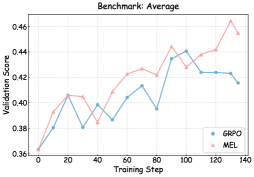
The image is a line graph comparing the validation scores of two models, GRPO and MEL, across training steps. The x-axis represents training steps (0–140), and the y-axis represents validation scores (0.36–0.46). Two lines are plotted: a blue line for GRPO and a red line for MEL.
### Components/Axes
- **Title**: "Benchmark: Average"
- **X-axis**: "Training Step" (0–140, increments of 20)
- **Y-axis**: "Validation Score" (0.36–0.46, increments of 0.02)
- **Legend**: Located in the bottom-right corner, with:
- Blue circle labeled "GRPO"
- Red triangle labeled "MEL"
### Detailed Analysis
#### GRPO (Blue Line)
- **Data Points**:
- 0: 0.36
- 20: 0.38
- 40: 0.38
- 60: 0.40
- 80: 0.41
- 100: 0.43
- 120: 0.42
- 140: 0.41
- **Trend**: Starts at 0.36, rises to a peak of 0.43 at step 100, then declines to 0.41 by step 140. Shows moderate fluctuations.
#### MEL (Red Line)
- **Data Points**:
- 0: 0.36
- 20: 0.39
- 40: 0.40
- 60: 0.41
- 80: 0.42
- 100: 0.43
- 120: 0.44
- 140: 0.45
- **Trend**: Starts at 0.36, steadily increases to 0.45 by step 140. Shows consistent upward growth with minimal fluctuations.
### Key Observations
1. **MEL Outperforms GRPO**: MEL consistently achieves higher validation scores across most training steps, especially after step 80.
2. **GRPO Volatility**: GRPO exhibits sharper fluctuations, with a peak at step 100 followed by a decline.
3. **Final Scores**: At step 140, MEL reaches 0.45, while GRPO drops to 0.41.
### Interpretation
The graph suggests that MEL demonstrates more stable and effective learning over training steps compared to GRPO. While GRPO briefly surpasses MEL around step 100, its subsequent decline indicates potential instability or overfitting. MEL’s steady ascent implies robust performance, making it the superior model for this benchmark. The divergence in trends highlights differences in optimization strategies or architectural strengths between the two models.