## Flowchart: LoongFlow System Architecture
### Overview
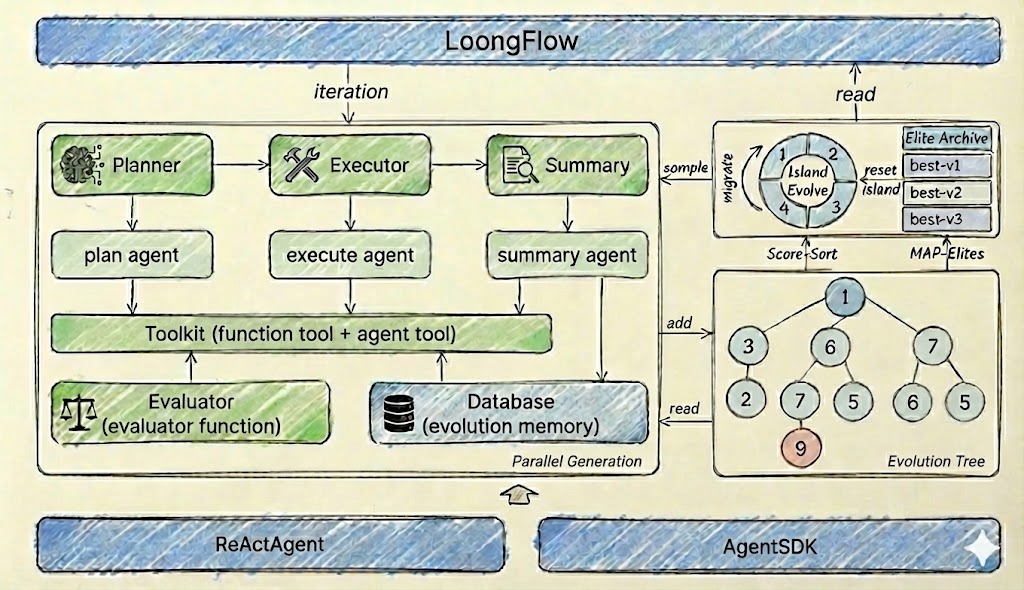
The diagram illustrates a multi-component system architecture titled "LoongFlow," depicting iterative processes involving planning, execution, summarization, and evolution. Key elements include agents, toolkits, evaluators, and a database, with flows connecting components and parallel generation mechanisms.
### Components/Axes
- **Main Components**:
- **Planner**: Contains "plan agent" (green box).
- **Executor**: Contains "execute agent" (green box).
- **Summary**: Contains "summary agent" (green box).
- **Toolkit**: Labeled "Toolkit (function tool + agent tool)" (green box).
- **Evaluator**: Labeled "Evaluator (evaluator function)" (green box).
- **Database**: Labeled "Database (evolution memory)" (blue box).
- **Processes**:
- **Parallel Generation**: Arrows indicate concurrent workflows.
- **Migration**: Includes "migrate," "Island Evolve," and "reset island" steps.
- **Evolution Tree**: Nodes numbered 1–9, with node 9 highlighted in red.
- **Legends**:
- Green: Components (Planner, Executor, Summary, Toolkit, Evaluator).
- Blue: Processes (Database, Parallel Generation).
- Gray: Database (evolution memory).
- **Arrows**: Indicate directional flow between components.
### Detailed Analysis
1. **Top Section**:
- **Planner → Executor → Summary**: Sequential flow from planning to execution to summarization.
- **Toolkit**: Connects to all three agents (plan, execute, summary).
- **Evaluator**: Feeds into the Database.
2. **Bottom Section**:
- **Database**: Stores "evolution memory" and connects to "Parallel Generation."
- **AgentSDK** and **ReActAgent**: Positioned at the bottom, likely frameworks or libraries.
3. **Right Sidebar**:
- **Evolution Tree**: Nodes 1–9, with node 9 highlighted (red).
- **Migration Steps**: Includes "Island Evolve," "reset island," and versioned archives ("best-v1," "best-v2," "best-v3").
- **Score-Sort** and **MAP-Elites**: Likely optimization or evaluation metrics.
### Key Observations
- **Cyclical Workflow**: The system iterates through planning, execution, and summarization, feeding results into the Database.
- **Evolution Mechanism**: The "evolution memory" and "evolution tree" suggest optimization or selection processes (e.g., genetic algorithms).
- **Parallelism**: "Parallel Generation" implies concurrent task execution.
- **Versioning**: Migration steps reference versioned archives ("best-v1," etc.), indicating model iteration or deployment.
### Interpretation
The diagram represents a dynamic system for iterative task management, likely in AI/ML or optimization contexts. The "evolution tree" and "evolution memory" imply a focus on improving performance over iterations, possibly through reinforcement learning or genetic algorithms. The "Island Evolve" and "reset island" steps suggest modular or population-based optimization techniques. The inclusion of "AgentSDK" and "ReActAgent" indicates integration with external frameworks for agent-based workflows. The system emphasizes modularity, with distinct roles for planning, execution, and evaluation, while the Database acts as a central repository for evolutionary data.