\n
## Diagram: Clever Hans vs. AI - Spurious Correlations
### Overview
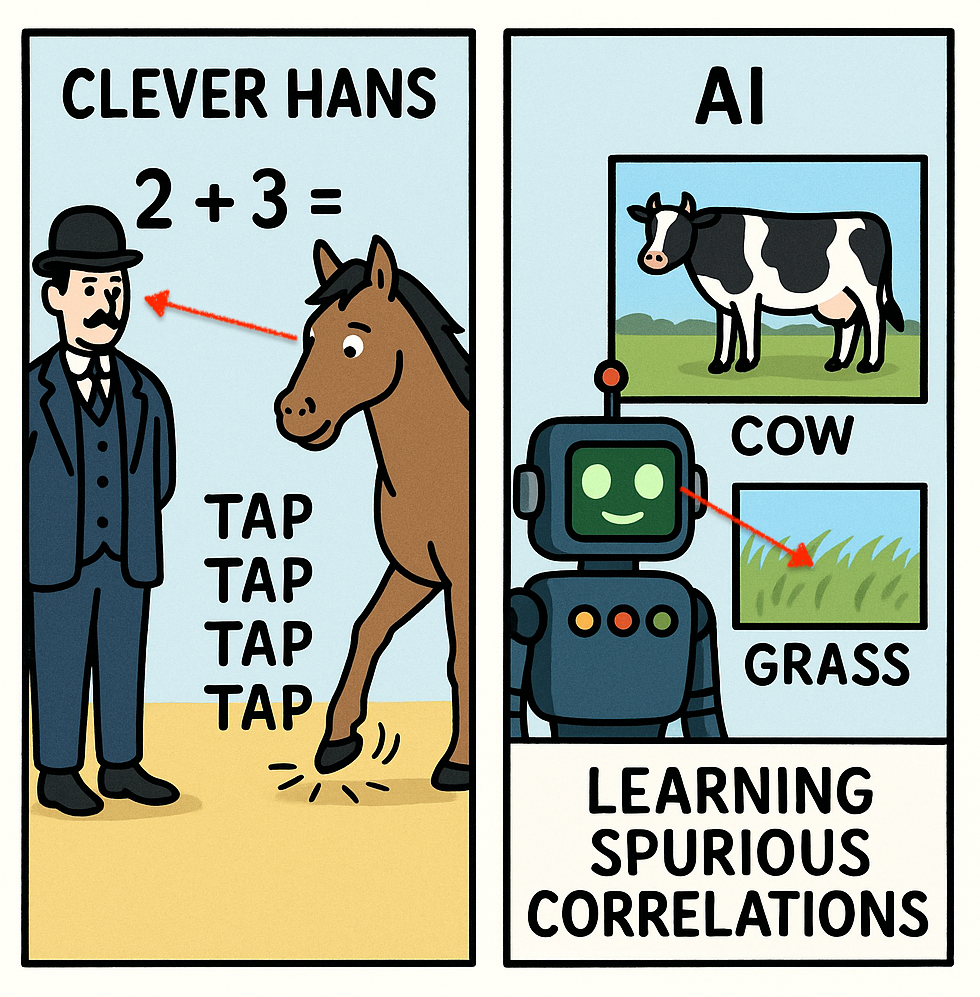
The image is a comparative diagram split into two panels. The left panel depicts the "Clever Hans" phenomenon, a historical case of a horse appearing to solve arithmetic problems. The right panel illustrates a similar issue in the context of Artificial Intelligence (AI), specifically the problem of learning spurious correlations. The diagram uses illustrative figures and text to convey the concept.
### Components/Axes
The diagram consists of two distinct panels, each with its own set of visual elements and text.
* **Left Panel (Clever Hans):**
* A man in a bowler hat and formal attire.
* A brown horse.
* Text: "CLEVER HANS" at the top.
* Equation: "2 + 3 =" positioned above the horse's head, with a red arrow pointing towards the horse.
* Repeated text: "TAP" written multiple times below the horse, suggesting tapping of the horse's hoof.
* **Right Panel (AI):**
* A blue robot with a screen displaying a green "eye".
* An image within a frame showing a black and white cow.
* An image within a frame showing green grass.
* Text: "AI" at the top.
* Labels: "COW" and "GRASS" next to the respective images.
* Text: "LEARNING SPURIOUS CORRELATIONS" at the bottom.
* A red arrow pointing from the robot to the grass.
### Detailed Analysis or Content Details
The diagram doesn't present numerical data but rather a conceptual comparison.
* **Clever Hans Panel:** The equation "2 + 3 =" suggests an arithmetic problem. The repeated "TAP" indicates that the horse was responding to subtle cues from the questioner (tapping of the foot), rather than actually solving the problem. The red arrow highlights the connection between the question and the horse's response.
* **AI Panel:** The robot is shown "looking" at the grass. The labels "COW" and "GRASS" identify the images within the frames. The red arrow suggests the AI is associating the robot's action with the grass, potentially learning a spurious correlation (e.g., the robot activates when grass is present, even if there's no logical connection). The text "LEARNING SPURIOUS CORRELATIONS" explicitly states the issue.
### Key Observations
The diagram highlights a common pitfall in both animal training and AI: the misinterpretation of behavior as evidence of understanding when, in reality, the subject is responding to unintended cues or correlations. The diagram uses a historical example (Clever Hans) to illustrate a contemporary problem in AI.
### Interpretation
The diagram illustrates the dangers of spurious correlations in learning systems. Clever Hans wasn't actually doing math; he was responding to unconscious cues from his trainer. Similarly, an AI might learn to associate unrelated features (like the presence of grass) with a desired outcome, leading to incorrect or unreliable behavior. The diagram suggests that careful design and evaluation are crucial to ensure that AI systems are learning genuine relationships rather than accidental correlations. The use of the historical example of Clever Hans serves as a cautionary tale, emphasizing that apparent intelligence doesn't necessarily equate to true understanding. The diagram is a visual metaphor for the challenges of building robust and reliable AI systems. The positioning of the images, with the human/animal on the left and the AI on the right, suggests a parallel between the two scenarios. The frames around the cow and grass in the AI panel emphasize the AI's limited perception and potential for misinterpreting its environment.