\n
## Conceptual Diagram: Clever Hans vs. AI - Learning Spurious Correlations
### Overview
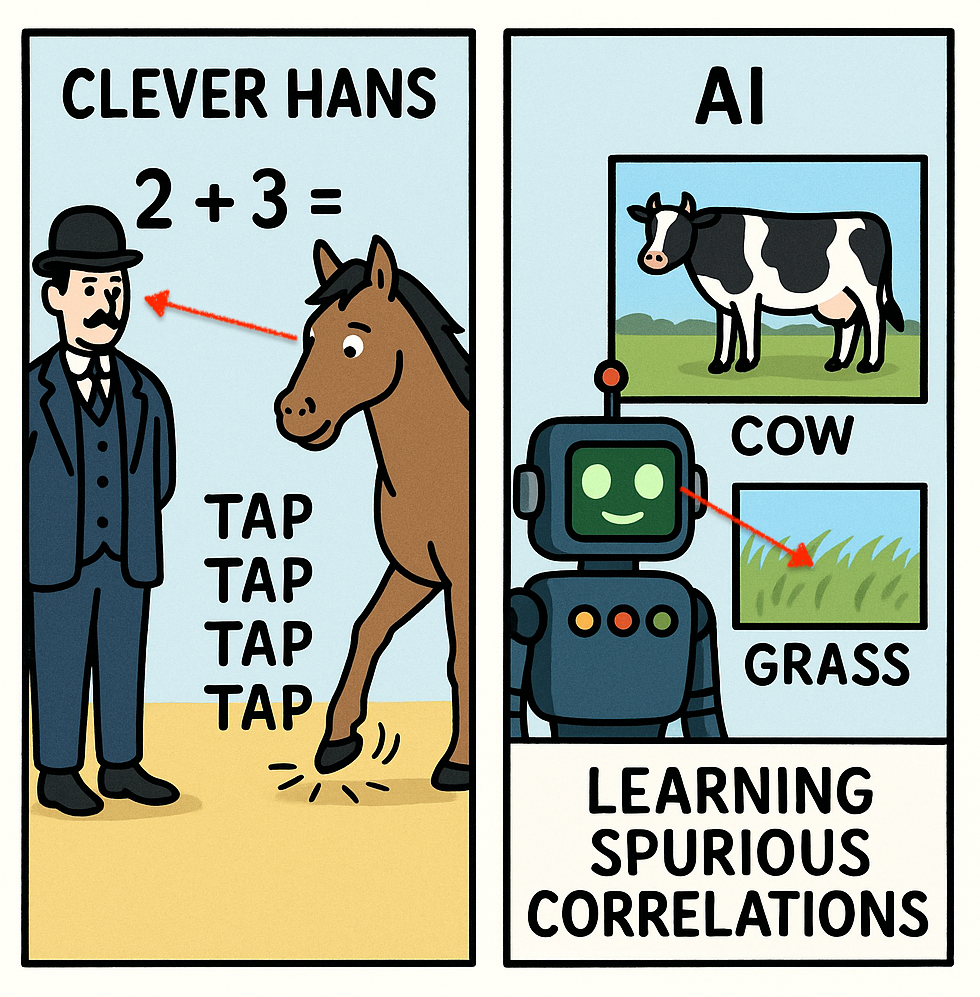
The image is a two-panel vertical cartoon illustrating the concept of "spurious correlations" in learning systems. It draws a parallel between the historical case of "Clever Hans," a horse believed to perform arithmetic, and modern artificial intelligence (AI) systems. The core message is that both can learn to rely on irrelevant, coincidental cues in their environment rather than understanding the actual task.
### Components/Axes
The image is divided into two distinct, vertically oriented panels with black borders.
**Left Panel: "CLEVER HANS"**
* **Header Text:** "CLEVER HANS" (top center, bold, black font).
* **Central Elements:**
* A man in a blue suit and bowler hat stands on the left.
* A brown horse stands on the right, tapping its front hoof.
* Between them, the text "2 + 3 =" is displayed.
* Below the horse's hoof, the onomatopoeia "TAP TAP TAP TAP" is written vertically.
* **Visual Cue:** A red arrow originates from the horse's eye and points directly to the man's face, indicating the horse is watching the man, not solving the math problem.
**Right Panel: "AI"**
* **Header Text:** "AI" (top center, bold, black font).
* **Central Elements:**
* A blue robot with a green screen face is positioned on the left.
* To its right are two framed images stacked vertically:
* Top frame: A black and white cow in a field. The label "COW" is below it.
* Bottom frame: A patch of green grass. The label "GRASS" is below it.
* **Visual Cue:** A red arrow originates from the robot's screen "eyes" and points directly to the grass in the lower frame, indicating the AI is focusing on the background (grass) rather than the primary subject (cow).
* **Footer Text:** "LEARNING SPURIOUS CORRELATIONS" (bottom center, bold, black font, spanning the width of the panel).
**Language:** All text in the image is in English.
### Detailed Analysis
The diagram uses a direct visual analogy to explain a technical concept.
1. **Clever Hans Panel (Historical Analogy):**
* **Task:** The implied task is arithmetic (solving "2 + 3 =").
* **Apparent Behavior:** The horse taps its hoof, seemingly providing the correct answer (5 taps).
* **Actual Mechanism (Revealed by the arrow):** The horse is not calculating. It is watching the questioner's subtle, unconscious body language (e.g., a slight relaxation of posture) to know when to stop tapping. The "correlation" it learned is between the questioner's cues and the correct stopping point, not between numbers and quantities.
2. **AI Panel (Modern Analogy):**
* **Task:** The implied task is image classification (identifying a "cow").
* **Apparent Behavior:** The AI system might correctly label images containing cows.
* **Actual Mechanism (Revealed by the arrow):** The AI may not be learning the features of a cow itself. Instead, it might be learning a "spurious correlation" – that the presence of green grass (a common background in cow photos) is a reliable predictor for the label "cow." This fails if presented with a cow on a beach or grass without a cow.
### Key Observations
* **Parallel Structure:** Both panels are structured identically: a header naming the system, a depiction of the system facing a task, and a red arrow revealing the true, flawed focus of its attention.
* **Focus of Attention:** The critical element in both panels is the red arrow, which visually isolates the source of the spurious correlation (the man's face / the grass) from the intended subject of the task (the math problem / the cow).
* **Textual Labels:** The labels "COW" and "GRASS" are explicit, highlighting the specific features the AI might be incorrectly associating.
* **Unified Message:** The footer text "LEARNING SPURIOUS CORRELATIONS" explicitly states the overarching theme connecting both examples.
### Interpretation
This diagram is a pedagogical tool explaining a fundamental pitfall in machine learning and behavioral psychology.
* **What it Demonstrates:** It illustrates that learning systems (biological or artificial) can achieve high performance on a test set by exploiting convenient, but ultimately irrelevant, patterns in the training data. This is known as learning a "spurious correlation" or "shortcut."
* **Relationship Between Elements:** The left panel provides a well-documented historical precedent (Clever Hans) to make the more abstract and contemporary problem in AI (right panel) immediately understandable. The analogy argues that the core issue—mistaking correlation for causation or understanding—is not new.
* **Implications and Anomalies:** The major implication is that benchmark accuracy can be misleading. An AI system may appear competent while being fundamentally flawed and brittle. The "anomaly" it warns against is a model that fails catastrophically when deployed in environments where the spurious correlation (e.g., grass in the background) does not hold. This underscores the critical need for robust evaluation, careful dataset curation, and techniques that encourage models to learn causal, invariant features rather than statistical shortcuts.