\n
## Diagram: Agent-Knowledge Graph Interaction Loop
### Overview
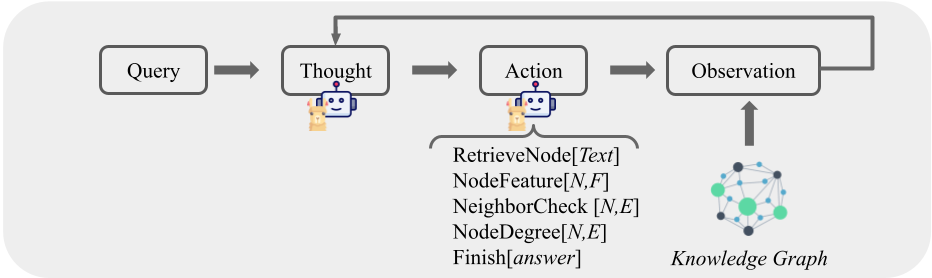
The image depicts a diagram illustrating an agent's interaction loop with a knowledge graph. The loop consists of four stages: Query, Thought, Action, and Observation, with the Action stage branching into several specific actions that interact with the Knowledge Graph. The diagram visually represents a process where an agent receives a query, processes it into a thought, translates that thought into an action, observes the result from a knowledge graph, and repeats the cycle.
### Components/Axes
The diagram consists of four main rectangular blocks labeled "Query", "Thought", "Action", and "Observation", arranged horizontally from left to right and connected by arrows indicating the flow of the process. Below the "Action" block is a list of actions: "RetrieveNode[Text]", "NodeFeature[N,F]", "NeighborCheck [N,E]", "NodeDegree[N,E]", and "Finish[answer]". To the bottom-right of the diagram is a visual representation of a "Knowledge Graph" consisting of nodes and edges.
### Detailed Analysis or Content Details
The diagram shows a sequential process:
1. **Query:** The starting point, represented by a rectangular box labeled "Query".
2. **Thought:** An agent icon (a small robot) is placed inside a rectangular box labeled "Thought".
3. **Action:** Another agent icon is placed inside a rectangular box labeled "Action". Below this box, a list of actions is provided:
* **RetrieveNode[Text]:** Retrieves a node based on text input.
* **NodeFeature[N,F]:** Extracts features (F) from a node (N).
* **NeighborCheck [N,E]:** Checks the neighbors (E) of a node (N).
* **NodeDegree[N,E]:** Determines the degree of a node (N) based on its edges (E).
* **Finish[answer]:** Finalizes the process and provides an answer.
4. **Observation:** A rectangular box labeled "Observation".
5. **Knowledge Graph:** A visual representation of a graph with green nodes and blue edges. The graph appears to be a network of interconnected nodes.
The arrows connecting the blocks indicate the flow of information. An arrow points from "Action" to the "Knowledge Graph", indicating that the actions are performed on the knowledge graph. An arrow points from the "Knowledge Graph" to "Observation", indicating that the observation is based on the results from the knowledge graph.
### Key Observations
The diagram highlights the iterative nature of the agent's interaction with the knowledge graph. The agent doesn't simply query the graph once but engages in a loop of thought, action, and observation to refine its understanding and ultimately arrive at an answer. The specific actions listed under "Action" suggest that the agent can perform various operations on the knowledge graph, such as retrieving nodes, extracting features, checking neighbors, and determining node degrees.
### Interpretation
This diagram illustrates a common architecture in knowledge-based AI systems, particularly those employing agents that interact with knowledge graphs. The loop represents a reasoning process where the agent uses the knowledge graph as its source of information and iteratively refines its understanding through a series of actions and observations. The actions listed suggest a focus on graph traversal and feature extraction, which are essential for tasks such as knowledge discovery, question answering, and reasoning. The diagram suggests a system designed for complex problem-solving where the agent needs to explore and analyze a knowledge graph to arrive at a solution. The use of agent icons suggests an autonomous or semi-autonomous system capable of independent reasoning and action. The diagram does not provide any specific data or numerical values, but rather a conceptual framework for how an agent interacts with a knowledge graph.