## Diagram: Agent-Based Reasoning Process with Knowledge Graph
### Overview
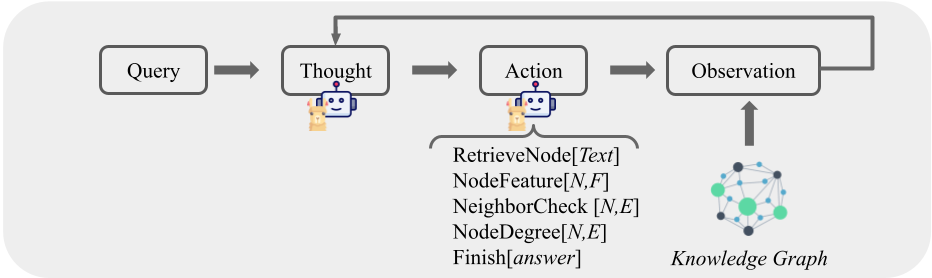
The image is a flowchart diagram illustrating a cyclical, agent-driven reasoning process. It depicts a system where a query initiates a loop of thought, action, and observation, with actions performed on a knowledge graph. The diagram uses simple boxes, arrows, and icons to represent components and data flow.
### Components/Axes
The diagram consists of four primary rectangular boxes connected by directional arrows, forming a loop. Below the "Action" box is a list of specific functions. To the right, connected to the "Observation" box, is a network graph icon labeled "Knowledge Graph."
**Primary Flow Components (from left to right, top):**
1. **Box 1:** Labeled "Query". A right-pointing arrow connects it to the next box.
2. **Box 2:** Labeled "Thought". Contains a small icon of a robot head (blue) with a yellow thought bubble. A right-pointing arrow connects it to the next box.
3. **Box 3:** Labeled "Action". Contains a small icon of a robot head (blue) with a yellow gear or action symbol. A right-pointing arrow connects it to the next box.
4. **Box 4:** Labeled "Observation". A left-pointing arrow originates from this box and loops back to the "Thought" box, completing the cycle.
**Action Sub-Components (listed below the "Action" box):**
A list of five functions or operations is presented, each in a `Function[Parameters]` format:
* `RetrieveNode[Text]`
* `NodeFeature[N,F]`
* `NeighborCheck[N,E]`
* `NodeDegree[N,E]`
* `Finish[answer]`
**Knowledge Graph Component (bottom-right):**
* An icon depicting a network graph with interconnected nodes (circles) of varying sizes and colors (green and blue).
* A label below the icon reads: "Knowledge Graph".
* An upward-pointing arrow connects this icon to the "Observation" box.
### Detailed Analysis
The diagram outlines a specific, iterative workflow:
1. **Initiation:** The process begins with a "Query".
2. **Reasoning Loop:** The core is a three-stage loop:
* **Thought:** The agent processes information (indicated by the thought bubble icon).
* **Action:** The agent executes one of five possible operations on a knowledge graph. The parameters suggest graph-based operations: `N` likely represents a Node, `F` a Feature, and `E` an Edge or neighbor.
* **Observation:** The agent receives feedback or results from the action, which is informed by the "Knowledge Graph".
3. **Feedback:** The "Observation" feeds back into the "Thought" stage, allowing for iterative reasoning and refinement.
4. **Termination:** The final function in the list, `Finish[answer]`, indicates a concluding action that produces the final output, breaking the loop.
### Key Observations
* **Cyclical Flow:** The most prominent feature is the feedback loop from "Observation" back to "Thought", emphasizing an iterative, non-linear process.
* **Agent-Centric Design:** The use of robot icons in the "Thought" and "Action" boxes personifies the system as an active agent performing cognitive and physical tasks.
* **Structured Action Space:** The five listed functions under "Action" define a clear, limited set of operations the agent can perform, all related to querying and analyzing a graph structure.
* **External Knowledge Source:** The "Knowledge Graph" is depicted as an external data source that the "Action" functions operate on and the "Observation" is derived from.
### Interpretation
This diagram models a **ReAct (Reasoning + Acting) style agent** designed for **graph-based question answering or analysis**. The process suggests the agent doesn't just retrieve static information but actively explores a knowledge graph.
* **What it demonstrates:** The system is built for complex queries requiring multi-step reasoning over connected data. The agent formulates a thought (e.g., "I need to find nodes related to X"), chooses an action (e.g., `RetrieveNode` or `NeighborCheck`), observes the result from the graph, and then uses that new information to inform its next thought.
* **Relationships:** The "Action" functions are the bridge between the agent's internal reasoning ("Thought") and the external structured data ("Knowledge Graph"). The "Observation" is the direct result of applying an action to the graph.
* **Notable Design Choice:** The inclusion of `NodeDegree` and `NeighborCheck` as primitive actions indicates the agent can perform structural analysis of the graph (assessing connectivity and importance of nodes), not just content retrieval. This implies capability for tasks like finding central entities or tracing relationship paths.
* **Underlying Paradigm:** The loop embodies an investigative, trial-and-error approach to problem-solving, where the agent refines its understanding through successive interactions with the data source. The `Finish[answer]` action represents the point of sufficient confidence to generate a final response.