## Stacked Bar Chart: Tool Choice Correctness Analysis
### Overview
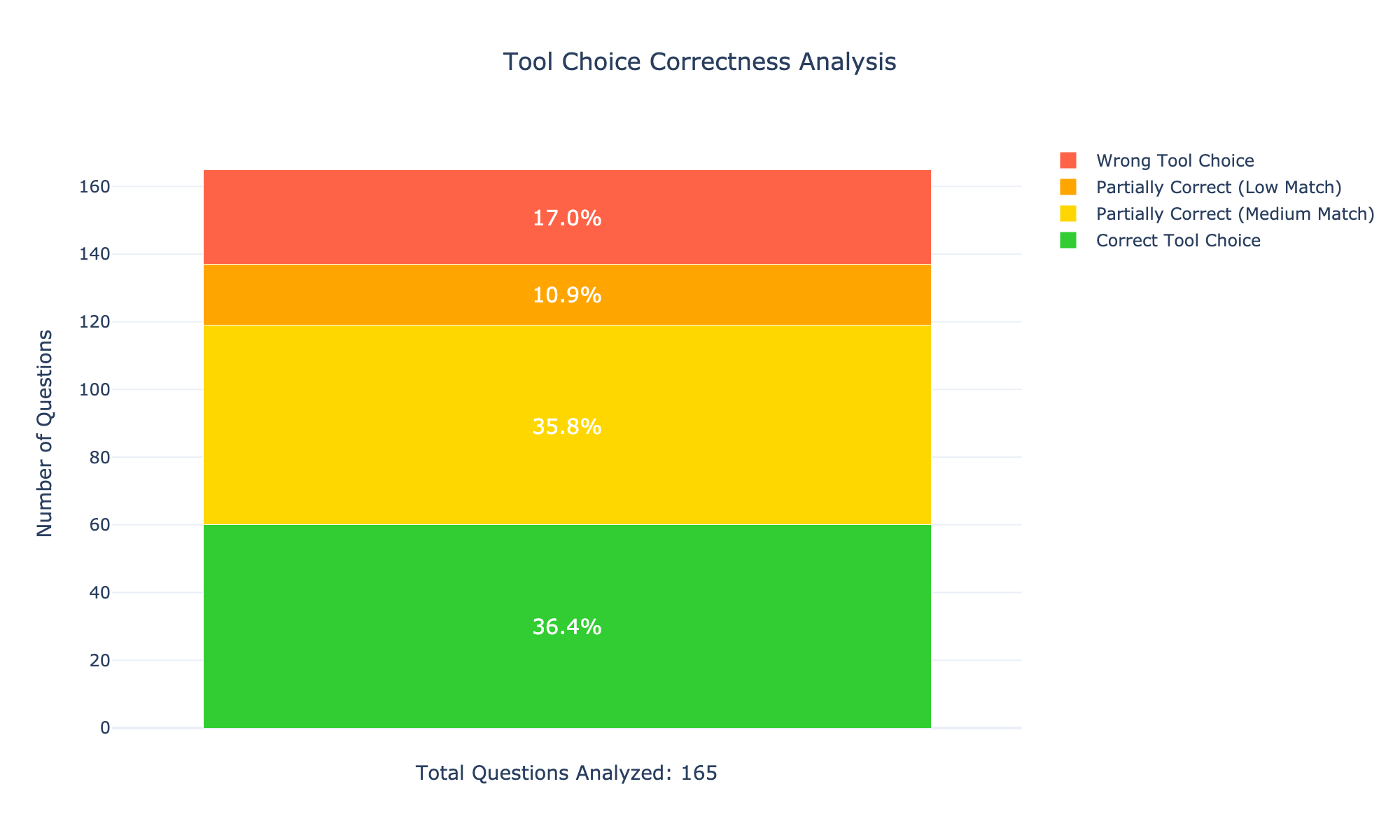
The chart visualizes the distribution of tool choice correctness across four categories for 165 analyzed questions. It uses a single stacked bar segmented by color-coded correctness levels, with percentages displayed within each segment.
### Components/Axes
- **Title**: "Tool Choice Correctness Analysis" (centered at the top)
- **Y-Axis**: "Number of Questions" (linear scale, 0–160, increments of 20)
- **X-Axis**: "Total Questions Analyzed: 165" (single label at the base)
- **Legend**: Located on the right side, with four categories:
- **Red**: Wrong Tool Choice
- **Orange**: Partially Correct (Low Match)
- **Yellow**: Partially Correct (Medium Match)
- **Green**: Correct Tool Choice
### Detailed Analysis
- **Total Questions**: 165 (explicitly stated on the x-axis)
- **Segment Breakdown**:
- **Green (Correct Tool Choice)**: 36.4% (60 questions)
- **Yellow (Partially Correct, Medium Match)**: 35.8% (59 questions)
- **Orange (Partially Correct, Low Match)**: 10.9% (18 questions)
- **Red (Wrong Tool Choice)**: 17.0% (28 questions)
- **Visual Trends**:
- The green segment (Correct) is the largest, followed closely by yellow (Medium Match).
- Orange (Low Match) and red (Wrong) occupy smaller portions, with red being the second-largest incorrect category.
### Key Observations
1. **Dominance of Correct/Medium Matches**: 72.2% of responses (green + yellow) fall into correct or medium-match categories.
2. **Significant Wrong Choices**: 17.0% (red) represents a notable proportion of incorrect tool selections.
3. **Low-Match Disparity**: Orange (Low Match) is the smallest segment, suggesting fewer instances of partial correctness with low relevance.
### Interpretation
The data indicates that tool choice accuracy is moderately high overall, with nearly equal distributions between correct and medium-match responses. However, the 17% wrong choices highlight a critical area for improvement in tool selection processes. The low-match category (10.9%) suggests that while some tool choices were partially relevant, they lacked sufficient alignment with user needs. This imbalance between correct/medium matches and incorrect/low-match responses underscores the need for better user guidance or tool recommendation systems to reduce errors and enhance relevance.