\n
## Diagram: Set Representation
### Overview
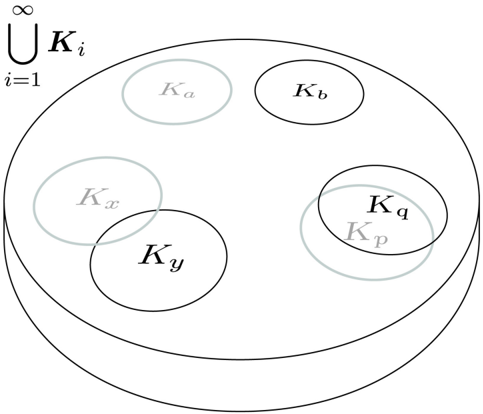
The image depicts a diagram illustrating a set-theoretic concept. It shows a large encompassing set formed by the union of infinitely many smaller sets, represented as overlapping ovals within the larger set. The diagram is a visual representation of a mathematical concept, likely related to topology or set theory.
### Components/Axes
The diagram consists of:
* **Large Outer Set:** Represented by a large, encompassing oval. It is labeled with the mathematical notation: "∪ᵢ₌₁<sup>∞</sup> Kᵢ". This notation signifies the union of an infinite number of sets, denoted as Kᵢ, where 'i' ranges from 1 to infinity.
* **Inner Sets:** Several smaller ovals are contained within the large outer set. These are labeled as follows:
* K<sub>a</sub>
* K<sub>b</sub>
* K<sub>x</sub>
* K<sub>y</sub>
* K<sub>p</sub>
* K<sub>q</sub>
* **Overlapping Regions:** The inner sets overlap with each other and with the outer set, indicating intersections between the sets.
### Detailed Analysis / Content Details
The diagram does not contain numerical data or precise measurements. It is a qualitative representation of set relationships. The key elements are the sets themselves and their overlapping regions.
* The large outer set represents the union of all the smaller sets.
* The inner sets (K<sub>a</sub>, K<sub>b</sub>, K<sub>x</sub>, K<sub>y</sub>, K<sub>p</sub>, K<sub>q</sub>) are subsets of the large outer set.
* The overlapping regions represent the intersection of these subsets. For example, K<sub>x</sub> and K<sub>y</sub> overlap, indicating that there are elements common to both sets. K<sub>p</sub> and K<sub>q</sub> overlap. K<sub>x</sub> and K<sub>y</sub> also overlap with the outer set.
### Key Observations
* The diagram illustrates the concept of a union of sets, where the union contains all elements from all the individual sets.
* The overlapping regions highlight the concept of set intersection, where elements are common to multiple sets.
* The infinite union is represented by the notation, suggesting a potentially unbounded or limitless collection of sets.
* The arrangement of the sets is not geometrically precise, suggesting that the diagram is intended to convey the concept rather than a specific spatial relationship.
### Interpretation
The diagram visually represents a fundamental concept in set theory: the union of sets. The notation "∪ᵢ₌₁<sup>∞</sup> Kᵢ" indicates that the large outer set is formed by taking the union of an infinite number of sets, Kᵢ. This suggests a process of accumulation or aggregation, where elements from each Kᵢ are combined to form the larger set. The overlapping regions demonstrate that the sets are not necessarily disjoint; they can share common elements.
The diagram could be used to model various phenomena where elements belong to multiple categories or groups. For example, it could represent the set of all possible outcomes of an experiment, where each Kᵢ represents a specific event. The overlapping regions would then represent the outcomes that belong to multiple events.
The diagram is abstract and does not provide specific data or values. It is a conceptual tool for understanding set relationships and the concept of a union of sets. The use of an infinite union suggests a potentially complex or unbounded system.