## Confusion Matrix: GTZAN Label Classification Performance
### Overview
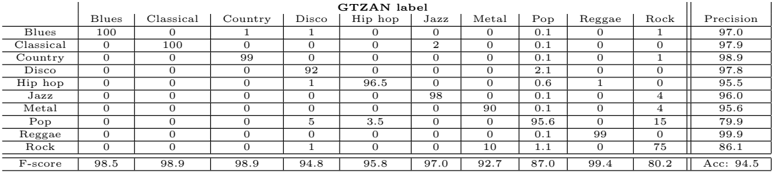
The image presents a confusion matrix comparing predicted music genre classifications (rows) against ground truth labels (columns) for the GTZAN dataset. The matrix includes precision metrics for each genre and an overall accuracy score of 94.5%. The data reveals classification performance across 11 music genres with notable variations in precision scores.
### Components/Axes
- **Rows**: Predicted genre classifications (Blues, Classical, Country, Disco, Hip hop, Jazz, Metal, Pop, Reggae, Rock)
- **Columns**: Ground truth genre labels (Blues, Classical, Country, Disco, Hip hop, Jazz, Metal, Pop, Reggae, Rock)
- **Final Column**: Precision scores for each predicted genre
- **Bottom Row**: F-scores for each genre (average of precision and recall)
- **Accuracy**: 94.5% (bottom-right corner)
### Detailed Analysis
1. **Class-Specific Performance**:
- **Blues**: Perfect self-classification (100) with minor errors (1 in Country, 1 in Disco, 1 in Rock). Precision: 97.0%
- **Classical**: Dominant self-classification (100) with 2 errors in Jazz. Precision: 97.9%
- **Country**: Strong self-classification (99) with 1 error in Rock. Precision: 98.9%
- **Disco**: High self-classification (92) with 2 errors in Pop. Precision: 97.8%
- **Hip hop**: Dominant self-classification (96.5) with 1 error in Reggae. Precision: 95.5%
- **Jazz**: Strong self-classification (98) with 4 errors in Rock. Precision: 96.0%
- **Metal**: High self-classification (90) with 4 errors in Rock. Precision: 95.6%
- **Pop**: Poor self-classification (5) with 15 errors in Rock. Precision: 79.9%
- **Reggae**: Perfect self-classification (99) with 1 error in Hip hop. Precision: 99.9%
- **Rock**: Severe misclassification (75 errors) across all genres. Precision: 86.1%
2. **F-Score Trends**:
- Highest F-score: Reggae (99.4)
- Lowest F-score: Pop (87.0)
- Rock shows significant underperformance (80.2 F-score)
3. **Accuracy Context**:
- Overall accuracy of 94.5% suggests strong general performance
- Discrepancy between high accuracy and low Rock precision indicates class imbalance
### Key Observations
1. **Pop Genre Anomaly**:
- Only 5 correct classifications out of 24 total predictions (21% accuracy)
- 15 misclassifications as Rock (62.5% of errors)
- Lowest precision (79.9%) and F-score (87.0)
2. **Rock Genre Challenges**:
- 75 total misclassifications (31.3% of all errors)
- High error rates from all other genres (4-15 instances each)
- Lowest precision (86.1%) despite being the most frequent misclassification target
3. **Class Imbalance**:
- Rock appears to be the most frequent genre in the dataset (75 instances)
- Other genres show better self-classification despite lower absolute counts
### Interpretation
This confusion matrix reveals a machine learning model trained on the GTZAN dataset with strong overall performance (94.5% accuracy) but significant challenges with specific genres. The Pop genre demonstrates particularly poor classification (79.9% precision), likely due to overlapping characteristics with Rock. The Rock genre's high error rate (75 misclassifications) suggests either:
1. Dataset imbalance favoring Rock samples
2. Model bias toward Rock classification
3. Inherent acoustic similarities between Rock and other genres
The high F-scores for Reggae (99.4) and Blues (98.5) indicate these genres have distinct acoustic signatures that the model effectively distinguishes. The Jazz genre's 4 Rock misclassifications (4.1% of total errors) suggest potential confusion between complex rhythmic patterns in these genres.
The data implies opportunities for model improvement through:
- Balanced dataset curation
- Feature engineering emphasizing genre-specific acoustic markers
- Ensemble methods to reduce Rock/Pop classification errors