\n
## Diagram: Causal Reasoning & Hypothesis Evaluation
### Overview
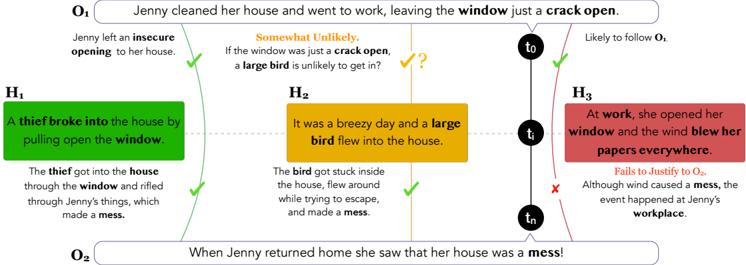
This diagram illustrates a causal reasoning process, evaluating different hypotheses (H1, H2, H3) to explain an observation (O2) given an initial condition (O1). It uses a timeline (t0, t1, t2) and visual cues (checkmarks, crosses, question marks) to indicate the likelihood and justification of each hypothesis.
### Components/Axes
The diagram consists of the following components:
* **O1 (Observation 1):** "Jenny cleaned her house and went to work, leaving the window just a crack open." – Located at the top center.
* **O2 (Observation 2):** "When Jenny returned home she saw that her house was a mess!" – Located at the bottom center.
* **H1 (Hypothesis 1):** A green box stating "A thief broke into the house by pulling open the window." with supporting text: "The thief got into the house through the window and rifled through Jenny’s things, which made a mess." – Located on the left side.
* **H2 (Hypothesis 2):** A yellow box stating "It was a breezy day and a large bird flew into the house." with supporting text: "The bird got stuck inside the house, flew around while trying to escape, and made a mess." – Located in the center.
* **H3 (Hypothesis 3):** A red box stating "At work, she opened her window and the wind blew her papers everywhere." with supporting text: "Although wind caused a mess, the event happened at Jenny’s workplace." – Located on the right side.
* **Timeline:** t0, t1, t2 – Representing sequential points in time. Located on the right side.
* **Arrows:** Connecting O1 to H1, H2, and H3, and connecting H1, H2, and H3 to O2. Arrows are colored to indicate likelihood (green = likely, red = unlikely, orange = somewhat unlikely).
* **Visual Cues:** Checkmarks (✓) indicate justification, crosses (✗) indicate failure to justify, and question marks (?) indicate uncertainty.
### Detailed Analysis or Content Details
* **O1 to H1:** A curved green arrow indicates that H1 is likely to follow from O1. A checkmark confirms justification.
* **O1 to H2:** A curved orange arrow indicates that H2 is "Somewhat Unlikely" to follow from O1. A question mark indicates uncertainty. The text above the question mark asks: "If the window was just a crack open, a large bird is unlikely to get in?".
* **O1 to H3:** A curved red arrow indicates that H3 is unlikely to follow from O1.
* **H1 to O2:** A green arrow from H1 to O2 with a checkmark indicates that H1 justifies O2.
* **H2 to O2:** A green arrow from H2 to O2 with a checkmark indicates that H2 justifies O2.
* **H3 to O2:** A red arrow from H3 to O2 with a cross indicates that H3 fails to justify O2. The text below the cross states: "Although wind caused a mess, the event happened at Jenny’s workplace."
* **Timeline Connections:**
* H1 is connected to t0 with a green arrow.
* H2 is connected to t1 with a green arrow.
* H3 is connected to t2 with a red arrow.
### Key Observations
* H1 and H2 are both considered plausible explanations for O2, given O1.
* H3 is deemed unlikely as it doesn't explain the mess at Jenny's *home*.
* The timeline suggests a sequence of events, with H1 occurring earliest (t0), followed by H2 (t1), and H3 latest (t2).
* The diagram emphasizes the importance of justification in evaluating hypotheses.
### Interpretation
This diagram demonstrates a process of abductive reasoning – inferring the best explanation for an observation. The diagram highlights that multiple hypotheses can be consistent with the available evidence (O1 and O2). The use of color-coded arrows and visual cues effectively communicates the degree of likelihood and justification for each hypothesis. The timeline suggests a possible order of events, but it's not necessarily a strict causal chain. The rejection of H3 is based on a spatial mismatch – the mess occurred at home, not at work. The diagram is a visual representation of a logical argument, illustrating how to evaluate competing explanations and arrive at the most plausible conclusion. The question mark above H2 indicates that the plausibility of a large bird entering through a small crack is being questioned, suggesting a need for further investigation or evidence.