## Diagram: LLM-Based Program Synthesis
### Overview
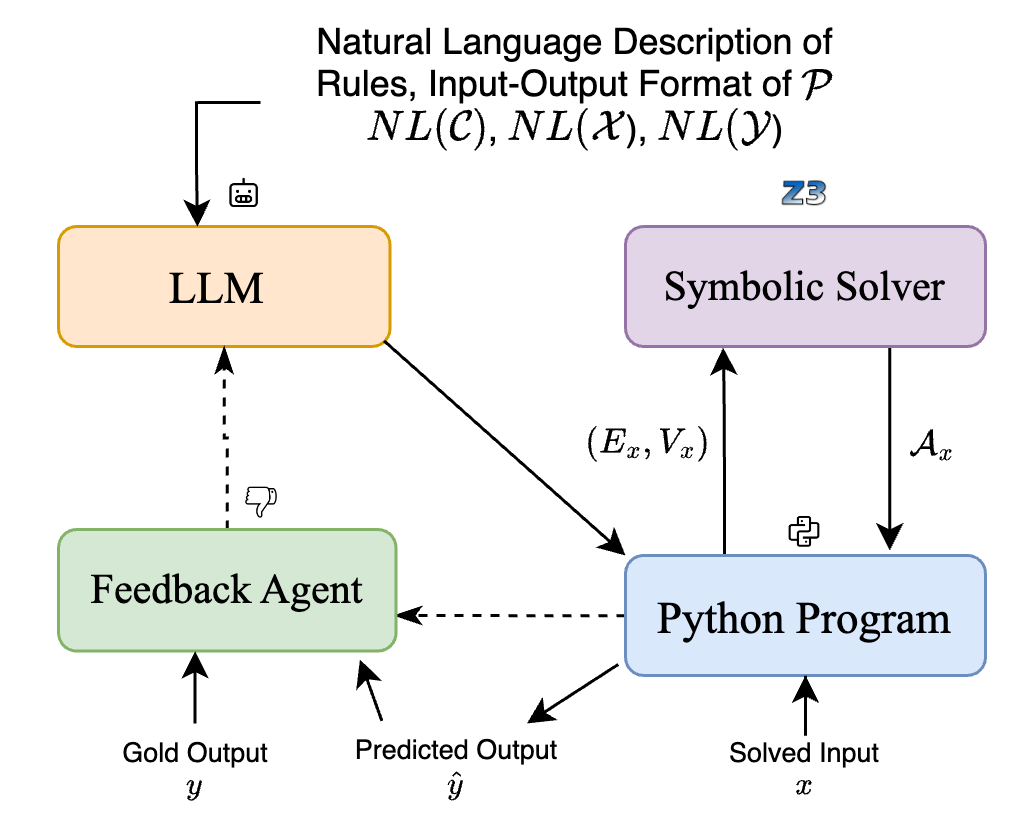
The image is a block diagram illustrating a system for program synthesis using a Large Language Model (LLM), a Symbolic Solver, a Feedback Agent, and a Python Program. The diagram shows the flow of information and interactions between these components.
### Components/Axes
* **Title:** Natural Language Description of Rules, Input-Output Format of P, NL(C), NL(X), NL(Y)
* **Components (from top to bottom, left to right):**
* LLM (Large Language Model): A yellow-orange rounded rectangle.
* Symbolic Solver: A light purple rounded rectangle with "Z3" above it.
* Feedback Agent: A light green rounded rectangle.
* Python Program: A light blue rounded rectangle with a Python logo above it.
* **Inputs/Outputs:**
* Gold Output: y
* Predicted Output: ŷ
* Solved Input: x
* **Arrows:** Arrows indicate the flow of information between components. Solid arrows indicate direct flow, while dashed arrows indicate feedback or less direct influence.
* **Annotations on Arrows:**
* (Ex, Vx): Annotation on the arrow from Python Program to Symbolic Solver.
* Ax: Annotation on the arrow from Symbolic Solver to Python Program.
* **Icons:**
* Robot icon above LLM.
* Thumbs down icon above Feedback Agent.
* Python logo above Python Program.
### Detailed Analysis
* **LLM (Large Language Model):**
* Receives input from an unspecified source (indicated by an arrow from above with a robot icon).
* Sends output to both the Python Program (solid arrow) and the Feedback Agent (dashed arrow).
* **Symbolic Solver:**
* Receives input (Ex, Vx) from the Python Program (solid arrow).
* Sends output Ax to the Python Program (solid arrow).
* **Feedback Agent:**
* Receives input from the LLM (dashed arrow).
* Receives "Gold Output" (y) from below (solid arrow).
* Receives "Predicted Output" (ŷ) from the Python Program (dashed arrow).
* Sends feedback to the LLM (dashed arrow).
* **Python Program:**
* Receives input from the LLM (solid arrow).
* Receives input Ax from the Symbolic Solver (solid arrow).
* Receives "Solved Input" (x) from below (solid arrow).
* Sends output (Ex, Vx) to the Symbolic Solver (solid arrow).
* Sends "Predicted Output" (ŷ) to the Feedback Agent (dashed arrow).
### Key Observations
* The LLM generates an initial program or solution.
* The Python Program interacts with the Symbolic Solver to refine the solution.
* The Feedback Agent compares the predicted output with the gold output and provides feedback to the LLM.
* The system appears to be an iterative process, with feedback loops between the components.
### Interpretation
The diagram illustrates a program synthesis system that leverages the strengths of both neural (LLM) and symbolic (Symbolic Solver) methods. The LLM provides an initial, potentially approximate, solution, while the Symbolic Solver provides a means to verify and refine the solution. The Feedback Agent acts as a critic, guiding the LLM towards better solutions based on a comparison with known correct outputs. The Python Program likely serves as an environment for executing and testing the generated code, as well as interfacing with the Symbolic Solver. The iterative nature of the system, with feedback loops, suggests a process of continuous improvement and refinement of the synthesized program. The use of natural language descriptions (NL(C), NL(X), NL(Y)) suggests that the system is designed to work with human-readable specifications.