\n
## Diagram: System Architecture for Program Synthesis with Feedback
### Overview
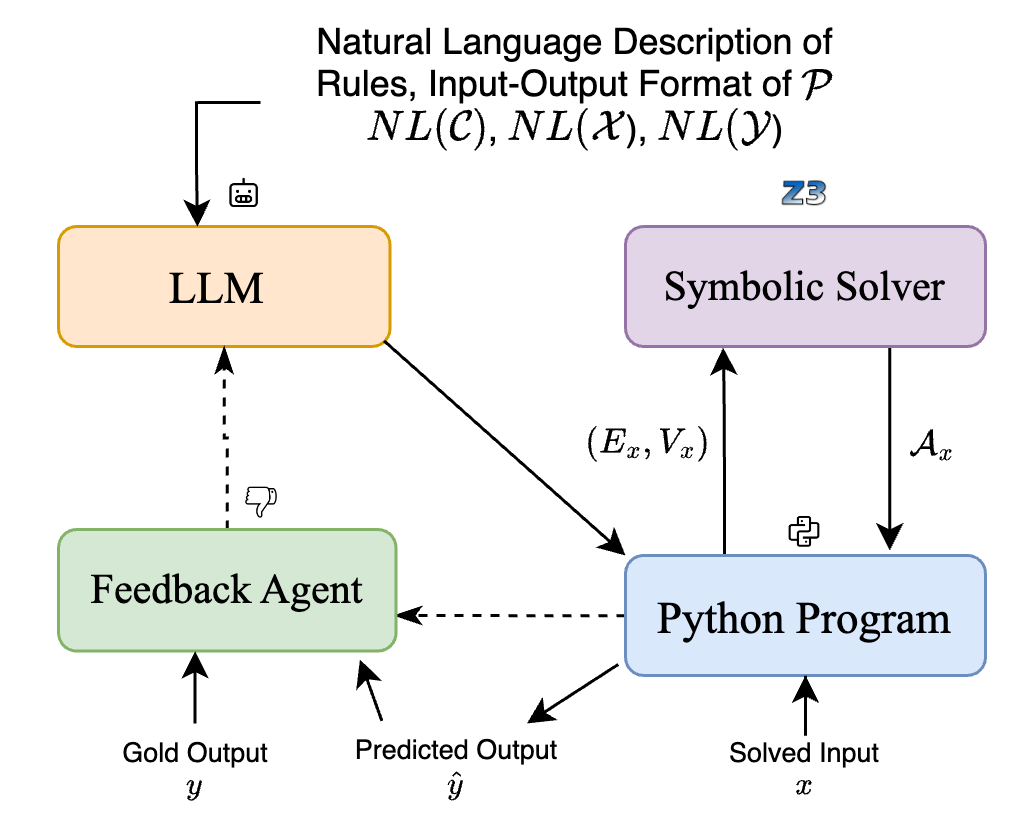
The image depicts a system architecture for program synthesis, involving a Large Language Model (LLM), a Symbolic Solver, a Python Program, and a Feedback Agent. The diagram illustrates the flow of information and interactions between these components to generate and refine programs based on natural language descriptions.
### Components/Axes
The diagram consists of four main components, each represented by a rounded rectangle:
* **LLM (Large Language Model):** Yellow, positioned in the top-left.
* **Symbolic Solver:** Purple, positioned in the top-right, with a "Z3" label.
* **Python Program:** Blue, positioned in the bottom-right, with a small wrench icon.
* **Feedback Agent:** Green, positioned in the bottom-left, with a thumbs-down icon.
The diagram also includes text labels describing the inputs and outputs of the system:
* **Natural Language Description of Rules, Input-Output Format of P:** Located at the top center. The formula `NL(C), NL(x), NL(y)` is also present.
* **(E<sub>x</sub>, V<sub>x</sub>):** Labeling the arrow from the Symbolic Solver to the Python Program.
* **A<sub>x</sub>:** Labeling the arrow from the Symbolic Solver.
* **x:** Labeling the arrow to the Python Program.
* **y:** Labeling the arrow from the Feedback Agent.
* **ŷ:** Labeling the arrow from the Feedback Agent.
Arrows indicate the direction of information flow. Solid arrows represent direct data transfer, while dashed arrows represent feedback loops.
### Detailed Analysis or Content Details
The diagram shows the following information flow:
1. **LLM Input:** The LLM receives a natural language description of rules and input-output format, represented as `NL(C), NL(x), NL(y)`.
2. **LLM to Symbolic Solver:** The LLM sends information to the Symbolic Solver.
3. **Symbolic Solver Output:** The Symbolic Solver generates a solution, represented as `(E<sub>x</sub>, V<sub>x</sub>)`, and sends it to the Python Program. It also outputs `A<sub>x</sub>`.
4. **Python Program Input:** The Python Program receives the solved input `x`.
5. **Python Program Output:** The Python Program generates a predicted output `ŷ`.
6. **Feedback Agent Input:** The Feedback Agent receives both the predicted output `ŷ` and the gold output `y`.
7. **Feedback Agent to LLM:** The Feedback Agent provides feedback to the LLM, indicated by a dashed arrow with a thumbs-down icon.
8. **Feedback Agent to Python Program:** The Feedback Agent also provides feedback to the Python Program, indicated by a dashed arrow.
### Key Observations
The diagram highlights a closed-loop system where the LLM generates a program, the Symbolic Solver refines it, the Python Program executes it, and the Feedback Agent evaluates the results, providing feedback to improve the program. The use of both solid and dashed arrows indicates a combination of direct data flow and iterative refinement. The inclusion of "Z3" suggests the use of a specific symbolic solver.
### Interpretation
This diagram illustrates a sophisticated program synthesis pipeline. The LLM acts as the initial program generator, leveraging natural language understanding. The Symbolic Solver likely performs formal verification or optimization of the generated program. The Python Program provides a concrete execution environment. The Feedback Agent is crucial for iterative improvement, comparing the program's output to a desired output and guiding the LLM towards a correct solution. The dashed arrows indicate a reinforcement learning or iterative refinement process. The system aims to bridge the gap between natural language specifications and executable code, potentially automating the programming process. The presence of both `x` and `ŷ` suggests a comparison between the solved input and the predicted output, which is the basis for the feedback loop. The diagram suggests a system designed for high accuracy and robustness in program generation.