## Flowchart: Hybrid System Architecture for Natural Language Processing and Symbolic Reasoning
### Overview
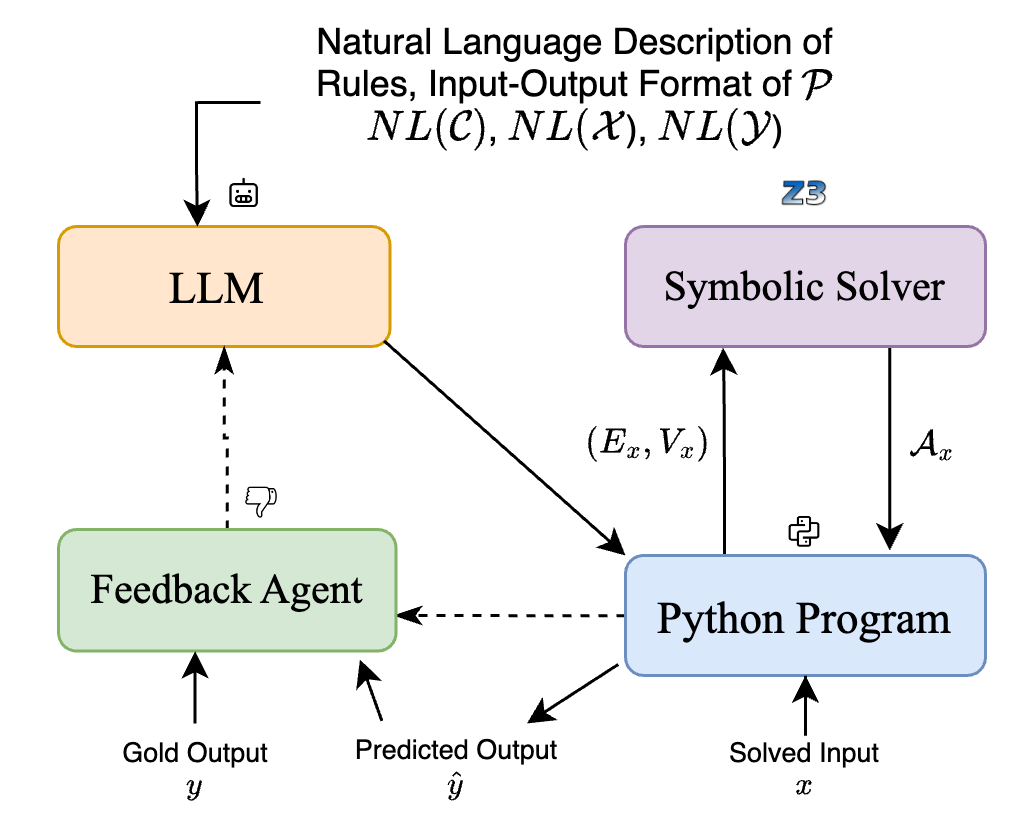
The diagram illustrates a hybrid computational system integrating machine learning (LLM) with symbolic reasoning (Symbolic Solver). It depicts data flow between four core components: LLM, Feedback Agent, Python Program, and Symbolic Solver, with explicit labels for inputs, outputs, and intermediate variables.
### Components/Axes
1. **Title**: "Natural Language Description of Rules, Input-Output Format of P" with subcomponents:
- `NL(C)`: Natural Language description of rules
- `NL(X)`: Input format
- `NL(Y)`: Output format
2. **Core Components**:
- **LLM** (Orange block): Receives natural language input and produces predicted outputs
- **Feedback Agent** (Green block): Compares predicted outputs (`ŷ`) with gold standard outputs (`y`)
- **Python Program** (Blue block): Processes inputs (`x`) and interfaces with the Symbolic Solver
- **Symbolic Solver** (Purple block): Executes symbolic reasoning with inputs (`E_x, V_x`) and outputs (`A_x`)
3. **Data Flow**:
- Arrows indicate directional relationships:
- `LLM → Feedback Agent`: Predicted Output (`ŷ`)
- `Feedback Agent → LLM`: Feedback signal (dashed line)
- `LLM → Python Program`: Solved Input (`x`)
- `Python Program → Symbolic Solver`: `(E_x, V_x)`
- `Symbolic Solver → Python Program`: `A_x`
### Detailed Analysis
- **LLM**:
- Receives natural language input (`NL(C), NL(X), NL(Y)`)
- Generates predicted outputs (`ŷ`) for the Feedback Agent
- Provides solved inputs (`x`) to the Python Program
- **Feedback Agent**:
- Compares `ŷ` (predicted) with `y` (gold standard)
- Sends feedback to LLM via dashed line (likely error correction signals)
- **Python Program**:
- Acts as intermediary between LLM and Symbolic Solver
- Processes `x` into `(E_x, V_x)` for symbolic reasoning
- Receives `A_x` (action/result) from Symbolic Solver
- **Symbolic Solver**:
- Executes rule-based logic using `(E_x, V_x)`
- Outputs `A_x` (likely actions or formalized results)
### Key Observations
1. **Feedback Loop**: The dashed line between Feedback Agent and LLM suggests iterative refinement of LLM outputs.
2. **Hybrid Architecture**: Combines statistical learning (LLM) with formal symbolic reasoning (Symbolic Solver).
3. **Data Transformation**: Python Program mediates between natural language processing and symbolic computation.
4. **Variable Notation**:
- `E_x, V_x`: Likely represent encoded input variables
- `A_x`: Action/result output from symbolic reasoning
### Interpretation
This architecture demonstrates a **neuro-symbolic AI system** where:
- The LLM handles pattern recognition and prediction
- The Feedback Agent ensures alignment with ground truth
- The Python Program serves as a computational bridge
- The Symbolic Solver enforces rule-based constraints
The system likely addresses challenges in:
1. **Explainability**: Symbolic Solver provides formal reasoning traces
2. **Robustness**: Feedback loop mitigates LLM hallucinations
3. **Generalization**: Python Program adapts outputs to formal systems
The absence of explicit numerical values suggests this is a conceptual architecture rather than an empirical study. The bidirectional flow between LLM and Feedback Agent implies continuous model improvement, while the Symbolic Solver's role indicates domain-specific constraint enforcement.