## Diagram: AI Purchase Likelihood Prediction Process
### Overview
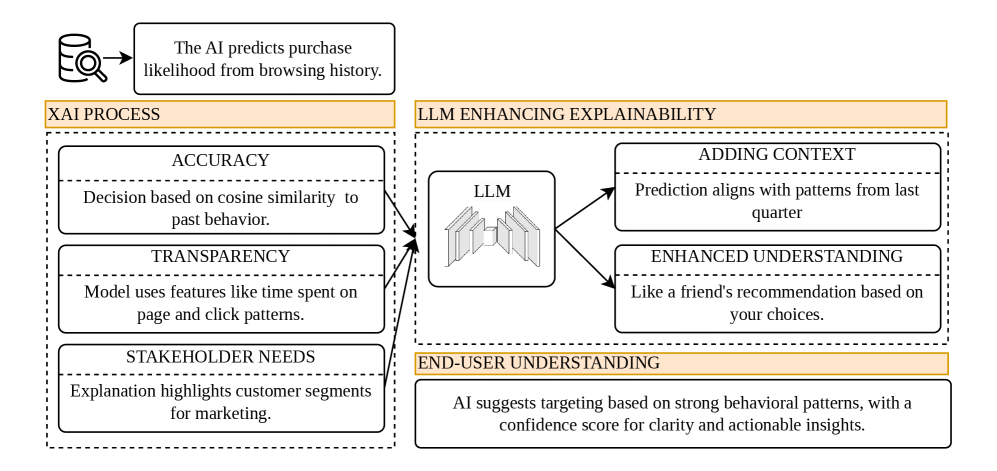
The image is a diagram illustrating how an AI system predicts purchase likelihood from browsing history, enhanced by Explainable AI (XAI) and Large Language Models (LLM) to improve explainability and end-user understanding. The diagram outlines the process from initial data input to the final output of actionable insights.
### Components/Axes
* **Top:** A database icon with a magnifying glass pointing to a text box that reads: "The AI predicts purchase likelihood from browsing history."
* **Left:** "XAI PROCESS" - This section focuses on the explainability of the AI model.
* "ACCURACY": "Decision based on cosine similarity to past behavior."
* "TRANSPARENCY": "Model uses features like time spent on page and click patterns."
* "STAKEHOLDER NEEDS": "Explanation highlights customer segments for marketing."
* **Center:** "LLM ENHANCING EXPLAINABILITY" - This section shows the role of LLMs in enhancing the explainability of the AI model.
* "LLM": A visual representation of a neural network.
* **Right:** This section shows the outputs of the LLM.
* "ADDING CONTEXT": "Prediction aligns with patterns from last quarter."
* "ENHANCED UNDERSTANDING": "Like a friend's recommendation based on your choices."
* **Bottom:** "END-USER UNDERSTANDING" - This section describes the final output for the end-user.
* "AI suggests targeting based on strong behavioral patterns, with a confidence score for clarity and actionable insights."
### Detailed Analysis or Content Details
The diagram is structured as a flow, starting with data input (browsing history) and moving through the XAI process and LLM enhancement to the final end-user understanding.
* **XAI Process:**
* **Accuracy:** The AI's decision-making is based on cosine similarity to past behavior, suggesting a method of comparing current browsing patterns to historical data to predict purchase likelihood.
* **Transparency:** The model uses features like time spent on a page and click patterns, indicating that these metrics are key indicators in predicting purchase likelihood.
* **Stakeholder Needs:** The explanation provided highlights customer segments for marketing, suggesting that the AI's insights are used to target specific groups with tailored marketing strategies.
* **LLM Enhancement:**
* The LLM takes the output from the XAI process and enhances its explainability.
* **Adding Context:** The LLM adds context by aligning predictions with patterns from the last quarter, providing a temporal dimension to the predictions.
* **Enhanced Understanding:** The LLM enhances understanding by providing explanations that are similar to a friend's recommendation, making the AI's predictions more relatable and understandable.
* **End-User Understanding:**
* The AI suggests targeting based on strong behavioral patterns, with a confidence score for clarity and actionable insights. This indicates that the final output is a set of actionable recommendations for marketers, along with a measure of confidence in those recommendations.
### Key Observations
* The diagram emphasizes the importance of explainability in AI systems, particularly in the context of predicting purchase likelihood.
* The use of LLMs to enhance explainability is a key feature of the system, making the AI's predictions more understandable and actionable.
* The diagram highlights the importance of both accuracy and transparency in AI systems, as well as the need to tailor explanations to the needs of stakeholders.
### Interpretation
The diagram illustrates a process where AI predicts purchase likelihood, but importantly, it also focuses on making those predictions understandable and actionable. The XAI process ensures that the AI's decisions are based on sound principles (accuracy), that the factors influencing those decisions are transparent, and that the explanations are tailored to the needs of stakeholders. The LLM further enhances explainability by adding context and providing explanations that are easy to understand. The final output is a set of actionable recommendations for marketers, along with a confidence score, which helps them make informed decisions. This approach is valuable because it not only provides predictions but also builds trust and understanding in the AI system, which is essential for its adoption and effective use.