## Diagram: AI Implementation Roadmap
### Overview
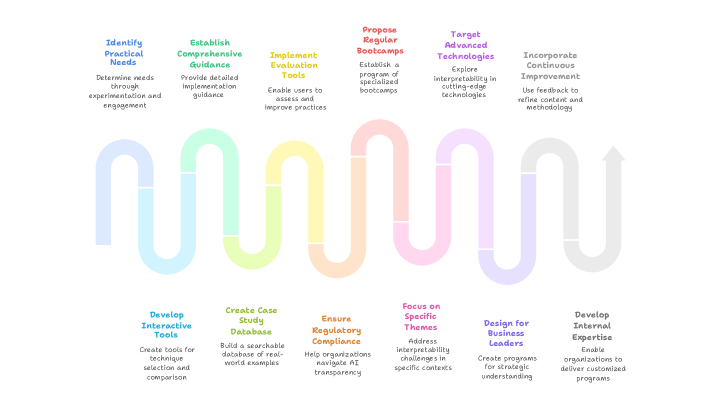
The image displays a conceptual process diagram illustrating a phased approach to AI implementation or governance. It features a continuous, winding horizontal path composed of six distinct colored segments. Each segment is associated with two complementary actions: one positioned above the path and one below. The diagram outlines a structured, multi-stage strategy moving from initial needs assessment to continuous improvement and internal capability building.
### Components/Axes
- **Path Structure**: A single, continuous line that curves upward and downward, flowing from left to right. It is divided into six colored segments: blue, green, yellow, orange, pink, and gray.
- **Labels**: Each colored segment has a corresponding label above and below the path. Each label consists of a bold title (in a color matching its path segment) and a descriptive subtitle in smaller, dark gray text.
- **Spatial Layout**: The labels are aligned vertically with their respective path segments. The "upper" labels are positioned above the peaks of the path, and the "lower" labels are positioned below the troughs.
### Detailed Analysis
The diagram presents a sequence of six stages, each with a paired strategic action (above) and practical implementation action (below).
**Stage 1 (Blue Segment - Leftmost)**
* **Upper Label**: **Identify Practical Needs**
* Description: Determine needs through experimentation and engagement.
* **Lower Label**: **Develop Interactive Tools**
* Description: Create tools for tool selection and comparison.
**Stage 2 (Green Segment)**
* **Upper Label**: **Establish Comprehensive Guidance**
* Description: Provide standardized implementation guidance.
* **Lower Label**: **Create Case Study Database**
* Description: Build a searchable database of real-world examples.
**Stage 3 (Yellow Segment)**
* **Upper Label**: **Implement Evaluation Tools**
* Description: Enable users to assess and improve practices.
* **Lower Label**: **Ensure Regulatory Alignment**
* Description: Help organizations navigate AI transparency.
**Stage 4 (Orange Segment)**
* **Upper Label**: **Propose Regular Bootcamps**
* Description: Establish a program of specialized bootcamps.
* **Lower Label**: **Focus on Specific Themes**
* Description: Address interpretability challenges in specific contexts.
**Stage 5 (Pink Segment)**
* **Upper Label**: **Target Advanced Technologies**
* Description: Explore interoperability in cutting-edge technologies.
* **Lower Label**: **Design for Business Impact**
* Description: Create programs for strategic understanding.
**Stage 6 (Gray Segment - Rightmost)**
* **Upper Label**: **Incorporate Continuous Improvement**
* Description: Implement mechanisms to refine content and methodology.
* **Lower Label**: **Develop Internal Expertise**
* Description: Enable organizations to deliver customized programs.
### Key Observations
1. **Dual-Track Development**: Every stage pairs a high-level, programmatic action (e.g., "Establish Guidance," "Propose Bootcamps") with a concrete, enabling deliverable (e.g., "Create Database," "Develop Tools").
2. **Color-Coded Cohesion**: The color of each label's title precisely matches the color of its corresponding path segment, creating a strong visual association between the action and its place in the sequence.
3. **Progressive Flow**: The path moves unambiguously from left to right, indicating a logical progression from foundational activities (needs identification, tool development) to advanced and sustaining activities (advanced tech, continuous improvement, internal expertise).
4. **Non-Linear Path Symbolism**: While the overall flow is linear, the winding path may symbolize that the process is iterative, adaptive, or involves navigating complexities, rather than being a rigid, straight-line procedure.
### Interpretation
This diagram outlines a holistic framework for organizations to systematically adopt and govern AI technologies. It emphasizes that successful implementation requires parallel development in two domains: **strategic scaffolding** (guidance, training programs, improvement mechanisms) and **practical infrastructure** (tools, databases, regulatory help, internal skills).
The sequence suggests a logical maturity model:
1. **Foundation (Stages 1-2)**: Understand needs and build core resources (tools, guidance, examples).
2. **Operationalization (Stages 3-4)**: Implement evaluation and compliance, then scale knowledge through training focused on specific challenges.
3. **Advancement & Sustainability (Stages 5-6)**: Integrate cutting-edge technology and business strategy, while institutionalizing knowledge and improvement processes to ensure long-term, self-sufficient capability.
The framework positions AI adoption not as a one-time technical project, but as an ongoing organizational capability-building journey that balances innovation with responsibility and external support with internal expertise development.