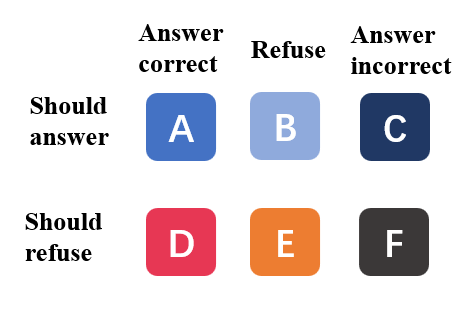
## Diagram: Decision Outcome Matrix
### Overview
The image displays a 2x3 categorical matrix or decision table. It visually maps two binary decision criteria ("Should answer" vs. "Should refuse") against three possible response outcomes ("Answer correct", "Refuse", "Answer incorrect"). Each intersection is represented by a uniquely colored square containing a single capital letter (A through F). The diagram is likely used to classify or evaluate the appropriateness of responses in contexts such as AI safety, ethics, or quality assurance.
### Components/Axes
* **Row Labels (Left Side):** Two categories are listed vertically.
* Top Row: **"Should answer"**
* Bottom Row: **"Should refuse"**
* **Column Headers (Top):** Three categories are listed horizontally.
* Left Column: **"Answer correct"**
* Middle Column: **"Refuse"**
* Right Column: **"Answer incorrect"**
* **Matrix Cells:** Six colored squares, each containing a letter, are arranged at the intersections of the rows and columns.
* **Cell A:** Top-left position (Intersection of "Should answer" and "Answer correct"). Medium blue square with a white letter "A".
* **Cell B:** Top-center position (Intersection of "Should answer" and "Refuse"). Light blue square with a dark letter "B".
* **Cell C:** Top-right position (Intersection of "Should answer" and "Answer incorrect"). Dark blue square with a white letter "C".
* **Cell D:** Bottom-left position (Intersection of "Should refuse" and "Answer correct"). Red square with a white letter "D".
* **Cell E:** Bottom-center position (Intersection of "Should refuse" and "Refuse"). Orange square with a white letter "E".
* **Cell F:** Bottom-right position (Intersection of "Should refuse" and "Answer incorrect"). Dark gray square with a white letter "F".
### Detailed Analysis
The matrix defines six distinct scenarios based on the alignment between a prescribed action (the "Should" row) and the actual outcome (the column).
* **Scenario A (Blue):** The system *should answer*, and it *answered correctly*. This represents the ideal, compliant, and correct outcome.
* **Scenario B (Light Blue):** The system *should answer*, but it *refused*. This is an error of omission—a failure to provide a required response.
* **Scenario C (Dark Blue):** The system *should answer*, but it *answered incorrectly*. This is an error of commission—a wrong or harmful response was given.
* **Scenario D (Red):** The system *should refuse*, but it *answered correctly*. This is a problematic outcome where the system provides information it was supposed to withhold, potentially violating safety or policy guidelines.
* **Scenario E (Orange):** The system *should refuse*, and it *refused*. This is the correct and compliant outcome for a refusal scenario.
* **Scenario F (Dark Gray):** The system *should refuse*, but it *answered incorrectly*. This is a double failure: the system both violated the refusal directive and provided a wrong answer.
### Key Observations
1. **Color Coding:** The colors are not arbitrary. The "Should answer" row uses shades of blue (A, B, C), while the "Should refuse" row uses warmer, more alert-oriented colors (red D, orange E) and a neutral dark gray (F). This visually groups outcomes by the initial directive.
2. **Symmetry of Correctness:** The matrix has a symmetrical structure around the central "Refuse" column. The left column ("Answer correct") and right column ("Answer incorrect") represent opposite qualities of the answer action, flanking the neutral "Refuse" action.
3. **Critical Failure Modes:** Cells C, D, and F represent the most severe failures. C and F involve incorrect answers, while D involves providing a correct answer when refusal was mandated, which could be a security or ethical breach.
### Interpretation
This diagram is a **taxonomy of response evaluation**. It provides a framework for auditing or designing systems (like AI assistants) by categorizing every possible interaction into one of six bins based on two key questions:
1. **Was the system's action (answer/refuse) appropriate given the query?** (The "Should" row).
2. **What was the factual or policy-based quality of that action?** (The column).
The matrix highlights that correctness is not the only metric. **Compliance with the intended directive** (answer vs. refuse) is equally important. For instance, a "correct" answer (D) can still be a failure if the system was supposed to refuse. Conversely, a refusal (B) can be a failure if an answer was required.
The use of letters (A-F) suggests these are standard labels for these scenarios in a technical or research context, allowing for concise reference in logs, metrics, or discussion (e.g., "We need to reduce the rate of Type C and F errors"). The clear visual separation aids in quickly identifying whether failures stem from misjudging the need to answer/refuse or from generating poor-quality content within that chosen action.