## Histogram: Length of Reasoning Chains in Tokens, Garden Path vs. non-Garden Path
### Overview
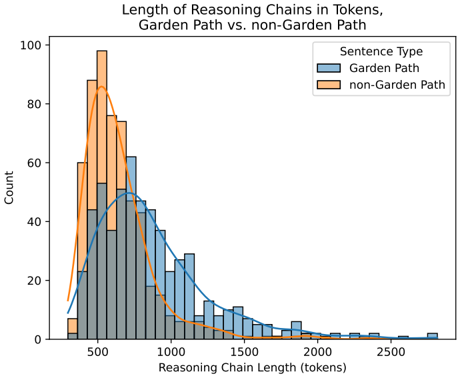
The image is a histogram comparing the distribution of reasoning chain lengths (in tokens) for two sentence types: "Garden Path" (blue) and "non-Garden Path" (orange). The x-axis represents reasoning chain length (tokens), and the y-axis represents the count of occurrences. Overlaid KDE (Kernel Density Estimation) curves approximate the distributions for both categories.
### Components/Axes
- **Title**: "Length of Reasoning Chains in Tokens, Garden Path vs. non-Garden Path" (top center).
- **X-axis**: "Reasoning Chain Length (tokens)" with approximate range 0–2500 tokens.
- **Y-axis**: "Count" with approximate range 0–100.
- **Legend**: Located in the top-right corner, labeled:
- "Garden Path" (blue).
- "non-Garden Path" (orange).
- **Data Series**:
- **Garden Path**: Blue bars and KDE curve.
- "non-Garden Path": Orange bars and KDE curve.
### Detailed Analysis
1. **non-Garden Path (Orange)**:
- **Peak**: Highest count (~100) at ~500 tokens.
- **Distribution**: Sharp decline after 500 tokens, with minimal counts beyond 1000 tokens.
- **KDE Curve**: Narrow, concentrated peak around 500 tokens.
2. **Garden Path (Blue)**:
- **Peak**: Highest count (~80) at ~600 tokens.
- **Distribution**: Gradual decline after 600 tokens, with counts extending to ~2500 tokens (though very low).
- **KDE Curve**: Broader, flatter peak compared to non-Garden Path, indicating a wider spread of chain lengths.
### Key Observations
- **non-Garden Path** sentences cluster tightly around shorter chain lengths (~500 tokens), suggesting concise reasoning.
- **Garden Path** sentences exhibit longer average chain lengths (~600 tokens) with a more dispersed distribution, indicating variability in reasoning complexity.
- Both distributions decay exponentially, but Garden Path retains non-zero counts at extreme lengths (up to 2500 tokens), while non-Garden Path drops to near-zero beyond 1000 tokens.
- The KDE curves confirm the visual trends: non-Garden Path is unimodal and narrow, while Garden Path is broader and multimodal.
### Interpretation
The data suggests that **Garden Path sentences** require longer and more variable reasoning chains compared to **non-Garden Path sentences**. This could reflect structural complexity in Garden Path sentences (e.g., ambiguous phrasing requiring backtracking), whereas non-Garden Path sentences are more direct. The extended tail in Garden Path chains may indicate outliers or sentences with unusually elaborate reasoning. The KDE curves reinforce these patterns, highlighting the distinct distributional characteristics of each sentence type.