## Venn Diagram: Comparison of Knowledge Graphs (KGs) and Large Language Models (LLMs)
### Overview
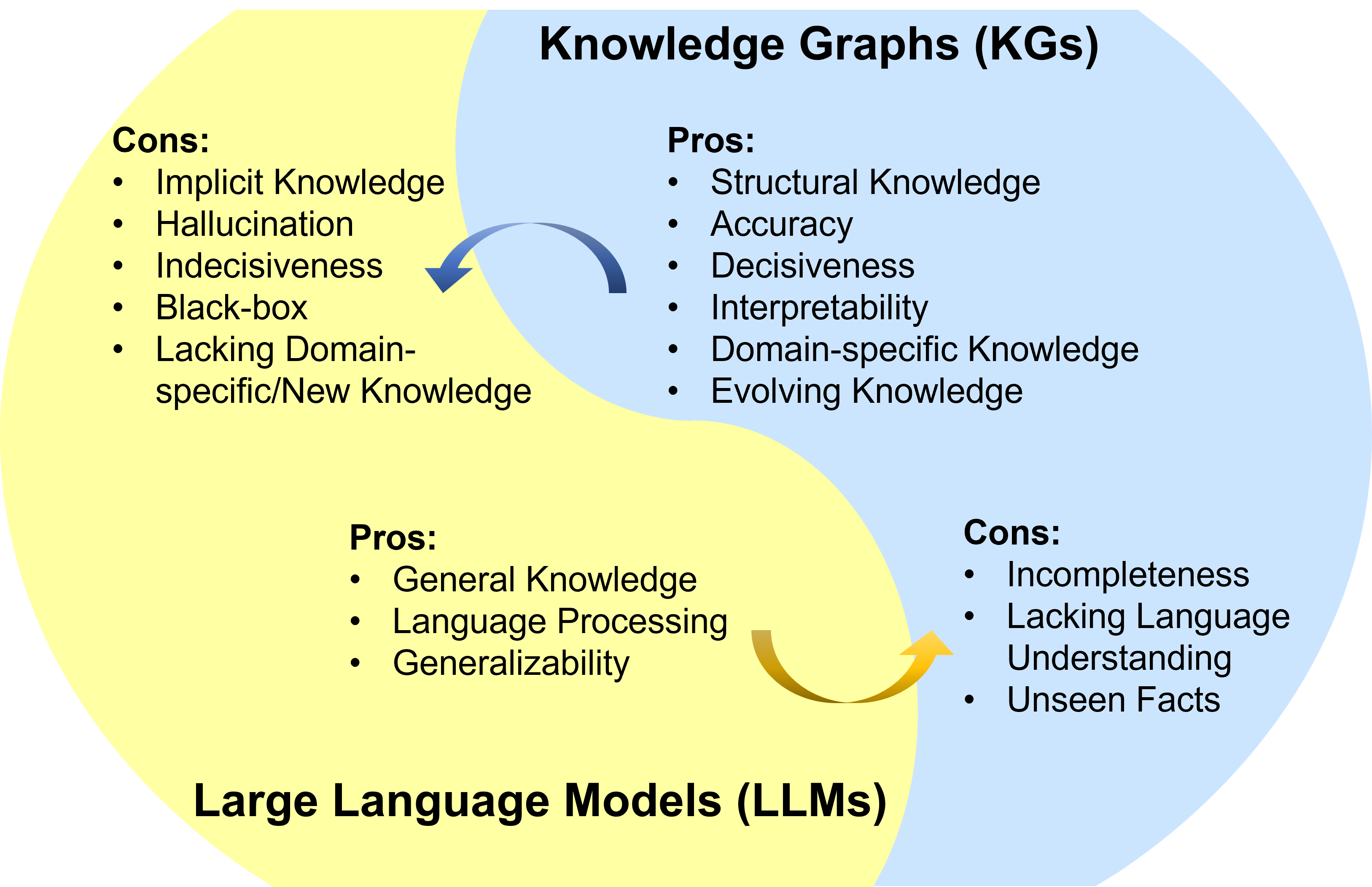
The image is a Venn diagram comparing the **pros** and **cons** of **Knowledge Graphs (KGs)** and **Large Language Models (LLMs)**. Two overlapping circles represent the two technologies, with shared and unique attributes.
### Components/Axes
- **Left Circle (KGs)**:
- **Pros**: Structural Knowledge, Accuracy, Decisiveness, Interpretability, Domain-specific Knowledge, Evolving Knowledge.
- **Cons**: Implicit Knowledge, Hallucination, Indecisiveness, Black-box, Lacking Domain-specific/New Knowledge.
- **Right Circle (LLMs)**:
- **Pros**: General Knowledge, Language Processing, Generalizability.
- **Cons**: Incompleteness, Lacking Language Understanding, Unseen Facts.
- **Overlap (Shared Space)**:
- Arrows indicate bidirectional relationships:
- A **blue arrow** points from KGs to LLMs, labeled "Domain-specific/New Knowledge."
- A **yellow arrow** points from LLMs to KGs, labeled "General Knowledge."
### Detailed Analysis
- **KGs Pros**:
- Focus on structured, accurate, and interpretable knowledge.
- Evolving knowledge implies dynamic updates.
- **KGs Cons**:
- Hallucination and black-box nature suggest reliability issues.
- Lacking domain-specific knowledge highlights gaps in specialization.
- **LLMs Pros**:
- Strengths in general knowledge and language processing.
- Generalizability indicates adaptability across tasks.
- **LLMs Cons**:
- Incompleteness and unseen facts point to knowledge gaps.
- Lacking language understanding suggests limitations in nuanced comprehension.
### Key Observations
1. **Complementary Relationships**:
- KGs provide structured, domain-specific knowledge to address LLMs' incompleteness.
- LLMs offer general knowledge and language processing to mitigate KGs' black-box limitations.
2. **Trade-offs**:
- KGs excel in accuracy and interpretability but struggle with new/implicit knowledge.
- LLMs handle broad language tasks but lack precision and domain specificity.
3. **Bidirectional Arrows**:
- Highlight interdependence: KGs supply domain-specific data to LLMs, while LLMs generalize knowledge for KGs.
### Interpretation
The diagram illustrates a **symbiotic relationship** between KGs and LLMs:
- **KGs** act as a **structured foundation**, ensuring accuracy and domain specificity but requiring external input (e.g., LLMs) for adaptability.
- **LLMs** provide **broad, general knowledge** and language fluency but rely on KGs to ground outputs in verified facts.
- **Hallucination** (KGs) and **unseen facts** (LLMs) represent critical limitations that could be addressed through integration.
- The **evolving knowledge** of KGs and **generalizability** of LLMs suggest potential for hybrid systems that combine structured reasoning with flexible language understanding.
This analysis underscores the need for **collaborative frameworks** where KGs and LLMs compensate for each other’s weaknesses, enabling more robust AI systems.