\n
## Diagram: Foundation Model for Learning
### Overview
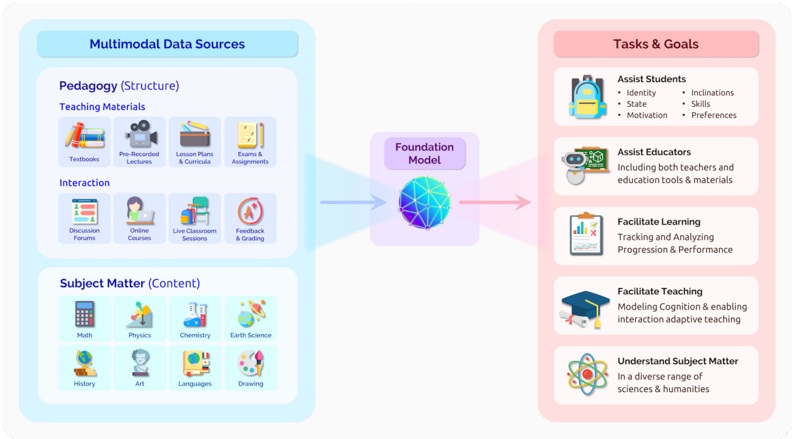
The image is a diagram illustrating a Foundation Model for learning, connecting Multimodal Data Sources to Tasks & Goals. The diagram is divided into three main sections: Multimodal Data Sources (Pedagogy & Subject Matter), a central "Foundation Model" component, and Tasks & Goals. Arrows indicate the flow of information from the data sources to the tasks.
### Components/Axes
The diagram consists of the following components:
* **Header:** "Multimodal Data Sources"
* **Left Section (Pedagogy - Structure):**
* "Teaching Materials"
* Icons representing: Textbooks, Pre-Recorded Lectures, Lesson Plans & Curricula, Exams & Assignments.
* "Interaction"
* Icons representing: Discussion Forums, Online Courses, Live Classroom Sessions, Feedback & Grading.
* **Bottom Section (Subject Matter - Content):**
* "Subject Matter (Content)"
* Icons representing: Math, Physics, Chemistry, Earth Science, History, Art, Languages, Drawing.
* **Center:** "Foundation Model" - depicted as a globe with interconnected nodes.
* **Right Section (Tasks & Goals):**
* "Tasks & Goals"
* Icons and text representing:
* Assist Students: Identity, Inclinations, State, Skills, Motivation, Preferences.
* Assist Educators: Including both teachers and education tools & materials.
* Facilitate Learning: Tracking and Analyzing Progression & Performance.
* Facilitate Teaching: Modeling Cognition & enabling interaction adaptive teaching.
* Understand Subject Matter: In a diverse range of sciences & humanities.
### Detailed Analysis or Content Details
The diagram illustrates a flow of information. The "Multimodal Data Sources" (Pedagogy and Subject Matter) feed into the "Foundation Model," which then outputs to the "Tasks & Goals."
* **Pedagogy (Structure):** This section focuses on how learning is structured, with teaching materials and interaction methods.
* **Subject Matter (Content):** This section represents the content being taught, covering a range of subjects from STEM fields (Math, Physics, Chemistry, Earth Science) to humanities (History, Art, Languages, Drawing).
* **Foundation Model:** The central component, depicted as a globe, suggests a comprehensive and interconnected system.
* **Tasks & Goals:** This section outlines the desired outcomes of the learning process, including assisting students and educators, facilitating learning and teaching, and understanding subject matter.
The "Assist Students" goal lists specific attributes to be understood: Identity, Inclinations, State, Skills, Motivation, and Preferences.
### Key Observations
The diagram emphasizes the integration of various data sources (pedagogy and subject matter) into a central "Foundation Model" to achieve a range of learning goals. The use of icons makes the diagram visually appealing and easy to understand. The flow of information is clearly indicated by the arrows. The diagram does not contain any numerical data or specific measurements.
### Interpretation
The diagram represents a conceptual framework for a learning system powered by a Foundation Model. The model aims to leverage multimodal data sources – both the structure of pedagogy and the content of various subjects – to achieve specific tasks and goals related to student and educator support, learning facilitation, and subject matter understanding. The Foundation Model acts as a central processing unit, integrating information from diverse sources to personalize and optimize the learning experience. The emphasis on understanding student attributes (Identity, Inclinations, etc.) suggests a focus on personalized learning. The diagram highlights the potential of a unified model to address multiple aspects of the learning process, from content delivery to performance tracking. The diagram is a high-level overview and does not provide details on the specific algorithms or technologies used within the Foundation Model.