## Diagram: Educational Framework Architecture
### Overview
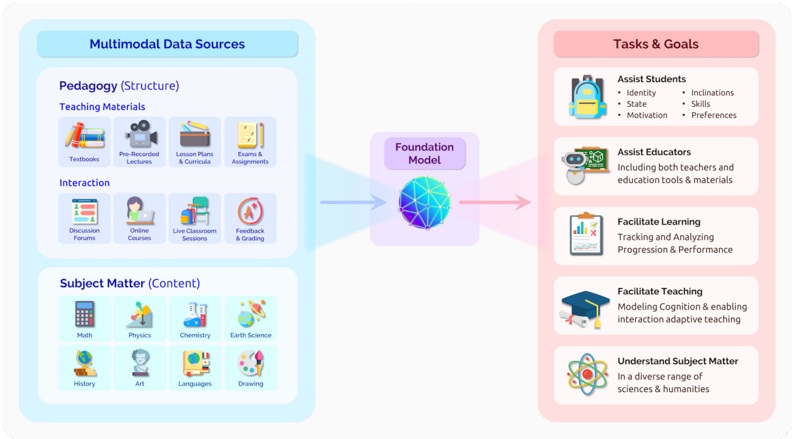
The diagram illustrates an educational framework architecture centered around a "Foundation Model" that integrates multimodal data sources to achieve specific educational tasks and goals. The system is divided into three primary components:
1. **Multimodal Data Sources** (left)
2. **Foundation Model** (center)
3. **Tasks & Goals** (right)
### Components/Axes
#### Left Section: Multimodal Data Sources
- **Pedagogy (Structure)**
- **Teaching Materials**: Textbooks, Pre-Recorded Lectures, Lesson Plans & Curricula, Exams & Assignments
- **Interaction**: Discussion Forums, Online Courses, Live Classroom Sessions, Feedback & Grading
- **Subject Matter (Content)**
- Math, Physics, Chemistry, Earth Science, History, Art, Languages, Drawing
#### Center: Foundation Model
- A stylized purple sphere with a network pattern, symbolizing an AI/ML model.
- Arrows indicate bidirectional flow:
- **Input**: Pedagogy (Structure) and Subject Matter (Content) → Foundation Model
- **Output**: Foundation Model → Tasks & Goals
#### Right Section: Tasks & Goals
- **Assist Students**: Identity, State, Skills, Motivation, Preferences
- **Assist Educators**: Tools & materials for teachers and education systems
- **Facilitate Learning**: Tracking and Analyzing Progression & Performance
- **Facilitate Teaching**: Modeling Cognition & enabling interaction adaptive teaching
- **Understand Subject Matter**: Diverse range of sciences & humanities
### Detailed Analysis
#### Pedagogy (Structure)
- **Teaching Materials** (4 items):
- Textbooks (book icon)
- Pre-Recorded Lectures (film reel icon)
- Lesson Plans & Curricula (notebook icon)
- Exams & Assignments (grading scale icon)
- **Interaction** (4 items):
- Discussion Forums (chat bubble icon)
- Online Courses (laptop icon)
- Live Classroom Sessions (video camera icon)
- Feedback & Grading (bell icon)
#### Subject Matter (Content)
- 8 categories represented by icons:
- Math (calculator), Physics (atom), Chemistry (beaker), Earth Science (globe), History (hourglass), Art (paint palette), Languages (speech bubble), Drawing (pencil).
#### Tasks & Goals
- **Assist Students** (backpack icon): Focus on personalization (identity, state, skills, motivation, preferences).
- **Assist Educators** (robot icon): Support for teachers and institutional tools.
- **Facilitate Learning** (chart icon): Data-driven tracking and performance analysis.
- **Facilitate Teaching** (graduation cap icon): Cognitive modeling and adaptive teaching strategies.
- **Understand Subject Matter** (atom + DNA helix icon): Holistic comprehension across disciplines.
### Key Observations
1. **Bidirectional Flow**: The Foundation Model processes inputs from both pedagogy and subject matter, suggesting a feedback loop between data ingestion and task execution.
2. **Holistic Design**: Tasks & Goals emphasize student-centered outcomes (e.g., motivation, preferences) alongside educator support and systemic analysis.
3. **Iconography**: Visual metaphors (e.g., atom for science, globe for Earth Science) reinforce domain-specific content.
### Interpretation
The framework positions the Foundation Model as a central hub that synthesizes structured pedagogical data (e.g., lesson plans, interaction logs) and subject-specific content (e.g., math, art) to drive adaptive educational outcomes. By explicitly linking inputs to goals like "Modeling Cognition" and "Analyzing Progression," the diagram underscores the model's role in enabling personalized, data-informed teaching. The inclusion of both student and educator assistance highlights a dual focus on learner engagement and institutional efficiency.
**Notable Pattern**: The absence of explicit technical details (e.g., algorithms, data pipelines) suggests the diagram prioritizes conceptual over implementation-level design.