## Directed Graph: System Flow Diagram
### Overview
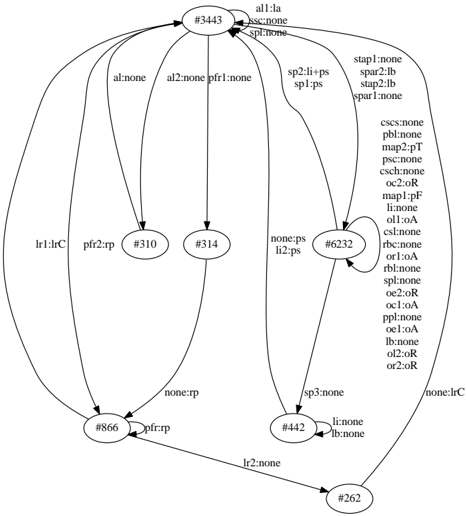
The image displays a directed graph, also known as a state diagram or flowchart, consisting of seven distinct nodes (represented as ellipses with numerical labels) and numerous directed edges connecting them. Each edge is labeled with a colon-separated string, indicating a transition, a relationship, or a condition between nodes. The graph illustrates a complex system with multiple pathways, branching logic, and self-loops, suggesting various states and transitions within a process or system architecture.
### Components/Axes
The diagram is composed solely of nodes and directed edges; it does not feature traditional axes, legends, or scales typically found in charts. All information is embedded within the node and edge labels.
**Nodes (Ellipses with numerical labels):**
* **#3443**: Positioned at the top-center of the diagram. This node appears to be a primary source or initial state, with multiple outgoing edges.
* **#310**: Positioned mid-left, directly below #3443.
* **#314**: Positioned mid-center, directly below #3443.
* **#6232**: Positioned mid-right, directly below #3443. This node is notable for having a large number of self-loops and associated labels.
* **#866**: Positioned at the bottom-left of the diagram.
* **#442**: Positioned at the bottom-center-right of the diagram.
* **#262**: Positioned at the bottom-right of the diagram. This node appears to be a terminal state, as it has no outgoing edges.
**Edges (Directed lines with textual labels):**
Each edge connects a source node to a destination node, with an arrow indicating the direction of flow. Each edge is annotated with a label, typically in the format `[identifier]:[value]` or `[identifier]:[identifier]+[identifier]`. These labels describe the nature of the transition or the condition under which it occurs.
### Detailed Analysis
**Node #3443 (Top-center):**
* **Self-loops (edges originating and terminating at #3443):**
* An edge loops back to #3443 with the label: `all:la`
* An edge loops back to #3443 with the label: `ssc:none`
* An edge loops back to #3443 with the label: `spl:none`
* **Outgoing Edges:**
* To #310 (down-left): `al:none`
* To #314 (down-center): `al2:none`
* To #314 (down-center): `pfr1:none`
* To #6232 (down-right): `sp2:li+ps`
* To #6232 (down-right): `sp1:ps`
* To #866 (long curved path down-left): `lr1:lrC`
* To #442 (long curved path down-right): `none:ps`
* To #442 (long curved path down-right): `li2:ps`
* To #262 (very long curved path down-right): `none:lrC`
**Node #310 (Mid-left):**
* **Incoming Edges:**
* From #3443: `al:none`
* **Outgoing Edges:**
* To #866 (down-left): `pfr2:rp`
**Node #314 (Mid-center):**
* **Incoming Edges:**
* From #3443: `al2:none`
* From #3443: `pfr1:none`
* **Outgoing Edges:**
* To #866 (down-left): `none:rp`
**Node #6232 (Mid-right):
* **Incoming Edges:**
* From #3443: `sp2:li+ps`
* From #3443: `sp1:ps`
* **Self-loops (edges originating and terminating at #6232):**
* An edge loops back to #6232 with the label: `stap1:none`
* An edge loops back to #6232 with the label: `spar2:lb`
* An edge loops back to #6232 with the label: `stap2:lb`
* An edge loops back to #6232 with the label: `spar1:none`
* A large block of text labels a self-loop to #6232, containing multiple colon-separated entries:
`cscs:none`
`pbl:none`
`map2:pT`
`psc:none`
`csch:none`
`oc2:oR`
`map1:pF`
`li:none`
`ol1:oA`
`csl:none`
`rbc:none`
`or1:oA`
`rbl:none`
`spl:none`
`oe2:oR`
`oc1:oA`
`ppl:none`
`oe1:oA`
`lb:none`
`ol2:oR`
`or2:oR`
* **Outgoing Edges:**
* To #442 (down-center): `sp3:none`
**Node #866 (Bottom-left):**
* **Incoming Edges:**
* From #3443: `lr1:lrC`
* From #310: `pfr2:rp`
* From #314: `none:rp`
* **Outgoing Edges:**
* To #442 (short curved path right): `pfr:rp`
**Node #442 (Bottom-center-right):**
* **Incoming Edges:**
* From #3443: `none:ps`
* From #3443: `li2:ps`
* From #6232: `sp3:none`
* From #866: `pfr:rp`
* **Self-loops (edges originating and terminating at #442):**
* An edge loops back to #442 with the label: `li:none`
* An edge loops back to #442 with the label: `lb:none`
* **Outgoing Edges:**
* To #262 (down-right): `lr2:none`
**Node #262 (Bottom-right):**
* **Incoming Edges:**
* From #3443: `none:lrC`
* From #442: `lr2:none`
* **Outgoing Edges:**
* No visible outgoing edges.
### Key Observations
* **Node #3443** serves as a highly connected initial or central node, initiating paths to all other nodes in the graph, including direct paths to #310, #314, #6232, #866, #442, and #262. It also has three self-loops.
* **Node #6232** exhibits the most complex internal behavior, indicated by a large number of self-loops and an extensive list of associated labels. This suggests a state with many internal operations, checks, or attributes that can change without necessarily transitioning to a different major node.
* The label `none` is a very common value in the second part of the edge labels (e.g., `al:none`, `ssc:none`, `sp3:none`, `li:none`), suggesting default conditions, null values, or unconditional transitions.
* Other recurring suffixes in edge labels include `la`, `lb`, `ps`, `rp`, `lrC`, `pT`, `oR`, `pF`, `oA`, which likely denote specific types of states, properties, or outcomes within the system.
* **Node #262** functions as a terminal node or a sink, as it has no outgoing edges. This implies it represents a final state, an endpoint, or a conclusion of a process.
* Multiple paths converge on nodes like #866 (from #3443, #310, #314) and #442 (from #3443, #6232, #866), indicating that these states can be reached through various preceding conditions or sequences.
* The label `sp2:li+ps` on an edge from #3443 to #6232 suggests a composite condition or a combination of attributes (`li` and `ps`) for that specific transition.
### Interpretation
This diagram is a representation of a system's behavior, likely a state machine, a process flow, or a dependency graph. Each numerically labeled ellipse (#3443, #310, etc.) represents a distinct state, a component, a module, or a stage within the system. The numerical labels are unique identifiers for these entities.
The directed edges signify transitions between these states or relationships between components. The labels on these edges provide critical context for understanding these transitions. For example, `al:none` might indicate an "action 'al' occurring without a specific parameter or condition," while `pfr2:rp` could mean "process 'pfr2' results in state 'rp'." The frequent appearance of `none` suggests either default transitions, the absence of a specific value, or conditions that are always met.
**Node #3443** appears to be an initial or central control state, from which various sub-processes or system branches originate. Its self-loops might represent internal initialization routines or minor state adjustments that don't change its fundamental role.
**Node #6232** is particularly complex, suggesting a state that involves extensive internal processing, validation, or a component with numerous configurable attributes. The detailed list of self-loop labels (e.g., `map2:pT`, `oc2:oR`, `ol1:oA`) could represent various internal functions, data mappings (e.g., `pT` for 'pass True', `pF` for 'pass False'), or output/error conditions (e.g., `oR` for 'output result', `oA` for 'output acknowledge').
**Nodes #310 and #314** act as intermediate steps or parallel sub-processes that diverge from #3443 and eventually lead to #866.
**Node #866** serves as a convergence point, indicating a state that can be reached through different preceding sequences, suggesting a common processing stage or a consolidated outcome.
**Node #442** also receives inputs from multiple sources and has its own self-loops, implying further processing or a stable state before the final transition.
**Node #262** is clearly a terminal state, representing the successful completion of a process, an error state, or a final output. The different paths leading to it (`none:lrC` and `lr2:none`) suggest alternative ways to reach this conclusion.
The specific meaning of the prefixes and suffixes in the labels (e.g., `al`, `pfr`, `sp`, `lr`, `li`, `ps`, `rp`, `la`, `lb`, `lrC`, `pT`, `pF`, `oA`, `oR`) would be domain-specific and crucial for a complete understanding of the system's logic. The `+` operator in `sp2:li+ps` implies a logical AND or concatenation of conditions/attributes for that particular transition. This diagram provides a high-level structural and behavioral overview of a system, highlighting its states, transitions, and the conditions governing them.