## Diagram: Network on Chip (NoC) Architecture and Communication Flow
### Overview
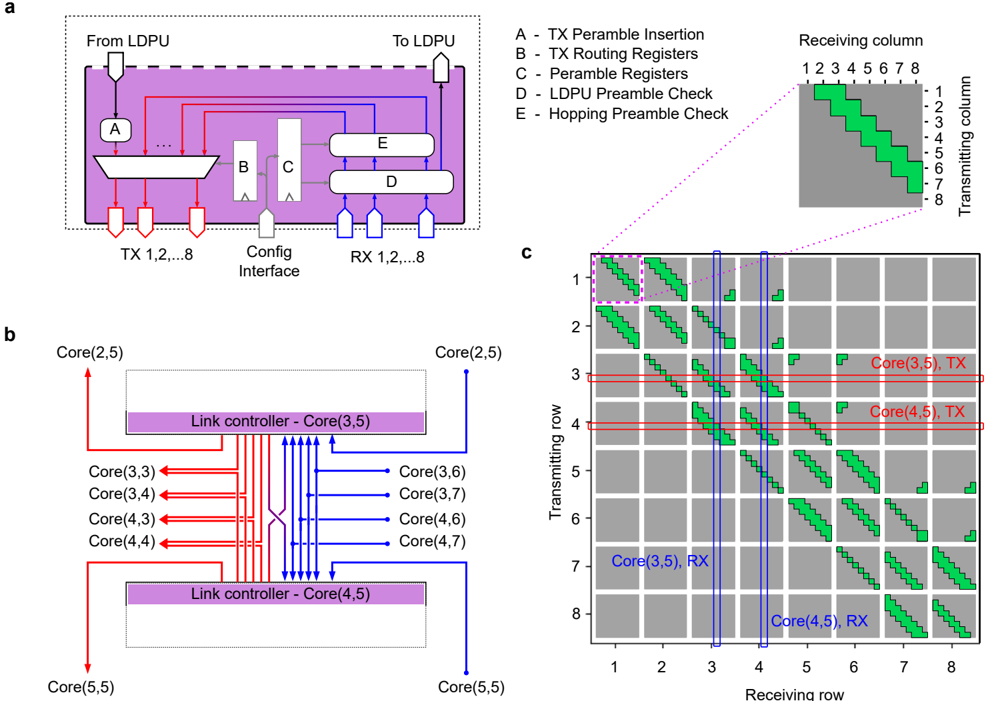
The image presents a diagram illustrating the architecture and communication flow within a Network on Chip (NoC). It consists of three main parts: (a) a block diagram of a transceiver unit, (b) a schematic of the core interconnection network, and (c) a visualization of data transmission paths within the NoC.
### Components/Axes
**Part (a): Transceiver Unit**
* **Input:** From LDPU (Local Data Processing Unit)
* **Output:** To LDPU
* **Components:**
* A: TX Preamble Insertion
* B: TX Routing Registers
* C: Preamble Registers
* D: LDPU Preamble Check
* E: Hopping Preamble Check
* **Interfaces:** TX 1,2,...8 and RX 1,2,...8
* **Visual Elements:** Rectangular blocks representing functional units, arrows indicating data flow.
**Part (b): Core Interconnection Network**
* **Cores:** Core(2,5), Core(3,3), Core(3,4), Core(4,3), Core(4,4), Core(3,6), Core(3,7), Core(4,6), Core(4,7), Core(5,5)
* **Link Controllers:** Core(3,5) and Core(4,5)
* **Connections:** Bidirectional arrows representing data paths between cores and link controllers.
**Part (c): Data Transmission Visualization**
* **Axes:** Transmitting row (1-8) and Receiving row (1-8).
* **Visual Elements:** Grid of squares representing the NoC array. Green squares indicate active transmission paths, and a single blue square indicates a receiving core.
* **Labels:** Core(3,5), TX; Core(4,5), TX; Core(3,5), RX; Core(4,5), RX.
### Detailed Analysis or Content Details
**Part (a): Transceiver Unit**
The transceiver unit receives data from the LDPU, inserts a preamble (A), routes the data (B), stores preamble information (C), performs preamble checks (D & E), and transmits the data to the LDPU. The unit has 8 transmit (TX) and 8 receive (RX) interfaces.
**Part (b): Core Interconnection Network**
The core interconnection network connects multiple cores through link controllers. Core(3,5) and Core(4,5) act as link controllers, managing data flow between the other cores. The connections are bidirectional, allowing for two-way communication.
**Part (c): Data Transmission Visualization**
The visualization shows data transmission paths within the NoC.
* **Core(3,5) TX:** Transmits data from row 3 to rows 1, 2, 3, 4, 5, 6, 7, and 8. The transmission path is diagonal, starting from row 3 and extending to all other rows.
* **Core(4,5) TX:** Transmits data from row 4 to rows 1, 2, 3, 4, 5, 6, 7, and 8. The transmission path is also diagonal, starting from row 4 and extending to all other rows.
* **Core(3,5) RX:** Receives data in row 3.
* **Core(4,5) RX:** Receives data in row 4.
### Key Observations
* The transceiver unit (a) handles the physical layer aspects of communication, including preamble insertion and checking.
* The core interconnection network (b) provides a flexible and scalable way to connect multiple cores.
* The data transmission visualization (c) demonstrates the diagonal communication pattern within the NoC.
* The transmission paths from Core(3,5) and Core(4,5) cover the entire NoC array, indicating a broadcast or multi-cast communication scheme.
### Interpretation
The diagram illustrates a typical NoC architecture used in modern multi-core processors and systems-on-chip. The NoC provides a scalable and efficient communication infrastructure for interconnecting multiple cores. The transceiver unit handles the physical layer details, while the core interconnection network provides the routing and switching functionality. The diagonal transmission pattern suggests a wormhole routing scheme, where data packets are transmitted through the NoC in a pipelined manner. The use of link controllers simplifies the routing process and improves performance. The diagram highlights the key components and communication flow within the NoC, providing a clear understanding of its architecture and operation. The visualization in part (c) suggests a relatively simple routing scheme, potentially optimized for latency or throughput. The fact that the transmission paths cover the entire array indicates a broadcast or multicast capability, which could be used for synchronization or data distribution.