## Diagram: Task Management System Architecture
### Overview
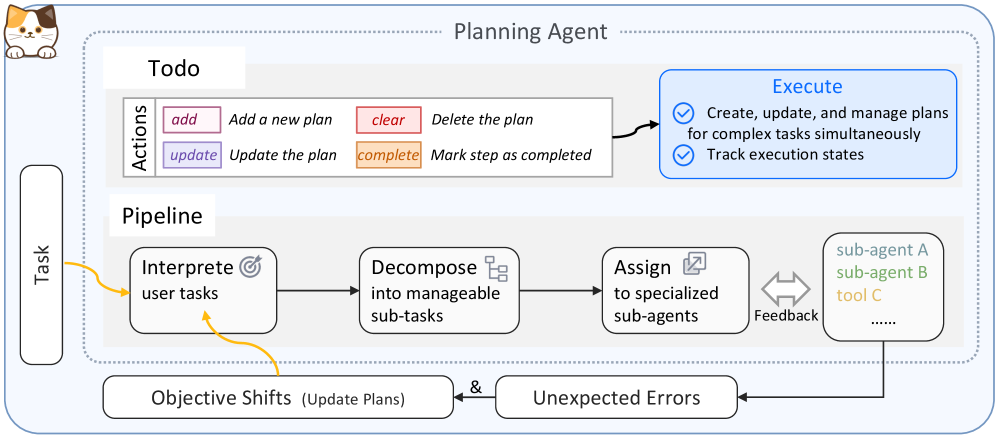
The diagram illustrates a task management system architecture with a central "Planning Agent" coordinating workflows. It includes components for task decomposition, assignment to specialized sub-agents, feedback loops, and error handling. The system emphasizes dynamic plan management and real-time execution tracking.
### Components/Axes
- **Main Sections**:
- **Planning Agent**: Central hub for plan creation, updates, and management.
- **Todo**: Actionable items (add, update, clear, complete plans).
- **Pipeline**: Task processing flow (interpret → decompose → assign → feedback).
- **Task**: User-defined objectives with potential shifts or errors.
- **Execute**: Plan execution capabilities (create/update plans, track states).
- **Sub-agents/Tools**: Specialized agents (A, B) and tools (C) for task execution.
- **Flow Arrows**:
- Yellow arrows indicate user task input and objective shifts.
- Black arrows show system workflow (e.g., decomposition, assignment).
- Feedback loops connect sub-agents back to the Planning Agent.
### Detailed Analysis
1. **Todo Section**:
- Actions: `add` (pink), `update` (purple), `clear` (red), `complete` (orange).
- Purpose: Manage plan lifecycle (creation, modification, deletion).
2. **Pipeline Workflow**:
- **Interpret**: Converts user tasks into actionable inputs.
- **Decompose**: Breaks tasks into manageable subtasks.
- **Assign**: Routes subtasks to specialized sub-agents (A, B) or tools (C).
- **Feedback**: Sub-agents provide status updates to the Planning Agent.
3. **Task Section**:
- **Objective Shifts**: Triggers plan updates (yellow arrow).
- **Unexpected Errors**: Routes to error-handling mechanisms (black arrow).
4. **Execute Section**:
- Features: Plan creation/updates and execution state tracking (blue box with checkmarks).
5. **Sub-Agents/Tools**:
- Sub-agent A (blue), Sub-agent B (green), Tool C (orange) represent specialized resources.
### Key Observations
- **Feedback Loops**: Sub-agents continuously report back to the Planning Agent, enabling adaptive plan adjustments.
- **Color Coding**: Distinct colors differentiate actions (Todo) and roles (sub-agents/tools), aiding visual clarity.
- **Error Handling**: Explicit path for unexpected errors ensures system resilience.
- **Dynamic Updates**: Objective shifts and plan updates are integrated into the workflow.
### Interpretation
This architecture demonstrates a modular, agent-based system designed for complex task management. The Planning Agent acts as a coordinator, decomposing tasks into subtasks and assigning them to specialized sub-agents (A, B) or tools (C). Feedback loops ensure real-time monitoring and adaptive updates, while the Todo section provides granular control over plan lifecycle. The system’s emphasis on decomposition and parallel execution suggests scalability for multi-step or concurrent tasks. The inclusion of error handling and objective shift mechanisms highlights robustness in dynamic environments. The color-coded components enhance usability by visually segregating roles and actions, reducing cognitive load during system interaction.