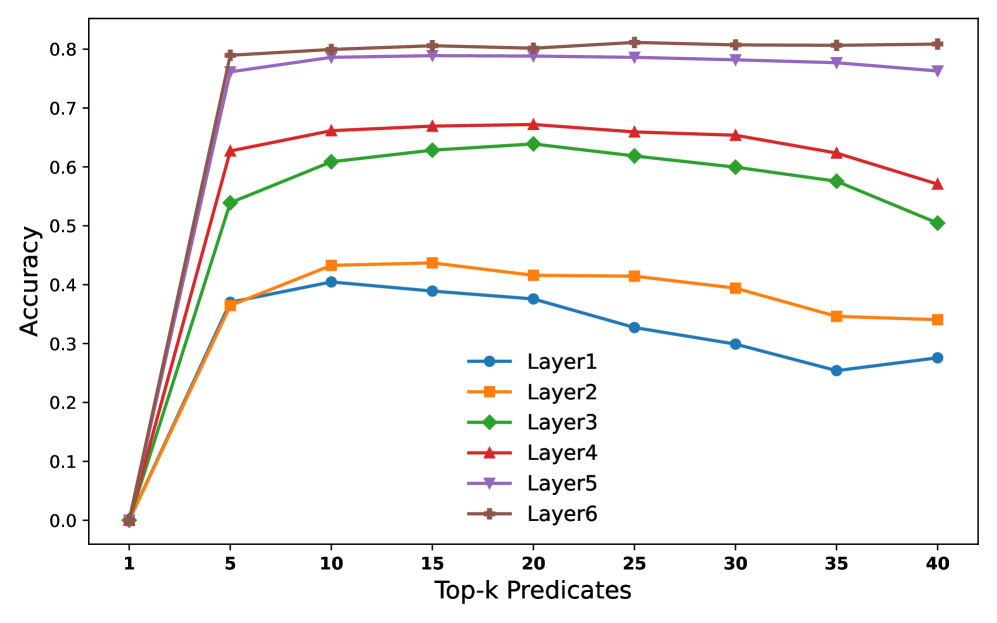
## Line Chart: Accuracy vs. Top-k Predicates for Different Layers
### Overview
The image is a line chart comparing the accuracy of different layers (Layer1 to Layer6) as a function of the number of top-k predicates used. The x-axis represents the "Top-k Predicates" ranging from 1 to 40, and the y-axis represents "Accuracy" ranging from 0.0 to 0.8. Each layer is represented by a different colored line with a distinct marker.
### Components/Axes
* **X-axis:** "Top-k Predicates" with values 1, 5, 10, 15, 20, 25, 30, 35, 40.
* **Y-axis:** "Accuracy" with values ranging from 0.0 to 0.8 in increments of 0.1.
* **Legend:** Located in the bottom-right of the chart, it identifies each layer with a specific color and marker:
* Layer1 (blue, circle marker)
* Layer2 (orange, square marker)
* Layer3 (green, diamond marker)
* Layer4 (red, triangle marker)
* Layer5 (purple, star marker)
* Layer6 (brown, plus marker)
### Detailed Analysis
* **Layer1 (blue, circle):** The accuracy increases sharply from approximately 0.0 at k=1 to approximately 0.37 at k=5, then increases to approximately 0.4 at k=10, remains relatively stable until k=20 (approximately 0.39), and then gradually decreases to approximately 0.27 at k=40.
* k=1: ~0.0
* k=5: ~0.37
* k=10: ~0.4
* k=20: ~0.39
* k=40: ~0.27
* **Layer2 (orange, square):** The accuracy increases sharply from approximately 0.0 at k=1 to approximately 0.37 at k=5, then increases to approximately 0.43 at k=10, remains relatively stable until k=20 (approximately 0.42), and then gradually decreases to approximately 0.34 at k=40.
* k=1: ~0.0
* k=5: ~0.37
* k=10: ~0.43
* k=20: ~0.42
* k=40: ~0.34
* **Layer3 (green, diamond):** The accuracy increases sharply from approximately 0.0 at k=1 to approximately 0.54 at k=5, then increases to approximately 0.61 at k=10, reaches a peak of approximately 0.67 at k=20, and then gradually decreases to approximately 0.51 at k=40.
* k=1: ~0.0
* k=5: ~0.54
* k=10: ~0.61
* k=20: ~0.67
* k=40: ~0.51
* **Layer4 (red, triangle):** The accuracy increases sharply from approximately 0.0 at k=1 to approximately 0.63 at k=5, then increases to approximately 0.67 at k=10, reaches a peak of approximately 0.68 at k=20, and then gradually decreases to approximately 0.57 at k=40.
* k=1: ~0.0
* k=5: ~0.63
* k=10: ~0.67
* k=20: ~0.68
* k=40: ~0.57
* **Layer5 (purple, star):** The accuracy increases sharply from approximately 0.0 at k=1 to approximately 0.78 at k=5, then increases to approximately 0.8 at k=10, remains relatively stable until k=40 (approximately 0.79).
* k=1: ~0.0
* k=5: ~0.78
* k=10: ~0.8
* k=40: ~0.79
* **Layer6 (brown, plus):** The accuracy increases sharply from approximately 0.0 at k=1 to approximately 0.79 at k=5, then increases to approximately 0.8 at k=10, remains relatively stable until k=40 (approximately 0.8).
* k=1: ~0.0
* k=5: ~0.79
* k=10: ~0.8
* k=40: ~0.8
### Key Observations
* All layers show a significant increase in accuracy from k=1 to k=5.
* Layers 5 and 6 consistently exhibit the highest accuracy across all values of k.
* Layers 1 and 2 have the lowest accuracy.
* The accuracy of Layers 1, 2, 3, and 4 decreases after reaching a peak around k=20.
* The accuracy of Layers 5 and 6 remains relatively stable after k=10.
### Interpretation
The chart suggests that using a higher number of top-k predicates (around k=10 to k=20) generally improves the accuracy of the model, but beyond that point, the accuracy may plateau or even decrease for some layers. Layers 5 and 6 appear to be the most effective, achieving high accuracy even with a relatively small number of top-k predicates. The performance differences between layers could be attributed to variations in their architecture, training data, or other hyperparameters. The initial rapid increase in accuracy for all layers indicates that incorporating even a small number of top-k predicates significantly enhances the model's performance. The subsequent decrease in accuracy for some layers suggests that including too many predicates may introduce noise or irrelevant information, negatively impacting the model's ability to make accurate predictions.