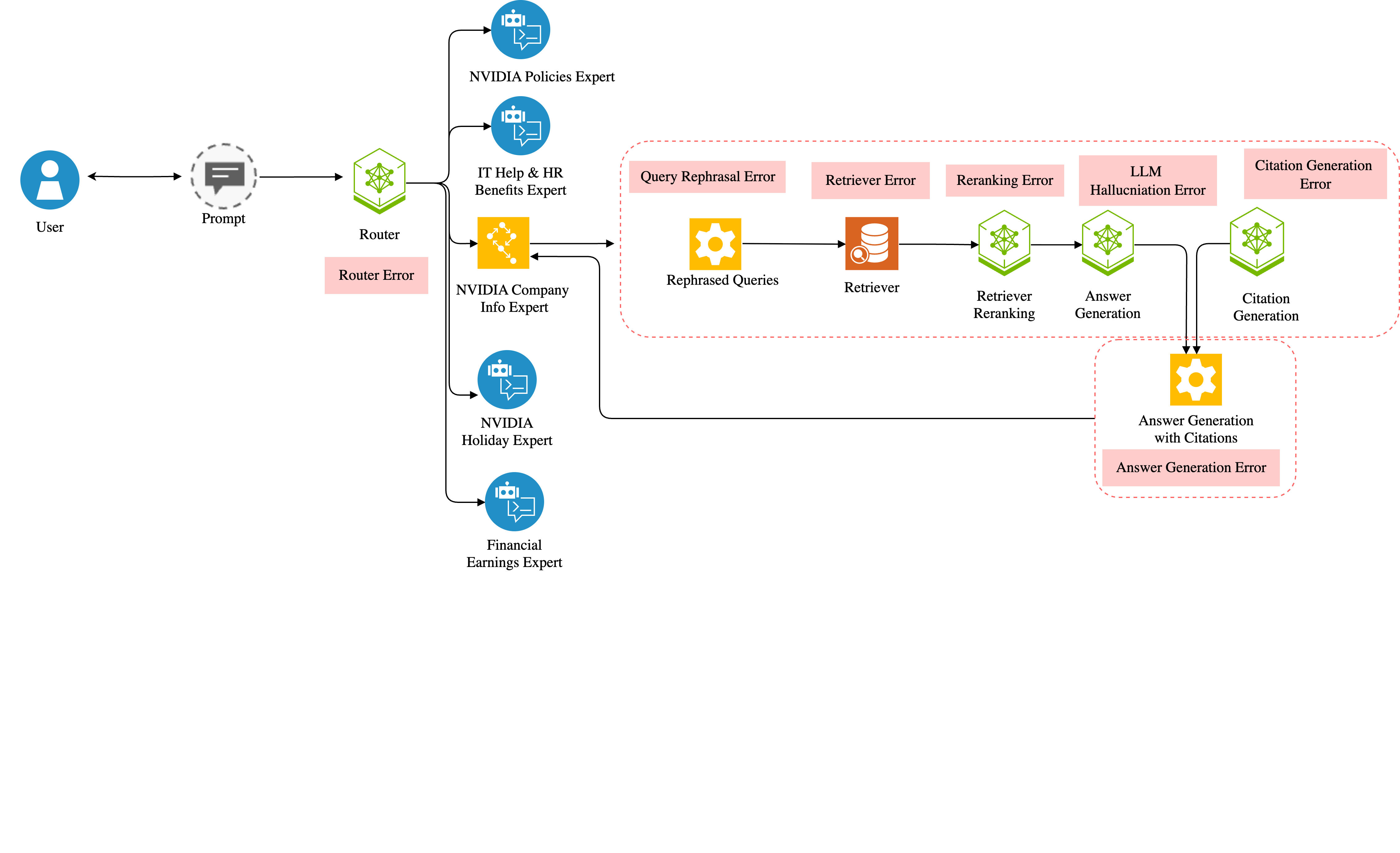
## Diagram: NVIDIA Retrieval Augmented Generation (RAG) Error Flow
### Overview
This diagram illustrates the flow of a user prompt through a Retrieval Augmented Generation (RAG) system, specifically focusing on potential error sources at each stage. The system utilizes multiple "Experts" to handle different types of queries, and the diagram highlights how errors can propagate through the process, leading to issues in answer generation. The diagram is oriented from left to right, showing the progression from user input to final answer.
### Components/Axes
The diagram consists of the following components:
* **User:** Represented by a blue icon on the far left.
* **Prompt:** A speech bubble icon, receiving input from the User.
* **Experts:** Four distinct expert modules:
* NVIDIA Policies Expert (top)
* IT Help & HR Benefits Expert (center-left)
* NVIDIA Company Info Expert (center)
* NVIDIA Holiday Expert (bottom-left)
* Financial Earnings Expert (bottom)
* **Router:** A hexagonal icon, directing the prompt to the appropriate Expert.
* **Rephrased Queries:** A gear icon, representing the output of query rephrasing.
* **Retriever:** A cylinder icon, responsible for retrieving relevant information.
* **Reranker:** A hexagonal icon, re-ranking the retrieved information.
* **Answer Generation:** A gear icon, generating an answer based on the retrieved and re-ranked information.
* **Citation Generation:** A hexagonal icon, generating citations for the answer.
* **Answer Generation with Citations:** A rectangular box, representing the final output.
* **Error Nodes:** Various hexagonal icons labeled with specific error types:
* Query Rephrasal Error
* Router Error
* Retriever Error
* Reranking Error
* LLM Hallucination Error
* Citation Generation Error
* Answer Generation Error
The diagram uses arrows to indicate the flow of information. The color coding is as follows:
* Blue: User and Prompt
* Light Blue: Experts
* Yellow: Router and Router Error
* Orange: Query Rephrasal and Query Rephrasal Error
* Red: Retriever and Retriever Error
* Green: Reranker and Reranking Error
* Purple: LLM and LLM Hallucination Error
* Teal: Citation Generation and Citation Generation Error
* Pink: Answer Generation and Answer Generation Error
* Grey: Rephrased Queries
### Detailed Analysis or Content Details
The diagram shows the following flow:
1. A **User** provides a **Prompt**.
2. The **Prompt** is sent to a **Router**.
3. The **Router** directs the prompt to one of the four **Experts**: NVIDIA Policies Expert, IT Help & HR Benefits Expert, NVIDIA Company Info Expert, NVIDIA Holiday Expert, or Financial Earnings Expert.
4. A **Router Error** can occur at this stage.
5. The selected Expert generates **Rephrased Queries**.
6. A **Query Rephrasal Error** can occur during this process.
7. The **Rephrased Queries** are sent to a **Retriever**.
8. A **Retriever Error** can occur during retrieval.
9. The retrieved information is sent to a **Reranker**.
10. A **Reranking Error** can occur during re-ranking.
11. The re-ranked information is sent to an **Answer Generation** module (likely a Large Language Model - LLM).
12. An **LLM Hallucination Error** can occur during answer generation.
13. The generated answer is sent to **Citation Generation**.
14. A **Citation Generation Error** can occur during citation generation.
15. Finally, the **Answer Generation with Citations** is produced.
16. An **Answer Generation Error** can occur during the final answer generation stage.
The diagram shows that errors can occur at multiple points in the process, and these errors are explicitly labeled. The flow is largely linear, with branching occurring at the Router stage.
### Key Observations
* The diagram highlights the complexity of a RAG system and the numerous potential points of failure.
* The inclusion of specific error types (e.g., "LLM Hallucination Error") suggests a focus on mitigating these issues.
* The diagram does not provide any quantitative data or performance metrics. It is a qualitative representation of the system's architecture and potential error sources.
* The diagram emphasizes the importance of robust error handling and monitoring in a RAG system.
### Interpretation
This diagram is a conceptual overview of a RAG pipeline, specifically designed to identify and visualize potential error sources. It suggests that the developers of this system are aware of the challenges associated with building reliable RAG applications, such as the potential for LLMs to generate inaccurate or misleading information (hallucinations). The diagram's focus on error propagation indicates a desire to understand how errors at one stage can impact the overall quality of the generated answers. The use of multiple "Experts" suggests a modular approach to knowledge retrieval, allowing the system to handle a wide range of queries. The diagram serves as a valuable tool for system designers and engineers, helping them to prioritize error mitigation efforts and improve the overall robustness of the RAG pipeline. The diagram does not provide any information about the specific algorithms or techniques used in each component, nor does it offer any insights into the frequency or severity of the different error types. It is a high-level representation of the system's architecture and potential vulnerabilities.