## Diagram: Maxwell's Demon Thought Experiment
### Overview
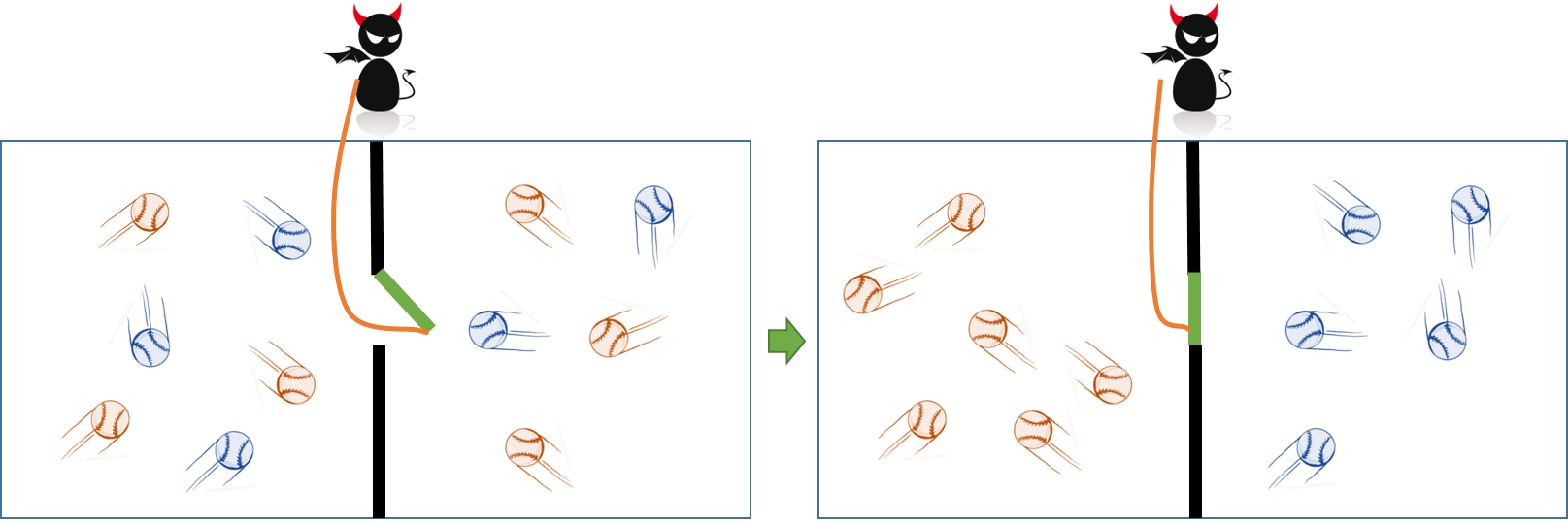
This image is a two-part diagram illustrating the classic physics and thermodynamics thought experiment known as "Maxwell's Demon." It depicts a closed system divided into two chambers filled with particles (represented by baseballs with motion lines). A cartoon demon controls a trapdoor between the chambers, transitioning the system from a mixed, disordered state (left panel) to a segregated, ordered state (right panel).
*Note: There is no explicit readable text in this image. Faint, illegible watermarks appear on the square backgrounds of the individual baseball graphics, indicating they are likely stock images, but no factual text or data labels are present.*
### Components/Axes
Because this is a conceptual diagram rather than a data chart, there are no traditional axes. The components act as a visual legend:
* **Container:** A light grey rectangular box outlined in blue, divided by a thick black vertical wall.
* **The "Demon":** A cartoon figure with a black spherical body, red horns, bat wings, and a pointed tail, positioned above the central dividing wall.
* **Mechanism:** An orange curved line representing an arm or mechanical linkage connecting the demon to a trapdoor.
* **Trapdoor:** A green rectangular segment in the central black wall that can open and close.
* **Orange Baseballs:** Represent high-energy, fast-moving (hot) particles. Motion lines indicate trajectory.
* **Blue Baseballs:** Represent low-energy, slow-moving (cold) particles. Motion lines indicate trajectory.
* **Progression Arrow:** A solid green arrow pointing right, located between the two main panels, indicating the flow of time or the result of a process.
### Detailed Analysis
#### Left Panel (Initial State)
* **Spatial Layout:** The container is divided into a Left Chamber and a Right Chamber. The demon sits top-center.
* **Mechanism State:** The green trapdoor is **open**, angled downwards and to the left, creating a gap in the central wall.
* **Left Chamber Contents:** Contains a mixed state of particles.
* 3 Orange particles (positioned top-left, bottom-left, bottom-center).
* 3 Blue particles (positioned mid-left, top-center, bottom-right).
* **Right Chamber Contents:** Contains a mixed state of particles.
* 3 Orange particles (positioned top-center, mid-right, bottom-center).
* 2 Blue particles (positioned top-right, and one actively passing through the door).
* **Active Event:** A Blue particle is positioned exactly at the gap in the wall. Its motion lines indicate it is traveling from the Right Chamber, through the open trapdoor, into the Left Chamber.
#### Transition
* A green arrow points from the left panel to the right panel, indicating that the right panel is the subsequent state of the system after the demon has performed its actions over time.
#### Right Panel (Final State)
* **Spatial Layout:** Identical container and demon placement as the left panel.
* **Mechanism State:** The green trapdoor is now **closed**, sitting flush within the black vertical wall, completely sealing the two chambers from one another.
* **Left Chamber Contents:** Contains a completely segregated state.
* 6 Orange particles.
* 0 Blue particles.
* **Right Chamber Contents:** Contains a completely segregated state.
* 5 Blue particles.
* 0 Orange particles.
### Key Observations
* **Conservation of Particles:** The total number of particles remains constant between the two panels (6 Orange, 5 Blue).
* **State Change:** The system transitions from a heterogeneous mixture in both chambers to a homogeneous state in each respective chamber.
* **Selective Sorting:** The visual implies that the demon has selectively opened and closed the door to allow only Orange particles to move to the left, and only Blue particles to move to the right (or vice versa, trapping them once they cross).
### Interpretation
This diagram is a visual representation of **Maxwell's Demon**, a thought experiment proposed by physicist James Clerk Maxwell in 1867 to question the Second Law of Thermodynamics.
* **What the data suggests:** The orange baseballs represent "hot" gas molecules with high kinetic energy, while the blue baseballs represent "cold" gas molecules with low kinetic energy. In a normal closed system, these molecules would mix, maximizing entropy (as seen in the left panel).
* **Relational Elements:** The demon acts as an intelligent agent that measures the speed of approaching particles. By opening the frictionless door only to let fast (orange) molecules into the left chamber and slow (blue) molecules into the right chamber, the demon sorts the gas.
* **Peircean/Investigative Reading:** The right panel shows the result: one chamber has become entirely hot (left) and the other entirely cold (right). This creates a temperature differential that could theoretically be used to do work, effectively decreasing the total entropy of an isolated system without expending energy—a direct violation of the Second Law of Thermodynamics.
* **Resolution of the Paradox:** While not explicitly shown in the diagram, modern physics resolves this paradox through information theory (Landauer's principle). The act of the demon measuring the particles and erasing that information from its memory requires work and generates more entropy than is saved by sorting the molecules, thus preserving the Second Law. The use of baseballs is a pedagogical tool to map invisible, microscopic molecular kinematics onto macroscopic, easily understandable objects.