## Diagram: Any4D: Unified Field - Forward Me
### Overview
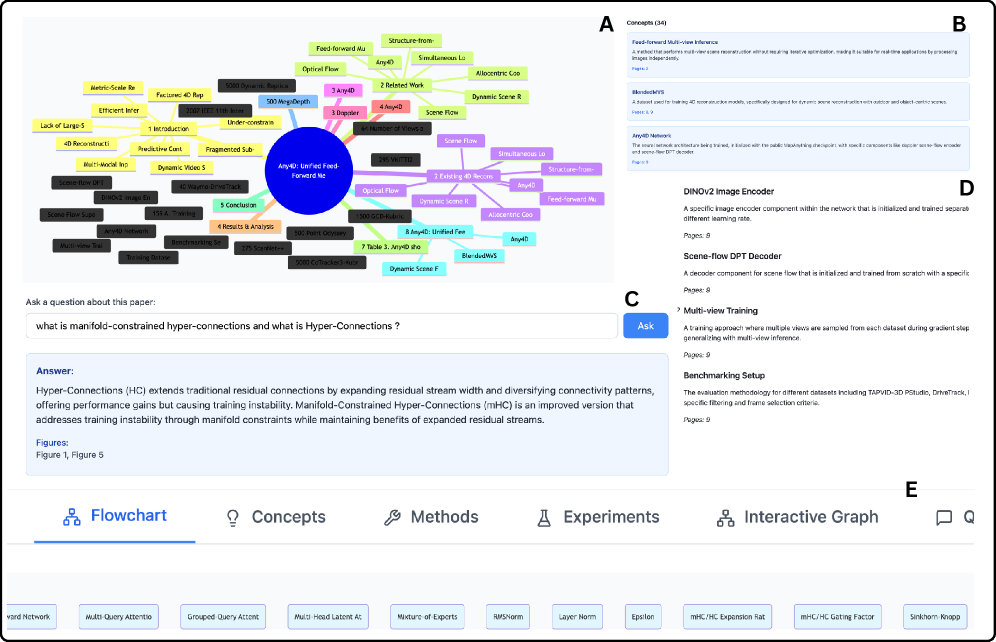
The image depicts a technical flowchart diagram titled "Any4D: Unified Field - Forward Me," accompanied by explanatory text in a sidebar, a question-answer section, and UI elements. The flowchart uses color-coded nodes to represent components of a multi-view reconstruction system, with a central blue node as the core concept. A sidebar explains "manifold-constrained hyper-connections" (mHC) and their technical context. UI tabs (Flowchart, Concepts, Methods, Experiments, Interactive Graph) suggest an interactive technical interface.
### Components/Axes
**Flowchart Diagram**:
- **Central Node**: Blue circle labeled "Any4D: Unified Field - Forward Me" (core concept).
- **Categorized Nodes**:
- **Top/Left**:
- Yellow nodes: "Metric-Scale Re", "Lack of Large-S", "Efficient Infer", "Predictive Cost", "Dynamic Video S", "Scene Flow DPT", "Multi-view Trail", "Training Dataset", "Score Flow Sup."
- Black nodes: "40 Waymo-DriveTrack", "4D Reconstruct", "Fragmented Sub-Metric", "Dynamic 4D Video S".
- **Right**:
- Purple nodes: "Simultaneous Lo", "Dynamic Scene IT", "Dynamic Scene F", "Allocentric Coord", "Structure-from-Init", "Structure-from-Img".
- Green nodes: "Feed-Forward Wu", "Optical Flow", "Simultaneous Lo", "Any4D", "40 Waymo-DriveTrack".
- **Bottom**:
- Orange nodes: "8 40 Waymo-DriveTrack", "9 5000 Dynamic Dataset", "10 3D DeepStereo".
- **Bottom-Right**:
- Red nodes: "Scene Flow DPT", "3 5000 Scene Flow", "7 725 CoarseNet".
**Sidebar Text**:
- **Concepts**:
- **Feed-Forward Multi-view Inference**: "A reconstruction method that processes multi-view data without iterative optimization."
- **BlendochWS**: "A loss function for 4D monocular video reconstruction."
- **DINOv2 Image Encoder**: "A vision encoder trained on DINOv2 with 8% dropout rate."
- **Methods**:
- **Scene-Flow DPT Decoder**: "A decoder trained on scene flow data with specific architecture."
- **Multi-view Training**: "Training using multi-view inference."
- **Benchmarking Setup**: "Evaluation methodology for datasets like TAPVID-3D, DriveTrack, and Waymo Open Dataset."
**Question-Answer Section**:
- **Question**: "What is manifold-constrained hyper-connections (mHC), and what is Hyper-Connections (HC)?"
- **Answer**:
- **Hyper-Connections (HC)**: Extends residual connections by expanding stream width and diversifying connectivity patterns, improving performance but causing training instability.
- **Manifold-Constrained HC (mHC)**: Addresses instability via manifold constraints while retaining benefits of expanded streams.
- **Figures**: Figure 1 (mHC architecture), Figure 5 (training dynamics).
**UI Elements**:
- **Tabs**: Flowchart (active), Concepts, Methods, Experiments, Interactive Graph.
- **Technical Terms**:
- "mHC/HC Expansion Rat"
- "mHC/HC Gating Factor"
- "Sinkhorn-Knopp"
- "Grouped Query Attention"
- "Multi-Head Latent Attention"
### Detailed Analysis
1. **Flowchart Structure**:
- The central node "Any4D" connects to three main categories:
- **1 Introduction** (left): Focuses on foundational challenges (e.g., lack of large-scale datasets).
- **2 Existing 4D Recorder** (top-right): Details components like Scene Flow DPT and Optical Flow.
- **3 Dynamic Scene R** (bottom-right): Highlights challenges like fragmented sub-metrics.
- **4 40 Waymo-DriveTrack** (bottom-left): Represents the benchmarking dataset.
2. **Sidebar Technical Content**:
- Describes mHC as an improved version of HC, addressing training instability through manifold constraints.
- Explains DINOv2 Image Encoder and Scene-Flow DPT Decoder as specialized components.
- Multi-view Training and Benchmarking Setup emphasize evaluation methodologies.
3. **Question-Answer Section**:
- Clarifies the distinction between HC (general residual extension) and mHC (manifold-constrained improvement).
- References Figure 1 and 5 for architectural and training dynamics.
### Key Observations
- The flowchart emphasizes **multi-view reconstruction** with a focus on scene flow, dynamic 4D video, and dataset-specific challenges.
- The sidebar links mHC to technical improvements in training stability and reconstruction quality.
- UI tabs suggest an interactive platform for exploring technical components (e.g., "Interactive Graph" likely visualizes data flow).
### Interpretation
The diagram illustrates the **Any4D framework**, which integrates multi-view reconstruction techniques with hyper-connection optimizations. The central node ("Any4D") serves as the unifying concept, while connected nodes break down into components like scene flow, dynamic scenes, and dataset-specific challenges. The sidebar contextualizes mHC as a technical solution to training instability, positioning it within broader methods like DINOv2 encoding and benchmarking setups.
The UI elements (tabs, technical terms) imply an interactive environment where users can explore the flowchart’s nodes, access detailed methods, or visualize data flow. The question-answer section highlights the importance of mHC in balancing performance and stability, suggesting it is a critical innovation in the framework.
**Critical Uncertainty**:
- Color meanings for flowchart nodes are not explicitly defined in the legend, leaving their relationships to the core concept (Any4D) speculative.
- The exact numerical values for metrics like "3 5000 Scene Flow" or "7 725 CoarseNet" are ambiguous and require further context from figures (e.g., Figure 5).
**Notable Trends**:
- The flowchart prioritizes **scene flow** and **dynamic 4D video** as key research areas, with repeated references to Waymo datasets and Scene Flow DPT.
- The sidebar’s emphasis on mHC suggests it is a foundational component addressing prior limitations in hyper-connection methods.
This diagram positions Any4D as a system designed to improve multi-view 4D reconstruction through manifold-constrained hyper-connections, leveraging specialized decoders, training strategies, and benchmarking datasets.