## Diagram: Process Flow for Three Task Types with Reflection
### Overview
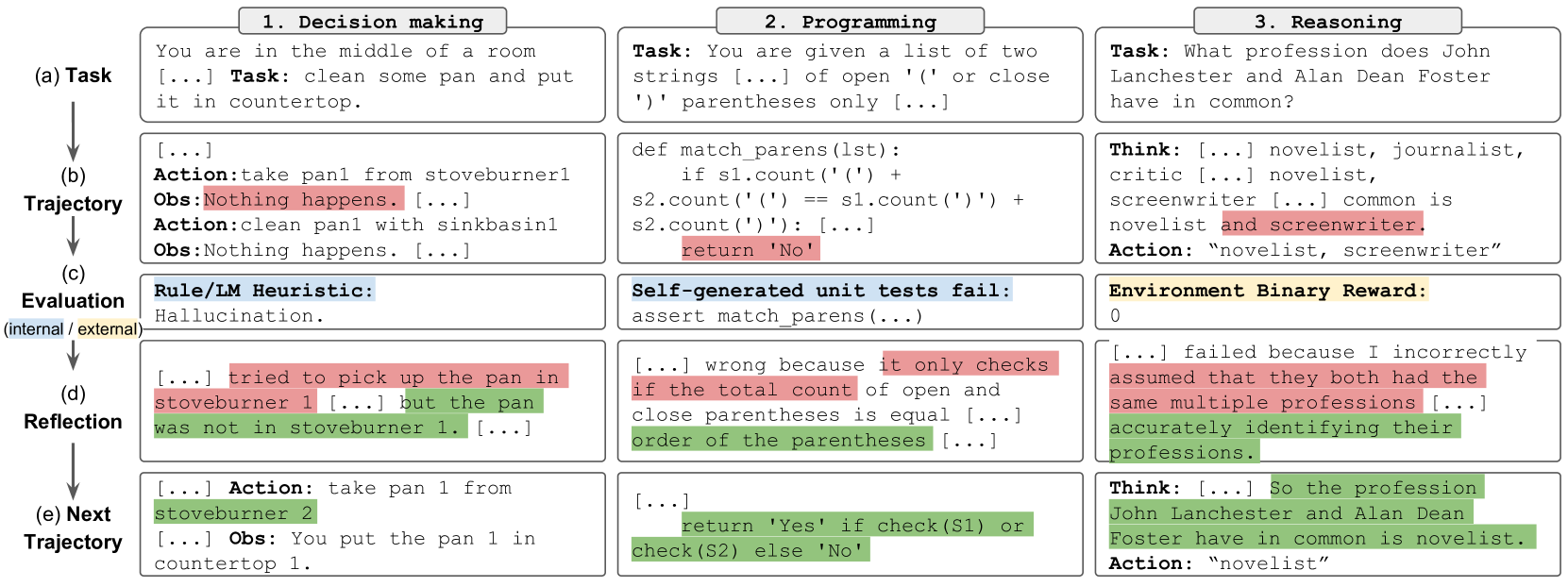
The image is a technical diagram illustrating a five-stage process applied to three distinct types of tasks: Decision Making, Programming, and Reasoning. The diagram is structured as a grid with three columns (one per task type) and five rows (one per process stage). Textual content within each cell describes the state or action at that stage. Certain text segments are highlighted in red (indicating errors or failures) or green (indicating corrections or successful outcomes).
### Components/Axes
* **Columns (Task Types):**
1. **1. Decision making** (Left column)
2. **2. Programming** (Center column)
3. **3. Reasoning** (Right column)
* **Rows (Process Stages):** Labeled on the far left with letters (a) through (e).
* **(a) Task:** The initial problem or instruction.
* **(b) Trajectory:** The sequence of actions and observations taken.
* **(c) Evaluation (internal / external):** The assessment of the trajectory's success.
* **(d) Reflection:** The analysis of why the evaluation result occurred.
* **(e) Next Trajectory:** The subsequent action or thought process informed by the reflection.
### Detailed Analysis
#### Column 1: Decision Making
* **(a) Task:** "You are in the middle of a room [...] **Task:** clean some pan and put it in countertop."
* **(b) Trajectory:**
* "[...] **Action:**take pan1 from stoveburner1"
* "**Obs:**<span style="background-color:#ffcccc">Nothing happens.</span> [...]"
* "**Action:**clean pan1 with sinkbasin1"
* "**Obs:**Nothing happens. [...]"
* **(c) Evaluation:** "**Rule/LM Heuristic:** Hallucination."
* **(d) Reflection:** "[...] <span style="background-color:#ffcccc">tried to pick up the pan in stoveburner 1</span> [...] <span style="background-color:#ccffcc">but the pan was not in stoveburner 1.</span> [...]"
* **(e) Next Trajectory:** "[...] **Action:** take pan 1 from <span style="background-color:#ccffcc">stoveburner 2</span> [...] **Obs:** You put the pan 1 in countertop 1."
#### Column 2: Programming
* **(a) Task:** "**Task:** You are given a list of two strings [...] of open '(' or close ')' parentheses only [...]"
* **(b) Trajectory:** Contains a Python function definition `def match_parens(lst):` with logic to count parentheses. The line `return 'No'` is highlighted in red.
* **(c) Evaluation:** "**Self-generated unit tests fail:** assert match_parens(...)"
* **(d) Reflection:** "[...] wrong because <span style="background-color:#ffcccc">it only checks if the total count of open and close parentheses is equal</span> [...] <span style="background-color:#ccffcc">order of the parentheses</span> [...]"
* **(e) Next Trajectory:** "[...] <span style="background-color:#ccffcc">return 'Yes' if check(S1) or check(S2) else 'No'</span>"
#### Column 3: Reasoning
* **(a) Task:** "**Task:** What profession does John Lanchester and Alan Dean Foster have in common?"
* **(b) Trajectory:** "**Think:** [...] novelist, journalist, critic [...] novelist, screenwriter [...] common is <span style="background-color:#ffccff">novelist and screenwriter.</span> **Action:** "novelist, screenwriter""
* **(c) Evaluation:** "**Environment Binary Reward:** 0"
* **(d) Reflection:** "[...] failed because I incorrectly <span style="background-color:#ffcccc">assumed that they both had the same multiple professions</span> [...] <span style="background-color:#ccffcc">accurately identifying their professions.</span>"
* **(e) Next Trajectory:** "**Think:** [...] <span style="background-color:#ccffcc">So the profession John Lanchester and Alan Dean Foster have in common is novelist.</span> **Action:** "novelist""
### Key Observations
1. **Consistent Process Flow:** All three columns follow the identical five-stage process: Task -> Trajectory -> Evaluation -> Reflection -> Next Trajectory.
2. **Error Highlighting:** Red highlights consistently mark the specific point of error or incorrect assumption in the (b) Trajectory or (d) Reflection stages.
3. **Correction Highlighting:** Green highlights consistently mark the corrected understanding or successful action in the (d) Reflection or (e) Next Trajectory stages.
4. **Evaluation Methods Vary:** The evaluation stage uses different mechanisms per task: a heuristic rule for Decision Making, unit tests for Programming, and an external binary reward for Reasoning.
5. **Reflection is Diagnostic:** The Reflection stage in each case explicitly diagnoses the cause of the failure identified in the Evaluation stage.
### Interpretation
This diagram demonstrates a **meta-cognitive or self-improvement framework** for AI systems. It illustrates how an agent can move from failure to success by incorporating a structured reflection step.
* **What it shows:** The core idea is that simply executing a task (Trajectory) and receiving feedback (Evaluation) is insufficient. The critical step is **Reflection**, where the agent analyzes the *reason* for failure. This analysis directly informs the corrective action in the Next Trajectory.
* **How elements relate:** The columns show the framework's generality across different AI domains (embodied AI, code generation, knowledge reasoning). The rows show the universal process. The colored highlights visually trace the causal chain from error to correction.
* **Underlying principle:** The diagram argues for moving beyond simple trial-and-error or reward-based learning. It promotes a model where agents build an internal, explanatory model of their own failures, leading to more efficient and accurate problem-solving. The "Rule/LM Heuristic," "Self-generated unit tests," and "Environment Binary Reward" represent different forms of external or internal feedback that trigger this reflective process.