## Flowchart: Task Execution Process with Decision Making, Programming, and Reasoning Components
### Overview
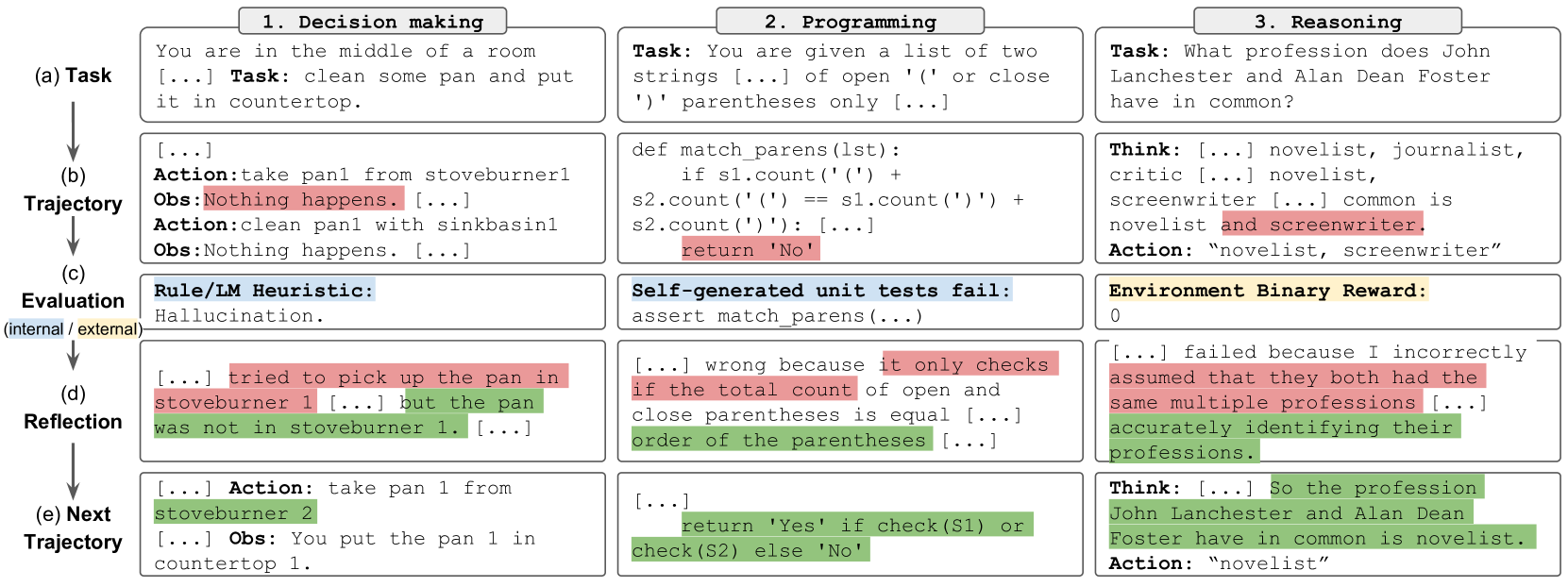
The image depicts a multi-stage workflow for task execution, combining decision-making, programming, and reasoning processes. It includes visual elements like color-coded text (red, green, blue) to highlight errors, corrections, and evaluations. The flowchart progresses through iterative steps with feedback loops.
---
### Components/Axes
1. **Main Sections**:
- **Decision Making** (Left Column)
- **Programming** (Center Column)
- **Reasoning** (Right Column)
2. **Subcomponents**:
- **Task**: Describes the objective (e.g., "clean some pan and put it in countertop").
- **Trajectory**: Lists actions and observations (e.g., "take pan1 from stoveburner1").
- **Evaluation**: Includes rule/heuristic checks (e.g., "Hallucination").
- **Reflection**: Notes errors or failures (e.g., "tried to pick up the pan in stoveburner1 but the pan was not in stoveburner1").
- **Next Trajectory**: Updated actions based on reflection (e.g., "take pan1 from stoveburner2").
3. **Color Coding**:
- **Red**: Errors or incorrect steps (e.g., "Nothing happens" in Decision Making).
- **Green**: Corrections or successful steps (e.g., "take pan1 from stoveburner2").
- **Blue**: Neutral or descriptive text (e.g., "Rule/LM Heuristic: Hallucination").
4. **Arrows**: Indicate flow between steps (e.g., from "Action" to "Obs" to "Evaluation").
---
### Detailed Analysis
#### Decision Making
- **Task**: "clean some pan and put it in countertop."
- **Trajectory**:
- Action: "take pan1 from stoveburner1" → Observation: "Nothing happens" (red).
- Action: "clean pan1 with sinkbasin1" → Observation: "Nothing happens" (red).
- **Evaluation**: "Rule/LM Heuristic: Hallucination" (blue).
- **Reflection**: "tried to pick up the pan in stoveburner1 but the pan was not in stoveburner1" (red).
- **Next Trajectory**: "take pan1 from stoveburner2" (green).
#### Programming
- **Task**: "match open/close parentheses in strings."
- **Code Example**:
```python
def match_parens(lst):
if s1.count('(') + s2.count('(') == s1.count(')') + s2.count(')'):
return 'No'
```
- **Self-Generated Unit Tests Fail**: "wrong because it only checks if the total count of open and close parentheses is equal, not the order" (red).
- **Binary Reward**: 0 (yellow).
#### Reasoning
- **Task**: "What profession do John Lanchester and Alan Dean Foster have in common?"
- **Initial Answer**: "novelist, screenwriter" (red).
- **Reflection**: "failed because I incorrectly assumed they both had the same multiple professions" (red).
- **Corrected Answer**: "novelist" (green).
- **Binary Reward**: 0 (yellow).
---
### Key Observations
1. **Iterative Correction**: The flowchart shows iterative refinement (e.g., moving from stoveburner1 to stoveburner2 in Decision Making).
2. **Code Logic Flaw**: The Programming section highlights a unit test failure due to ignoring parenthesis order.
3. **Reasoning Error**: The initial answer incorrectly lists multiple professions, corrected to "novelist" after reflection.
4. **Color-Coded Feedback**: Red highlights errors, green indicates corrections, and blue denotes neutral text.
---
### Interpretation
The diagram illustrates a system's process for executing tasks, debugging code, and reasoning through problems. Key insights include:
- **Decision-Making Errors**: The system initially fails to locate the pan correctly but adjusts its trajectory.
- **Programming Limitations**: The code for parenthesis matching fails to account for order, leading to incorrect unit test results.
- **Reasoning Flaws**: The system initially overgeneralizes professions but corrects itself by focusing on the most accurate common profession.
This workflow emphasizes the importance of iterative feedback and error correction in complex task execution, particularly in AI-driven systems.