\n
## Diagram: Conceptual Model of Observation
### Overview
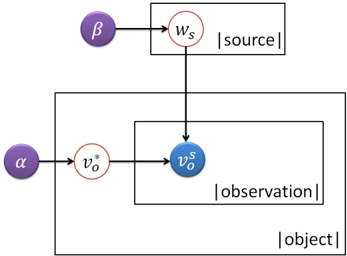
The image depicts a conceptual diagram illustrating a model of observation, likely within a theoretical framework such as perceptual psychology or information theory. It shows relationships between a source, an object, and an observation, represented by nodes and connecting arrows. The diagram uses a layered structure to represent these relationships.
### Components/Axes
The diagram consists of the following components:
* **β (Beta):** A purple circle, labeled "β", positioned in the top-left.
* **w<sub>s</sub>:** A circle with a red outline, labeled "w<sub>s</sub>", positioned to the right of β. The text "| source |" is associated with this element.
* **α (Alpha):** A purple circle, labeled "α", positioned to the left of the rectangular "observation" box.
* **v<sub>o</sub><sup>*</sup>:** A circle with a red outline, positioned to the right of α and inside the "observation" box.
* **v<sub>o</sub><sup>s</sup>:** A blue circle, positioned to the right of v<sub>o</sub><sup>*</sup> and inside the "observation" box.
* **"observation":** A large rectangular box encompassing v<sub>o</sub><sup>*</sup> and v<sub>o</sub><sup>s</sup>. The text "| observation |" is associated with this element.
* **"object":** A rectangular box encompassing the "observation" box. The text "| object |" is associated with this element.
* **Arrows:** Arrows indicate the direction of influence or relationship between the components.
### Detailed Analysis or Content Details
The diagram illustrates the following relationships:
1. β influences w<sub>s</sub>.
2. w<sub>s</sub> influences v<sub>o</sub><sup>s</sup>.
3. α influences v<sub>o</sub><sup>*</sup>.
4. v<sub>o</sub><sup>*</sup> influences v<sub>o</sub><sup>s</sup>.
The diagram does not contain numerical data or specific values. It is a conceptual representation of relationships.
### Key Observations
The diagram highlights a hierarchical structure: the source (β and w<sub>s</sub>) influences the observation (v<sub>o</sub><sup>*</sup> and v<sub>o</sub><sup>s</sup>) within the context of an object. The use of superscripts and subscripts (v<sub>o</sub><sup>*</sup>, v<sub>o</sub><sup>s</sup>, w<sub>s</sub>) suggests these variables represent different states or conditions. The red outlines around w<sub>s</sub> and v<sub>o</sub><sup>*</sup> may indicate they are intermediate or derived variables.
### Interpretation
This diagram likely represents a model of how an observation is formed based on a source and an object.
* **β** could represent a prior belief or expectation about the source.
* **w<sub>s</sub>** could represent the actual source signal.
* **α** could represent the observer's internal state or attention.
* **v<sub>o</sub><sup>*</sup>** could represent the initial processing of the object based on the observer's state.
* **v<sub>o</sub><sup>s</sup>** could represent the final observation, influenced by both the source signal and the observer's internal state.
The nested boxes ("object" and "observation") suggest that the observation is a component of the object, and the object provides the context for the observation. The arrows indicate a causal or influential relationship, suggesting that the source and observer's state contribute to the formation of the observation. The diagram is abstract and requires further context to fully understand its specific meaning. It appears to be a simplified representation of a complex perceptual or cognitive process.