\n
## Diagram: Causal Model with Source, Object, and Observation
### Overview
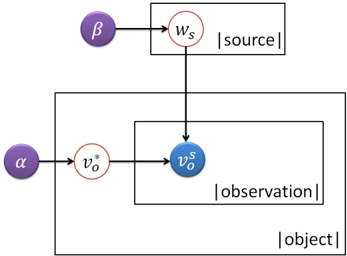
The image displays a directed acyclic graph (DAG) or a structural equation model diagram. It illustrates the hypothesized causal relationships between latent variables (represented by Greek letters) and observed or intermediate variables (represented by Latin letters with sub/superscripts). The diagram is organized into three nested or connected rectangular boxes labeled "source", "object", and "observation".
### Components/Axes
The diagram contains the following labeled components and their spatial relationships:
**Nodes (Circles):**
1. **β** (Beta): A purple-filled circle located in the top-left region of the diagram.
2. **α** (Alpha): A purple-filled circle located in the middle-left region, below and to the left of β.
3. **w_s**: A white circle with a red outline, located to the right of β, inside the "source" box.
4. **v_o^***: A white circle with a red outline, located to the right of α, inside the "object" box but outside the "observation" box.
5. **v_o^s**: A blue-filled circle, located to the right of v_o^*, inside the "observation" box.
**Boxes (Rectangles):**
1. **| source |**: A rectangular box in the upper portion of the diagram. It contains the node **w_s**.
2. **| object |**: A large rectangular box that encompasses the lower two-thirds of the diagram. It contains both the "observation" box and the node **v_o^***.
3. **| observation |**: A smaller rectangular box nested inside the "object" box. It contains the node **v_o^s**.
**Edges (Arrows):**
The arrows indicate the direction of influence or information flow:
1. From **β** to **w_s**.
2. From **w_s** to **v_o^s** (the arrow passes from the "source" box down into the "observation" box).
3. From **α** to **v_o^***.
4. From **v_o^*** to **v_o^s**.
### Detailed Analysis
The diagram defines a specific structural model:
* The variable **w_s** (within the "source" context) is determined by the parameter **β**.
* The variable **v_o^*** (an intermediate variable within the "object" context) is determined by the parameter **α**.
* The final observed variable **v_o^s** (within the "observation" context) is determined by two inputs: the source variable **w_s** and the object-intermediate variable **v_o^***.
* The nesting of boxes implies a hierarchical or scoping relationship: observations are a subset of, or are contained within, the object, which is separate from the source.
### Key Observations
1. **Color Coding**: Parameters (α, β) are purple. Intermediate/latent variables (w_s, v_o^*) are white with red outlines. The final output variable (v_o^s) is solid blue. This color scheme visually distinguishes the type of each node.
2. **Structural Separation**: The "source" and "object" are presented as distinct modules. The source influences the observation directly, while the object influences it through an internal intermediate step (v_o^*).
3. **Convergence Point**: The node **v_o^s** is the sole convergence point for all pathways in the diagram, indicating it is the primary outcome variable being modeled.
### Interpretation
This diagram represents a **causal model for data generation or perception**. It suggests that an observed measurement or perception (**v_o^s**) is not a direct reflection of reality. Instead, it is synthesized from two distinct streams:
1. A **source-driven stream**: An external source or context (governed by **β**) produces a signal or representation (**w_s**).
2. An **object-driven stream**: The inherent properties of an object (governed by **α**) produce an internal representation (**v_o^***).
The final observation (**v_o^s**) is a combination of these two streams. This structure is common in fields like:
* **Bayesian statistics or cognitive science**: Modeling how prior knowledge (source) and sensory data (object) combine to form a perception.
* **Machine learning**: Representing a model where predictions are based on both global (source) and local (object) features.
* **Causal inference**: Explicitly mapping the pathways through which variables influence an outcome to avoid confounding.
The model implies that to understand the observation **v_o^s**, one must account for both the external source context and the internal object properties, as isolating one from the other would provide an incomplete picture. The separation of **v_o^*** and **v_o^s** within the object box may indicate a transformation step from a pure object property to an observable feature.