## Diagram: Symbolic Graph Structures
### Overview
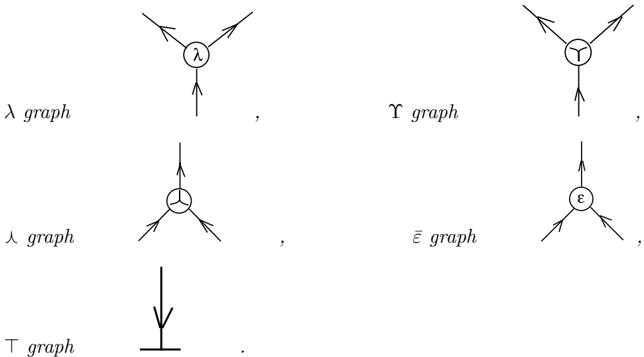
The image depicts five labeled graph structures arranged in two columns. Each graph uses directional arrows and central symbols to represent relationships or processes. The graphs are labeled with Greek letters (λ, λ, T, Υ, ε) and described as "graphs" (e.g., "λ graph," "Υ graph").
### Components/Axes
- **Left Column**:
1. **λ graph**: Three arrows radiating outward from a central circle labeled "λ."
2. **λ graph**: Three arrows radiating outward from a central circle labeled "λ," with a smaller circle inside the main circle.
3. **T graph**: A single vertical arrow pointing downward from a horizontal line (resembling a "T" shape).
- **Right Column**:
4. **Υ graph**: Three arrows radiating outward from a central circle labeled "Υ."
5. **ε graph**: Three arrows radiating outward from a central circle labeled "ε."
### Detailed Analysis
- **λ graphs**: Both instances show three outward-pointing arrows, suggesting a branching or distributive process. The second λ graph includes a nested circle, possibly indicating a sub-component or hierarchical relationship.
- **T graph**: The vertical arrow implies a unidirectional flow or termination point, distinct from the branching structures.
- **Υ and ε graphs**: Similar to the λ graphs but with unique central symbols (Υ and ε), potentially denoting specialized operations or states.
### Key Observations
- The repetition of the λ graph with slight variations (nested circle) suggests iterative or layered processes.
- The T graph’s simplicity contrasts with the complexity of the other graphs, possibly representing a base case or endpoint.
- The Υ and ε graphs introduce new symbols, which may signify distinct categories or transformations.
### Interpretation
This diagram likely represents abstract computational or logical processes, where:
- **λ graphs** model branching operations (e.g., function application, data distribution).
- The **T graph** could symbolize a terminal state or linear progression.
- **Υ and ε graphs** might represent specialized operations (e.g., unification, error handling) given their unique symbols.
- The nested circle in the second λ graph hints at recursion or nested dependencies.
The arrangement in two columns may categorize graphs by type (e.g., branching vs. specialized operations). No numerical data is present, so trends or quantitative analysis cannot be derived. The focus is on structural relationships and symbolic meaning.